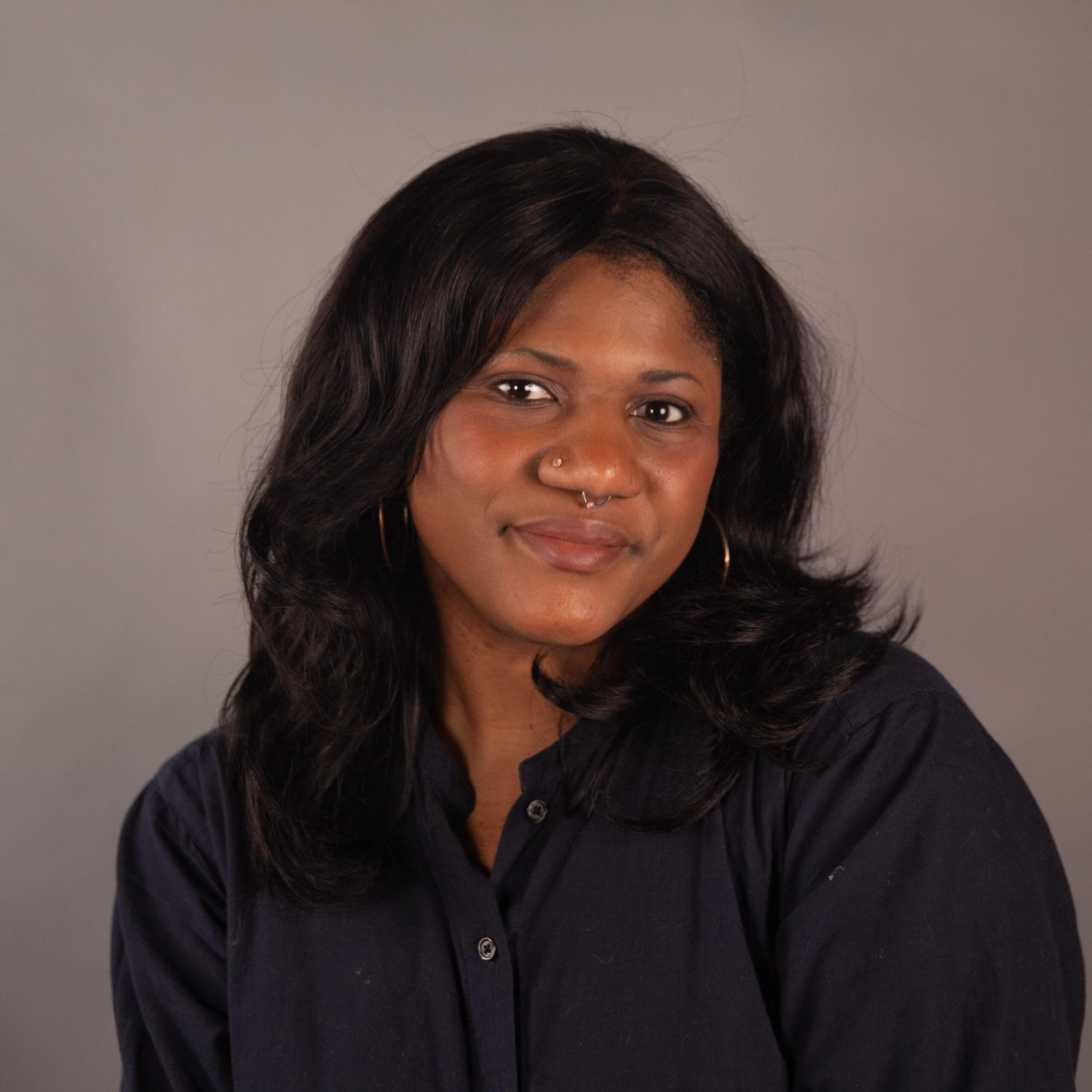








Dr. Charis Chambers was never a stranger to the medical field. Growing up in a small town in Alabama, her father was well-known within the community as the local OBGYN doctor.
Like her father, she quickly realized her calling in life to help others, studying pre-medicine at Spelman College. It was during an OBGYN rotation that she witnessed her first delivery and fell in love with the field, describing the experience as “the most magical and incredible and urgent and heightened experience” of her life.
From what started as being the go-to doctor friend for menstrual questions to posting about her life as she was studying for the OBGYN oral boards, Dr. Charis has amassed nearly 300,000 followers across Instagram and TikTok and has become a trusted professional for not only her patients, but many across the world.
Her Agenda: What’s something that’s commonly misunderstood about gynecology?
Dr. Charis Chambers: I think most of the marks would start with “she’s too young” for what it is. So it could be she’s too young to have endometriosis. No, she’s not. Or, she’s too young to have a period. The youngest age I’ve diagnosed with endometriosis was 12. The youngest age to get their period is eight.
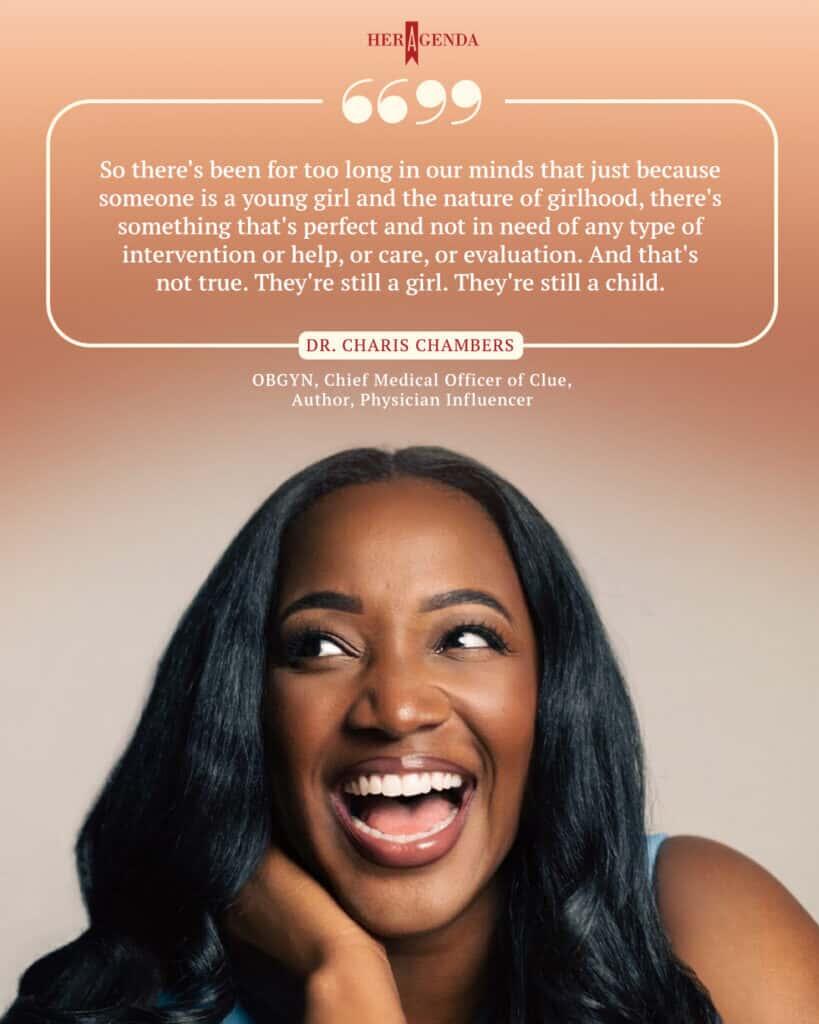
Her age in line doesn’t dictate medical necessity. It is the medical and clinical picture, and all of the experts know that. So there’s been for too long in our minds that just because someone is a young girl and the nature of girlhood, there’s something that’s perfect and not in need of any type of intervention or help, or care, or evaluation. And that’s not true. They’re still a girl. They’re still a child. That doesn’t mature them overnight. They’re still in need of your nursing, your care, and your support. Both things can exist.
And so a lot of the parents that are saying they’re too young for this; it is just desirable to keep their child small and perfect in a way, but they are inherently or inadvertently causing them harm, because they’re trying to force them to suffer or be able to live longer when their concerns are in need of medical evaluation.
Her Agenda: What’s something that all women should be asking at their next OGBYN visit?
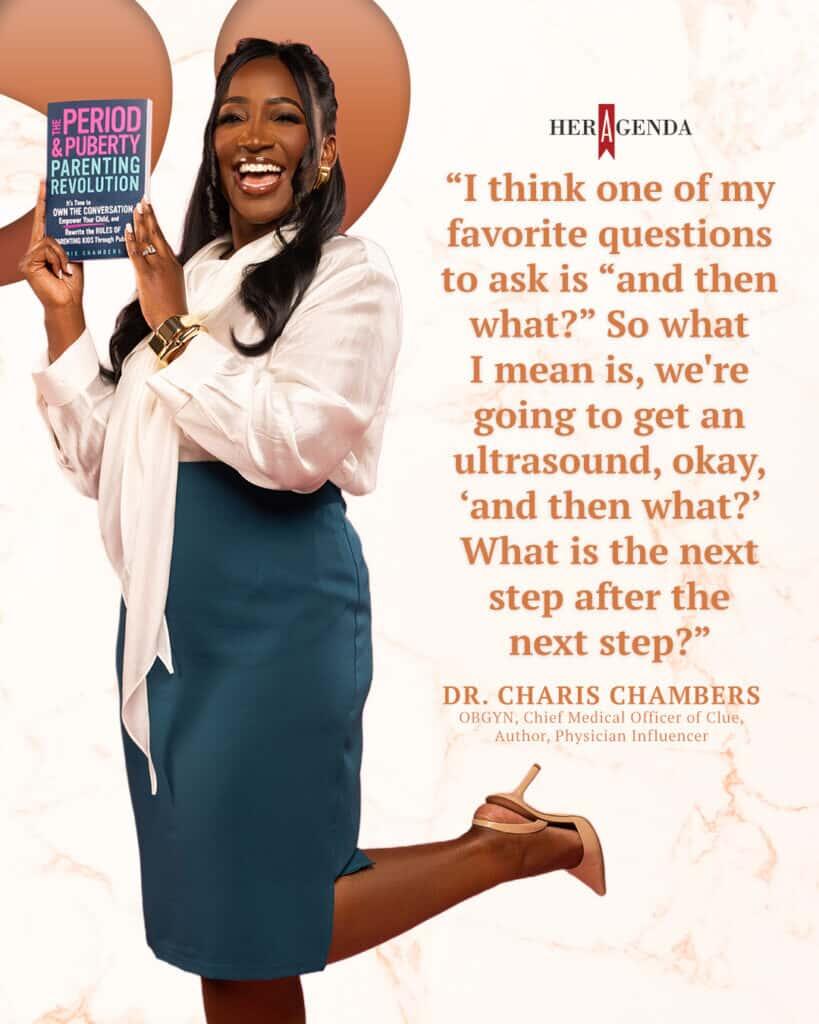
Dr. Charis: I think one of my favorite questions to ask is “and then what?” So what I mean is, we’re going to get an ultrasound, okay, and then what? What is the next step after the next step? And I think asking that question kind of holds the doctor accountable and makes them show you that they’ll have a true plan, that they’re taking two steps ahead, and they’re not just kicking the can down the road.
What are my options? Where do I go from this? So that I can mentally prepare and start to research these things, and find their forms along the way. A good doctor always knows the next step.
I can show my patients the next four or five steps. [I tell them], I’m never going to do that, and if that doesn’t work, I’m going to do that. Because I’m truly thinking about their clinical picture, not just a check mark or something to get done that day, but as something that needs to be thoroughly and thoughtfully prepared so that we can reach those truly appropriate conclusions.
Her Agenda: Why do you think some patients, especially women, often get their concerns dismissed by their doctor?
Dr. Charis: In a general sense, when it comes to complaints, like pain, for example, a woman can present with the exact same pain, exact same symptoms, and then she’ll be documented differently in her chart, and she’ll be offered different medicine than a man. So there are real documented discussions about how women are treated in order to tune in, as opposed to things that are measurable, like pain. And then the discrepancy kind of increases as you get lower and higher, so there’s like a power dynamic, right? It’s that women are lower than men in the power dynamic. Then, as you get younger and you get browner, and then if you have something like someone who is gender nonconforming and gender fluid or queer, all of those things, those people are more likely to be dismissed or disregarded in medicine.
And the main reason that happens is that it takes more thought to actually care for someone and show up for someone. It takes more time to hear out their lived experiences. It takes more time to reassure them and say, I’m so sorry for what you’ve been through.
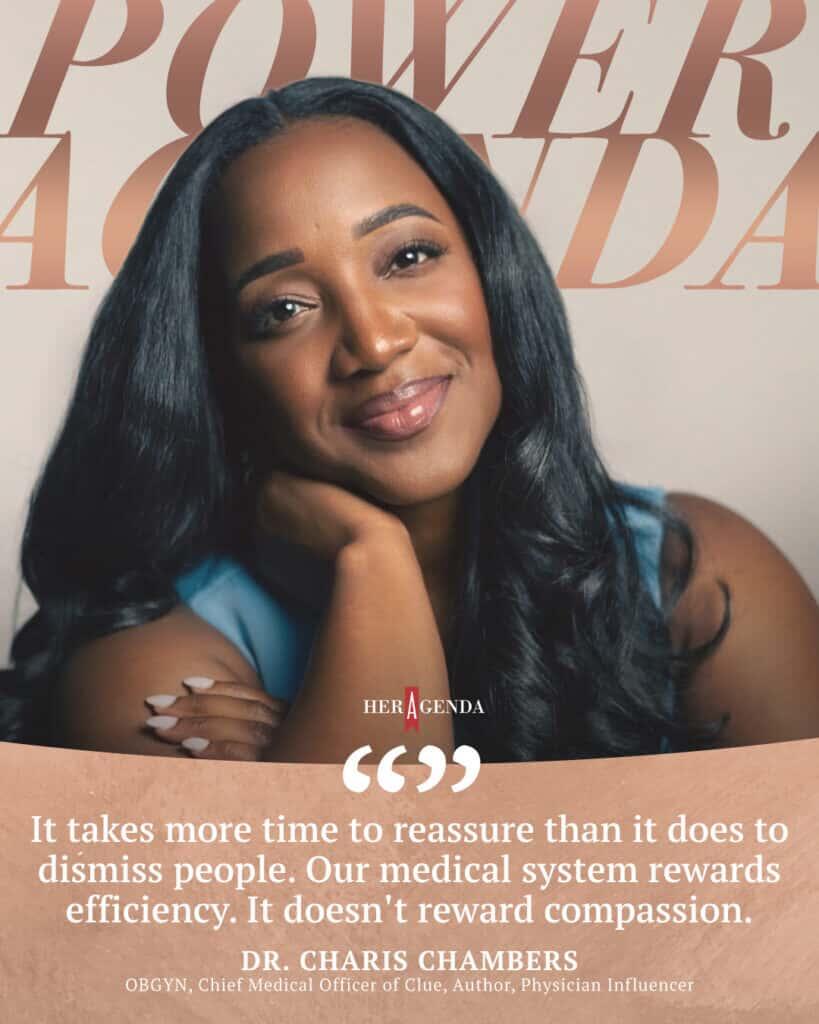
It takes more time to reassure than it does to dismiss people. Our medical system rewards efficiency. It doesn’t reward compassion.
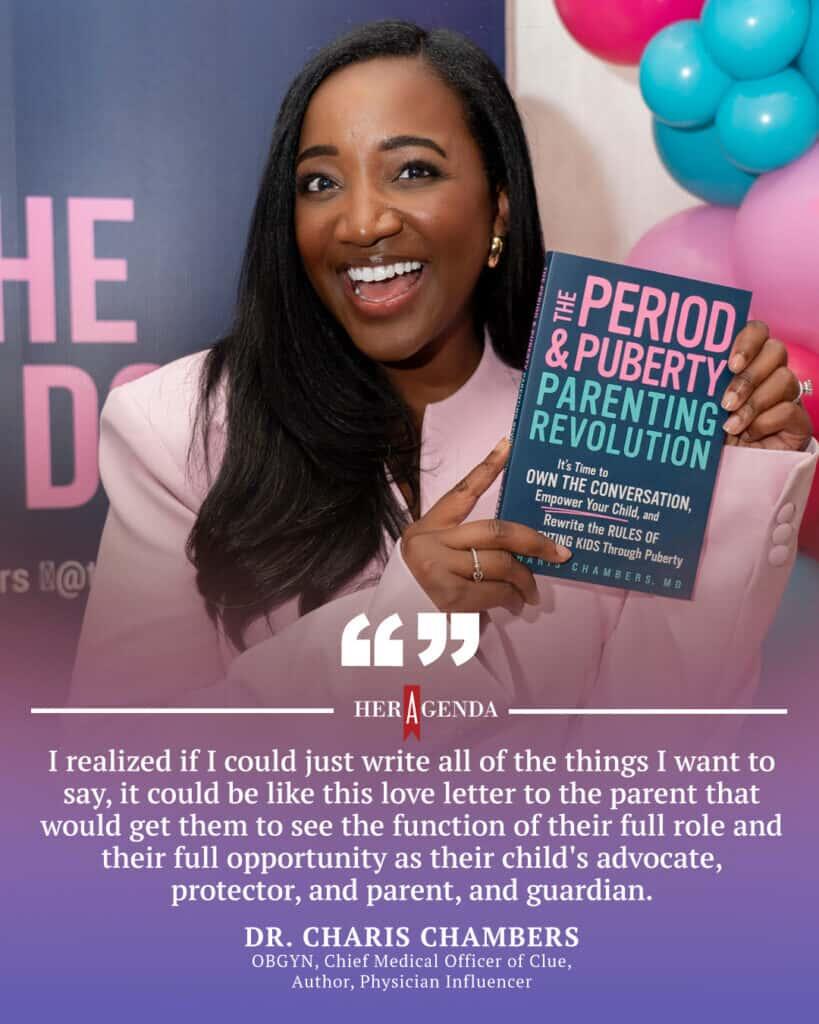
Her Agenda: Tell me about your new book (The Period & Puberty Parenting Revolution) that recently came out back in May. What was the writing process like?
Dr. Charis: I think most physicians don’t go into medicine thinking that they’re born to write a parenting book. That’s just not really top of mind. What I realized was that in all my patient encounters, even spending a bit of time with them, there were a lot of layers to the puberty parenting experience that were coming from their parent’s side and even on the child’s side.
And I was like, “Hey, this is actually normal. Why are you sad?” And their mom’s like, “I just have so much trauma around my period.” It’s bringing up so many things in your mind that you can’t always address in that visit. Or I’ve got parents, and they’re just like, “Hey, I didn’t get a good education. My mom didn’t tell me anything about my period. I had to figure this all out by myself, and I will not do that for my daughter.”
I see all these parents who seemingly want to show up for their child and come out because they have these wounds that have to be addressed, so they don’t feel like they have the influence and the resources and the tools to empower them. So I realized if I could just write all of the things I want to say, it could be like this love letter to the parent that would get them to see the function of their full role and their full opportunity as their child’s advocate, protector, and parent, and guardian.
What’s crazy is I was pregnant and postpartum when I wrote my book. I didn’t know at the time… and so that changed a lot. I wrote some of it in the process of not being a parent and just being a professional. And I think in the book you can see the medical accuracy and that guidance paired with the motherly love and understanding of someone who is a parent who wants what’s best for their child.
[Editor’s note: This interview has been edited for length and clarity.]