







Burnout has become the unofficial price of ambition. Long hours are celebrated as dedication, packed calendars are mistaken for success, and many leaders don’t realize they’ve crossed the line until exhaustion has already taken hold.
Charise Beckett knows that story all too well, not just from decades spent in executive leadership and HR, but from rebuilding her own life after becoming a widow at just 24 while raising young children.
Instead of allowing adversity to define her, Charise transformed it into a blueprint for resilience, creating a career dedicated to helping leaders build healthier workplaces where high performance doesn’t come at the expense of well-being.
As the founder of P.O.I.S.E. Consulting, an Amazon bestselling author, executive coach, and host of the Queens Behind the Scenes podcast, Charise is challenging outdated ideas of leadership and proving that emotional intelligence, self-advocacy, and sustainable success belong at the center of every workplace.
In this conversation, she shares why burnout isn’t a badge of honor, how women can confidently claim their space at the table, and what it really takes to lead without losing yourself.
Her Agenda: You became a widow at 24 while raising young children. How did that experience reshape your definition of success and leadership?
Charise Beckett: I will say going through something like that was one of the most terrifying, but it showed me that I could get through things. When I married my first husband, I was 19 years old, and I remember when I was widowed at 24, I said to my mom, ‘I never paid a water bill. I don’t even know how to pay a water bill.’
I felt like it affected me because it proved to me I could do so many more things than I thought I was able to do. It also made me want to prove that I was not the narrative that people thought I would be. I think that people thought my first husband was really, really successful, and they thought that I would be barefoot and pregnant, or I would be this woman who would spend all the money that was left to me when he passed away, which was not a lot of money.
I think people think it was so much. But I utilized all of the tools, and I was so resourceful, and I was able to get to a really great place in my life. And I wanted to always be a person that my kids could look at. I would say the kids are watching, and I wanted them to be able to see all the possibilities that the world has, and that they can do whatever they want.
Her Agenda: Burnout has become almost a badge of honor for ambitious women. Why do you think so many high achievers mistake burnout for commitment or excellence?
Charise Beckett: I think it comes down to societal influence. It’s like you had the ‘girl boss era,’ or the ‘hustle hard era,’ or you had the ‘grind era.’
All of these things have these really catchy names that sound sensational and sound good on social media. You also have these influencers who have a platform who tell people they have to do this, and they have to do that.

I think the mix of social media with all of these catchy, sensational names, it made people think that they really had to push to the limits, including their energy and even their mental capacity, to achieve things. And it’s just not that way because you really cannot reach maximum potential if you are burnt out. They’re not synonymous.
Her Agenda: In your book, Poise, the Blueprint for Escaping Burnout, Redefining Success and Creating a New Reality, you encourage women to redefine success. What does that look like in practice?
Charise Beckett: Redefining success to me is something that I had to do on my own.
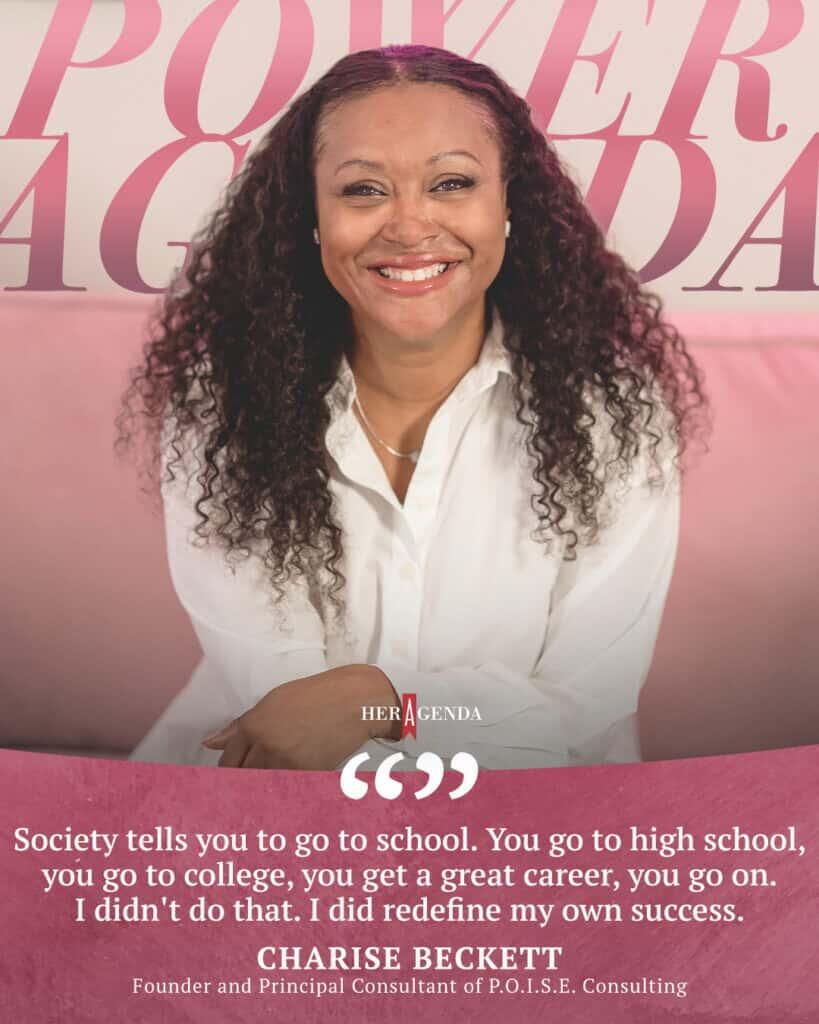
For example, society tells you to go to school. You go to high school, you go to college, you get a great career, you go on. I didn’t do that. I did redefine my own success. I went to school. I got pregnant when I was really young. I was 19. I was in college. I didn’t go back to college until I was just a little bit older. I didn’t go to some Ivy League college or some Big Ten college. I went to a super small college. I was widowed.
Those are redefining success because every single one of those things said that the odds should probably be against me, and I should not be where I am. I chose to redefine what success looked like for me. I redefined success by going back to school when I was ready to go back to school. I redefined success by choosing to pour into my children and myself at the same time. It doesn’t have to be one or the other, and so I chose that.
I chose to believe in love again and do a second marriage, and I’m completely, perfectly happy. I chose to go out on a limb and apply for roles where I didn’t always have all the qualifications in every job description. I had some of them, and I went out on a limb and did that. All of those things really helped me.
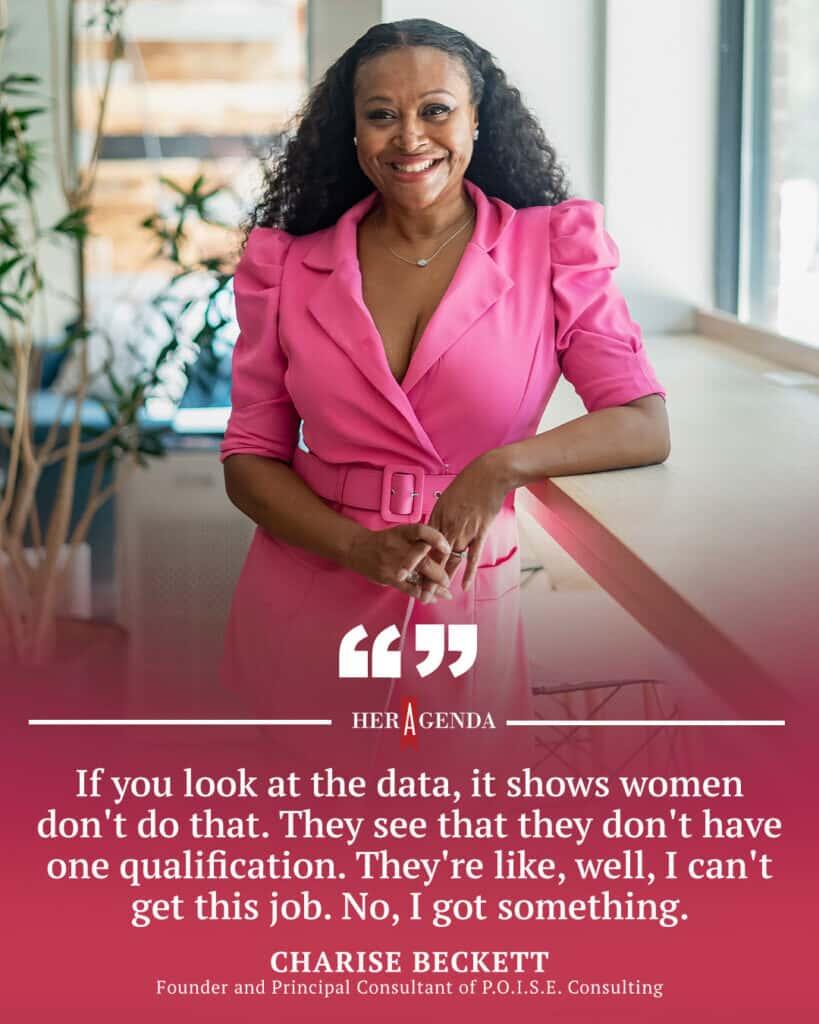
If you look at the data, it shows women don’t do that. They see that they don’t have one qualification. They’re like, well, I can’t get this job. No, I got something.
I can tell you, I have transferable skills that are going to work. For me, that is redefining success. It’s doing it the way that works for you. You don’t have to commit to these societal norms that have been placed upon you.
You also don’t have to have this imposter syndrome. We belong. We’ve had Michelle Obama and Barack Obama even comment that when you go in these rooms, these people ain’t all that.
Just knowing that you are supposed to be there, I think, is redefining success.
Her Agenda: As an executive HR leader, what were some of the most common leadership mistakes you saw that contributed to employee burnout, and how can organizations begin to fix them?
Charise Beckett: A lot of what I have seen in my career throughout it has been definitely the after-hours, especially in the fields I’ve worked in.
But nobody is delivering any babies in these fields. Everything is not urgent. I think creating urgency around everything creates the idea that if everything’s important, nothing’s important.
If you create urgency around everything, nothing’s important. What you do is you create a workforce of people scrambling around, doing double work. You end up having two people doing the same thing.
You end up wasting somebody’s time where you’re not maximizing their potential, and they’re getting burned out because there’s just a sense of urgency all the time. I think that creating a false sense of urgency is one of the things I’ve seen that has been one of the bigger issues.
The other one I really see is not having a plan. The organization does not have a strategy or a plan. If you don’t have a plan, then what are we working on? If there’s no collective goal, what are we doing? So now we’re just working to sustain.
Companies are coming around to it, but I just think that we need to also consider all people and have benefits that are whole human, for the whole human experience, and have whole human solutions. Those are the bigger things that I see organizations have kind of made mistakes or haven’t really met the moment.
Her Agenda: Emotional intelligence is at the core of your consulting work. What separates emotionally intelligent leaders from simply well-intentioned leaders?
Charise Beckett: Well-intentioned leaders, they want the best for the organization. They do want you to do good work. They do want the deliverables to be there, but that doesn’t mean they’re in tune with the whole person that’s coming to work.
Emotionally intelligent leaders are in tune with the whole person, not just the results. A well-intentioned person wants the best for you, but they’re not tuned in or dialed into you as a leader. And I think that’s what separates them as being dialed into the whole person.
Her Agenda: For women pursuing executive leadership, how can they advocate for themselves while remaining authentic to their values?
Charise Beckett: Advocate for yourself and for your money. Nobody’s coming to work for free.
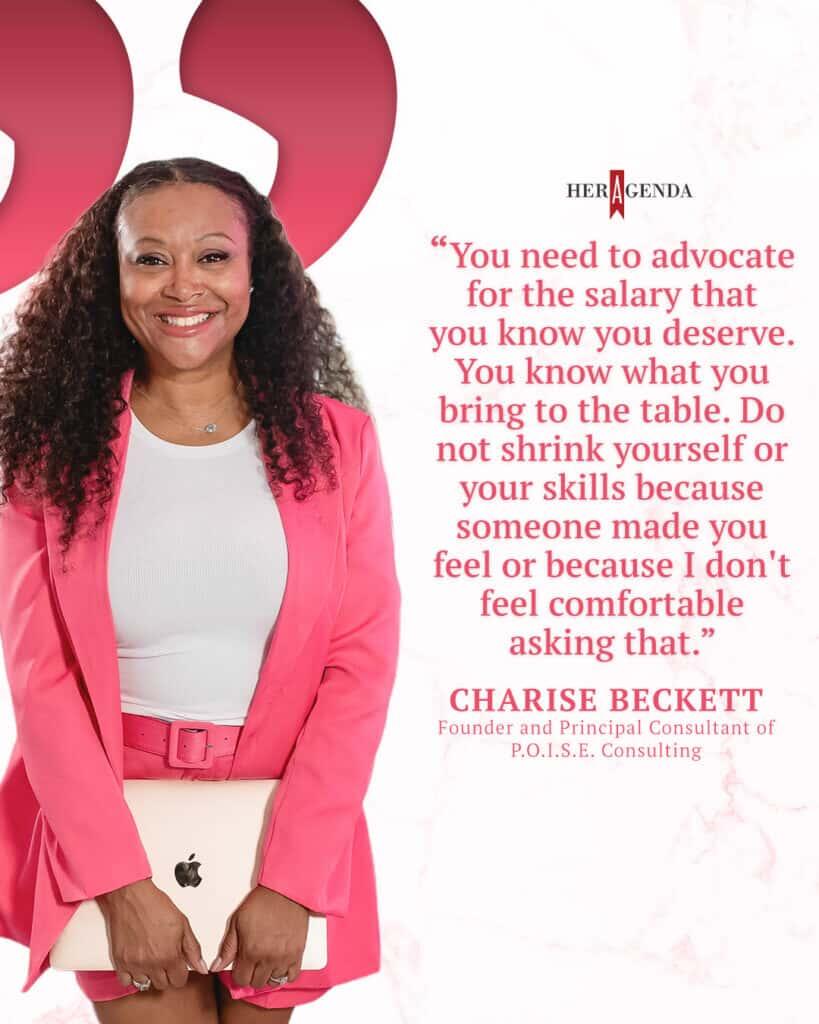
You need to advocate for the salary that you know you deserve. You know what you bring to the table. Do not shrink yourself or your skills because someone made you feel or because I don’t feel comfortable asking that.
You know what you offer. If you can list down the things you offer, you know what the market is paying. You ask for that. You ask for what you deserve. That’s one of the main things, because women oftentimes do not advocate for their compensation.
I think that it’s a big miss and we’re worth it. I think you fight for what you’re worth. The other thing is that I want women to not just have this seat at the table. I hate that. Let’s have a seat at the table. Don’t have a seat at the table if you’re not going to do stuff with it.
If you’re going to sit there and you’re not going to say anything, you’re not going to actually add value. Why even sit there? Add value where you sit. Have opinions and speak them. You don’t have to be there just to listen.
I think those are big things for me to take up space and advocate for your coins.
Her Agenda: What would you do in a situation if a woman does have a seat at the table, she is expressing her opinions and values, but it’s falling upon deaf ears?
Charise Beckett: We’re going to have a conversation about that. That’s one of the things I talk about is falling on deaf ears. We’re going to have a conversation in the moment. I’ve spoken. I want to be able to participate or offer some feedback to the conversation.
You check stuff at the moment. Don’t let it go by where you’re sitting there and it’s falling on deaf ears. It’s not going to fall on deaf ears because you all are listening to me.
I’m about to tell you it’s not going to fall on deaf ears because you see me talking and you’re not listening to me.
We are so much more powerful than we think.
Her Agenda: Through your Queens Behind the Scenes podcast, you have interviewed countless women leaders and entrepreneurs. What’s one lesson that consistently comes up across their journeys?
Charise Beckett: One thing that comes up consistently is that they all have unique journeys that they’re super appreciative for because it got them to where they are.
Every single one of them has this unique journey that has gotten them to where they are and where they want to be. I think the journey, the uniqueness of the journey, is what makes it such a common theme.
Her Agenda: What role does self-care really play in leadership? How can women move beyond treating it as an occasional luxury and instead as a leadership strategy?
Charise Beckett: It is so important. It’s not always money. Some self-care does cost money.
I like to go to the spa. I like to get waxed. I like to get my Botox. I like to get all the things. Although there are things that I do that don’t cost any money.
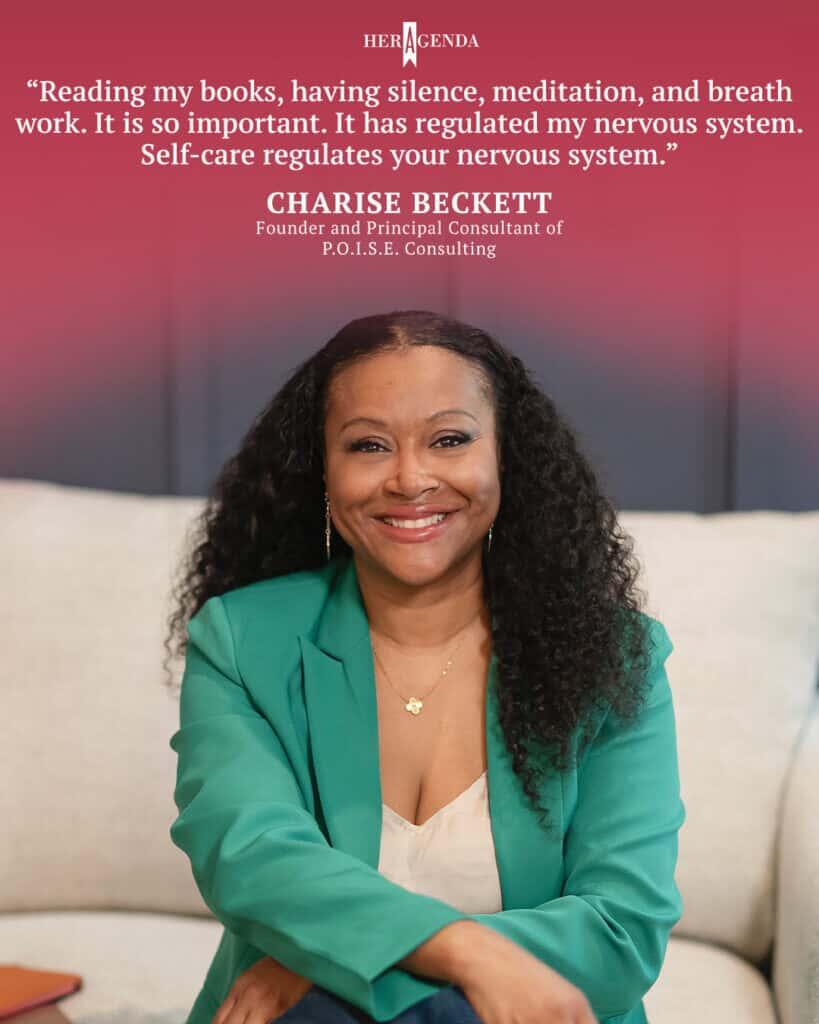
Reading my books, having silence, meditation, and breath work. It is so important. It has regulated my nervous system. Self-care regulates your nervous system. That is what I think is the benefit for especially women who are going into higher-ranking roles in corporate or external or founders; your nervous system has to stay regulated for you to be able to have that influence and that emotional intelligence. Self-care creates that.
You can’t sustain without it. You have to have some sort of self-care routine in order to sustain your nervous system.
Her Agenda: If someone today could make just one change this week to protect their peace while still pursuing their goals, what would you encourage them to do?
Charise Beckett: One of the biggest things I like to do to protect my peace and still achieve my goals is I would love to write down ten things I’m grateful for, just like a gratitude.
It really makes you realize how much you actually do have and what you’re grateful for. It helps you also look forward to the future because you’re thinking I have this, and I can work towards that. I think it’s just such a positive thing, and it’s contemplative, and it helps you really acknowledge that yes, you are going through a few things, but also you have this to look forward to as well.
[Editor’s note: This interview has been edited for length and clarity.]