








Christie Marchese is the founder and CEO of Kinema, a technology platform redefining how films are distributed and experienced. With Kinema, Christie empowers independent filmmakers to connect their stories directly with audiences, turning film screenings into community spaces. Born and raised in Valencia in Southern California’s Santa Clarita Valley, Christie studied international relations at San Diego State University before moving to New York in 2011. She went on to launch Picture Motion, a leading social impact agency that built campaigns and community screenings to amplify films’ social influence, and later co-founded Kinema to scale that same community-first approach through technology.
Fast Company named Christie one of its Most Creative People in 2021, and Fortune recognized her as a Rising Female Founder in 2023, celebrating her innovative approach to film distribution and her commitment to empowering creators. Beyond her entrepreneurial success, Christie champions women and believes deeply in the power of authentic relationships and storytelling. In this Her Agenda interview, Christie shares insights on the evolution of film distribution and the mantra that keeps her grounded as she builds the future of independent cinema.
Her Agenda: Looking back, what first sparked your belief that storytelling and film could drive social change?
Christie Marchese: I have always loved movies. I’ve always loved entertainment. I still see movies as therapy. It’s a way to [help] understand yourself better through someone else’s story. It’s a way to understand other people’s stories. It’s the great connector.
As human beings, we’re built on stories. We’re built on gathering around a campfire and telling stories and connecting, and having shared narratives and understanding people through their narratives. Genuinely, the first time I saw a movie where I was like ‘oh [wow] I knew nothing about this’ it was in college. I saw Hotel Rwanda. In one of my courses, we studied the Rwandan genocide. I had gone in to study film but ended up studying international relations, and we were learning about the Rwandan genocide mostly through textbooks and written history. I rented the movie from a local video store in San Diego, watched it, and was like, ‘[wow], now I understand it.’ I could finally feel and grasp what we’d been studying. There are scenes with Don Cheadle that are still seared in my mind. That was the first time I looked at film as [a way of] understanding something that happened in history and realizing the power it can have in just two hours.
Her Agenda: You co-founded Picture Motion in 2012 and Kinema in 2020. What lessons did you carry from one to the other?
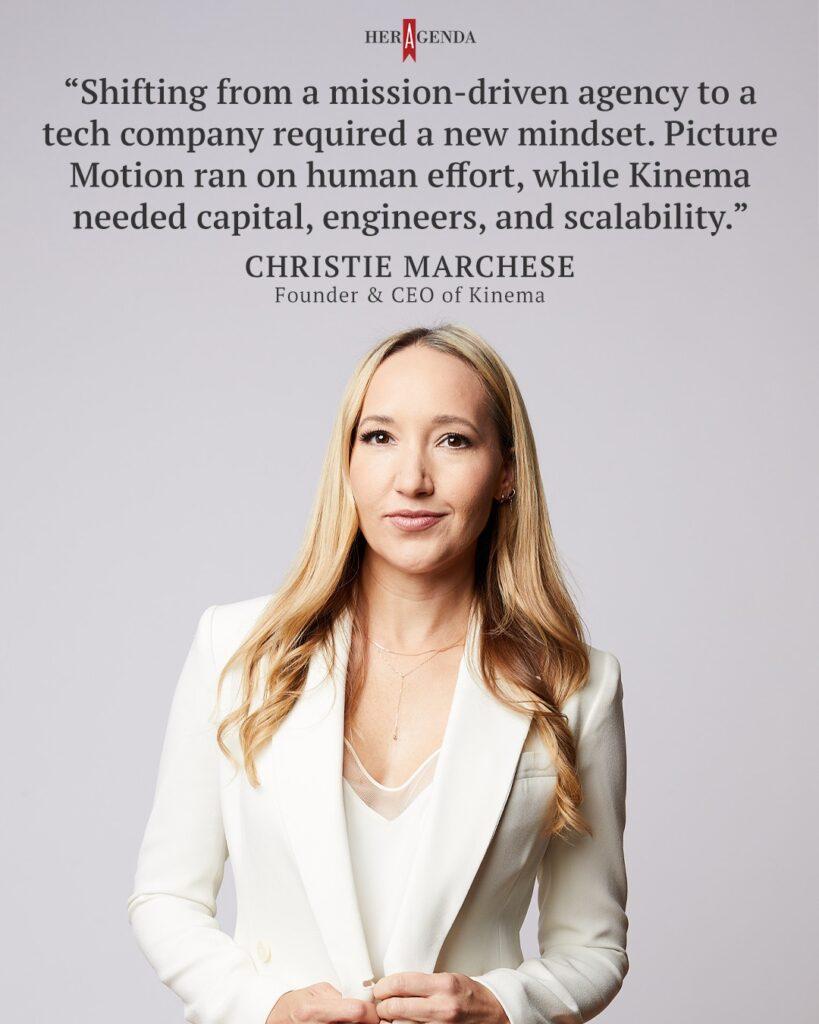
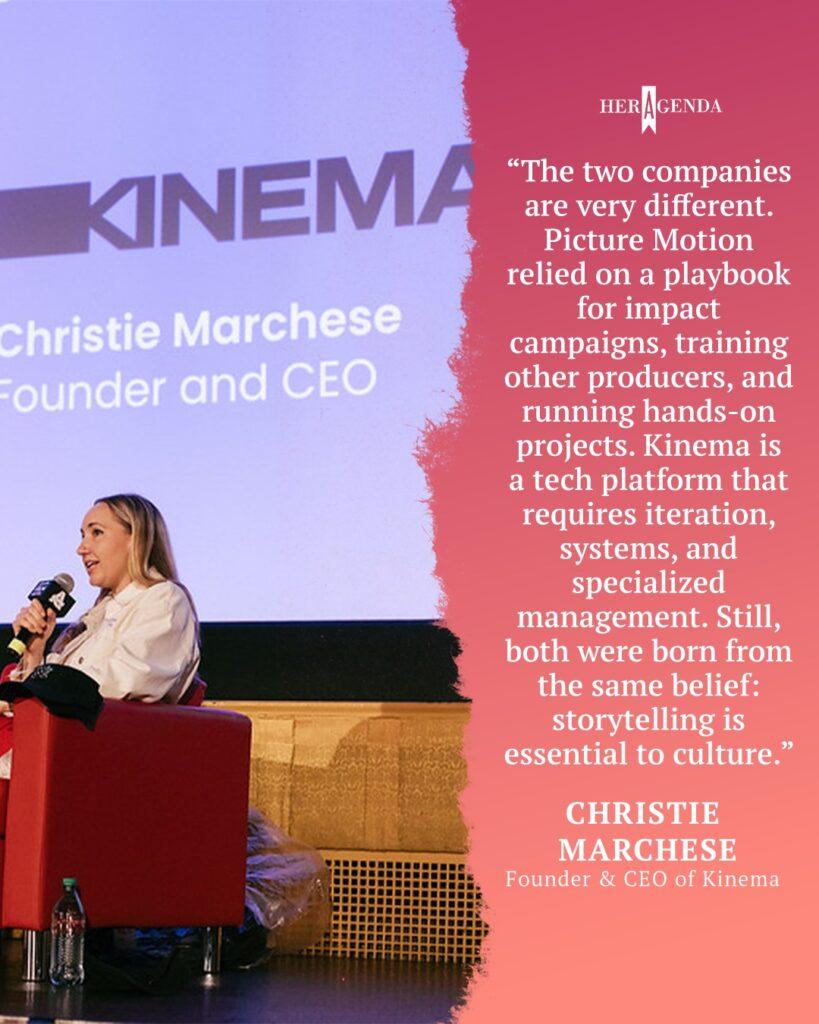
Christie Marchese: Picture Motion was built to help filmmakers translate a movie’s message into real-world change through impact campaigns and community screenings. Over time, we noticed that even with streaming taking over, audiences still craved shared, in-person viewing experiences. That led to Kinema: a platform that lets anyone, anywhere, host screenings of meaningful films. It automates everything, licensing, payments, scheduling, and connects hosts directly with films. The biggest lesson I carried over was to hire smart people and get out of their way. But shifting from a mission-driven agency to a tech company required a new mindset. Picture Motion ran on human effort, while Kinema needed capital, engineers, and scalability. We had to raise money, sell future potential, and bring in specialized skill sets engineers, finance experts, and a different type of salesperson. The two companies are very different. Picture Motion relied on a playbook for impact campaigns, training other producers, and running hands-on projects. Kinema is a tech platform that requires iteration, systems, and specialized management. Still, both were born from the same belief: storytelling is essential to culture.
Her Agenda: What exact moment made you realize, ‘This needs to exist, I have to build Kinema?’ Was it a lightbulb moment or a series of events that led to it?
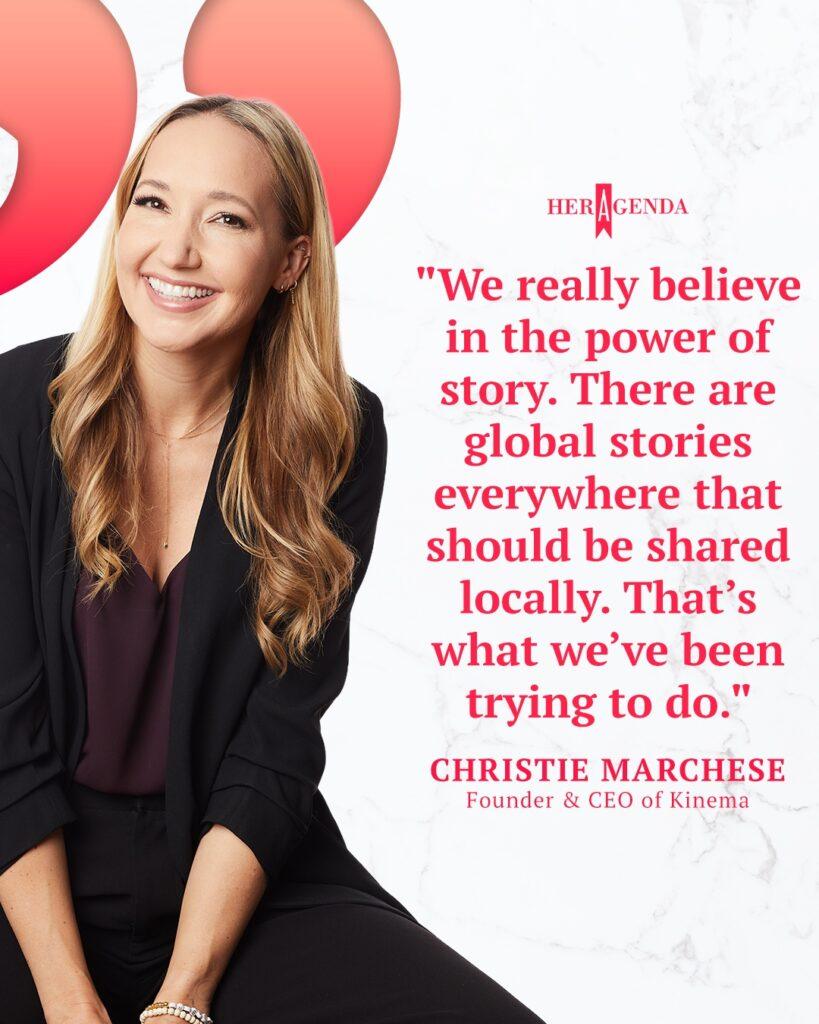
Christie Marchese: I wish it were a lightbulb moment. I really wish I was one of those founders who was like, ‘I’m a genius, I found something different and unique.’ Even when starting Picture Motion, I wish we could have had that. It was more of a logical series of steps. When I left and moved to New York, I started consulting for independent filmmakers, and we (Wendy Cohen and I) saw the need was immediate. There were filmmakers releasing independently or with distribution who wanted to do an impact campaign, and the studio wasn’t giving the resources. So we took everything we learned at Participant [Media] and applied it here. We just kept iterating. For Kinema, when we started, it was a different time. We launched in 2020, thinking we were solving one problem: how do we have an automated process, how do we make it available to other filmmakers, and these films aren’t getting a theatrical release, and they should have a communal experience. Then we had a pandemic, and everything went online, and all these great films lost all in-person screenings. Then we had a strike, and films weren’t getting released. Then budgets dropped, and then post-pandemic, the streamers condensed. And then this last year, the presidency, fear around supporting potentially political content, and a big divestment from DEI programs. What we’ve done at Kinema is respond to each of these. At the end of the day, we really believe in the power of story. There are global stories everywhere that should be shared locally. That’s what we’ve been trying to do.
Her Agenda: Community seems central to Kinema’s storytelling model. Can you share a story that shows how powerful that community element can be?
Christie Marchese: What we are seeing on Kinema is that about half, and sometimes more than half, of the screenings are still in person, which is incredible. People are still coming together to watch a movie and have a shared story. There is also a loss of community and a loneliness epidemic, and by being so individualized, we are desperate to connect and see people in person. Almost everybody feels the film is going to be available for streaming at some point, so why are they coming out? They are coming out for the community part of it. The film is the thing at the center, but they actually want the community and the connection.
Her Agenda: You co-authored The Distribution Playbook with Emily Best of Seed&Spark. If filmmakers could take away just one golden rule from it, what would it be?
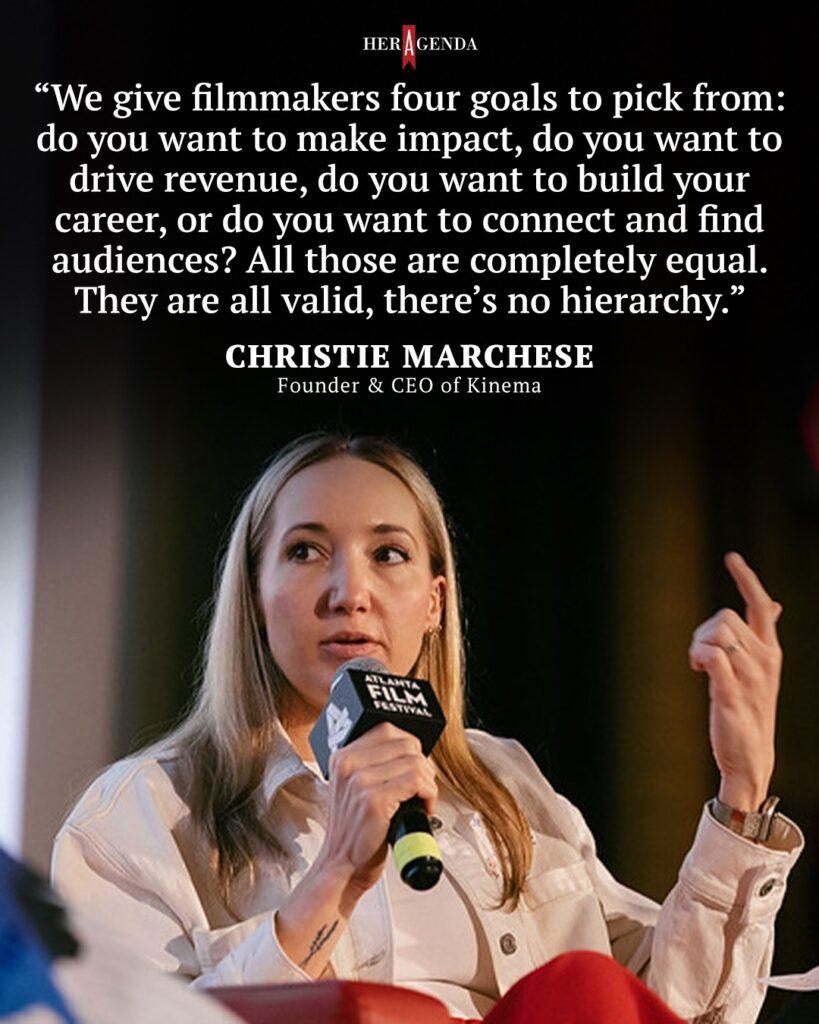
Christie Marchese: So what we did with The Distribution Playbook is we poured all those resources in there and then distilled it down to six steps. Like, okay, you don’t have time to read the whole thing, just read these six steps of how to build your distribution plan. The first thing we put in there, because it’s the number one, is to be very specific about your goal. I don’t know if this is a golden rule, but it’s a good place to start: really knowing in your heart what your actual goal is. We give filmmakers four goals to pick from: do you want to make impact, do you want to drive revenue, do you want to build your career, or do you want to connect and find audiences? All those are completely equal. They are all valid, there’s no hierarchy. What matters is what your number one goal is. Once you pick one goal and only one, that’s gotta be your north star because everything else falls into place afterwards.
Her Agenda: You wear many hats—founder, CEO, board member etc. How has this influenced your leadership and approach to balance?
Christie Marchese: I think it is about building a full life. There was a period of time where we were told life’s about balance, like divide your life, [as if] these are two separate things. And to me, it’s just creating a full life. And so what are the things that help me do my job well, and how does my job help me do my life well? Now, I’m forty-one, so I’ve made mistakes, I’ve lived a little bit, I feel like I have perspective to be able to say why I feel this way. So all those boards they serve two roles: one, I genuinely believe in those organizations; I wouldn’t give my time if I didn’t believe in the work of those organizations. Second, they’re very much a part of my work world because tthey help expose me to filmmakers as they have films in development, they help expose me to what grant makers are thinking, what is important to fund at that time, and how they evaluate different films. And it’s great to have a range of perspectives on that. And then I have something that I’m very specific about: I [have to] work out at seven in the morning. I don’t do it every day, but if I’m [going to] work out, [it’s] at seven a.m., and I’m a nicer, happier person if I get some exercise. And on Friday mornings, we do this boxing club, and this is something that I fully credit my husband for because he’s been boxing forever, and I’m not. I was never a boxer. I don’t fight, like it’s not my personality, but a few years ago he kind of convinced me to start going with him. Now I think we’ve had it for about three years. And I actually credit that a lot to [the strength of my] mental health.
Her Agenda: What’s your biggest lesson about success and failure?
Christie Marchese: If you’re not failing, you’re not trying. It’s like the silly saying that everyone says, but it’s actually true. You have to be willing to fail. You really have to be willing to fail, and it’s really hard. It’s really, really hard. I am constantly afraid of failure, constantly mitigating risk because I want to. It’s so difficult to take big swings. Failures are everywhere. I’ve had lots of small failures. We’ve had campaigns that didn’t work, things with employees I didn’t realize were happening, there are so many small failures along the way, it would take forever to document. The big failures, I’m trying to think, like, the big failures are when (this is like therapy) but [the moments] I haven’t really trusted myself to take the big swing, and I’ve had a missed opportunity. My failures have been not jumping in, not taking the big risk, not betting on myself, and not putting myself in the scary place. I should be doing that more.
Her Agenda: Where do you see the future of film distribution heading and how is Kinema shaping that vision?
Christie Marchese: So I think there are a couple trends. Data shows that there’s never been less trust in institutions. One shift is the growth of a new independent film industry from the creator community. Hollywood still feels like validation, everyone wants to be on the big screen but we should watch these creator studios like Creator Camp. They constantly give updates, show vulnerability, show how hard it is to raise money, and launch campaigns to involve audiences. Now, distribution: people still want Hollywood deals, but creators are going direct to their audiences. They know their audience, they help inform the product, and why give up revenue when they do all the work? We are that platform, offering in-person and digital experiences in a premium environment. Creators control pricing, get audience data, own their rights, and build direct relationships. So we sit between Hollywood, which is centralized, and the creator community, which is decentralized.
Her Agenda: Beyond Kinema’s success, what impact do you hope to leave on the film industry and its communities?
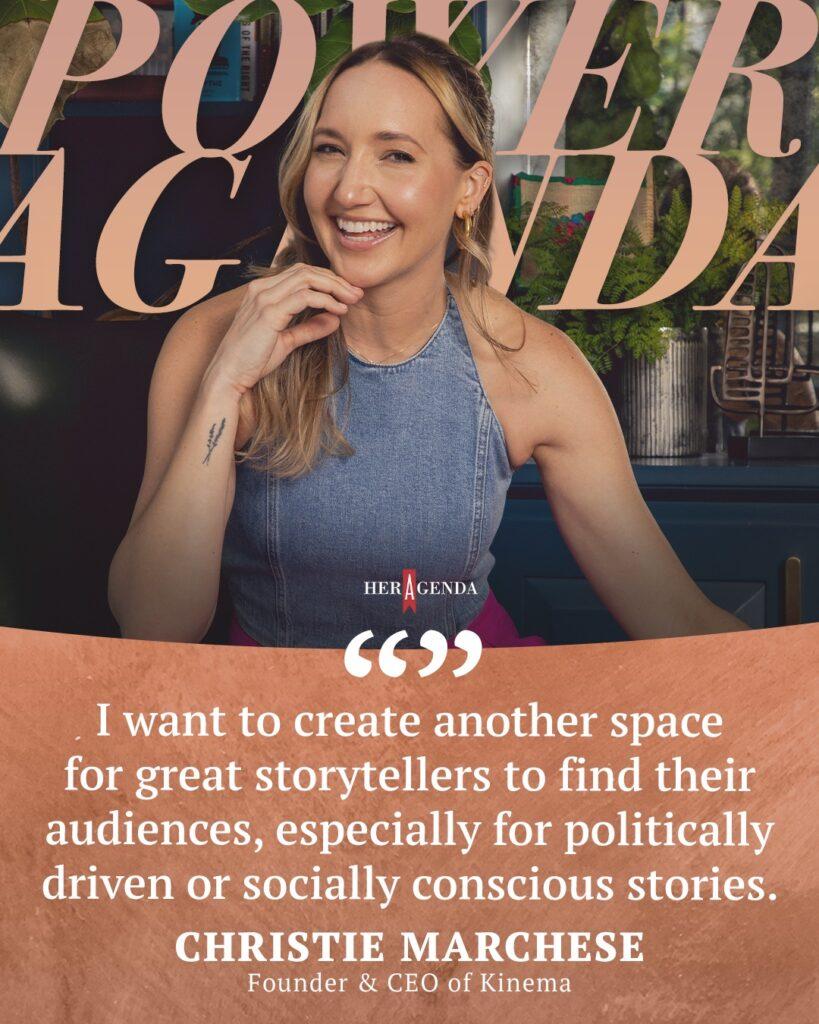
Christie Marchese: I guess my existential fear is from a creative standpoint, we’re not going to get like the Greta Gerwig’s or the Ryan Coogler’s who make these powerful stories that cost a lot of money. You need a strong ecosystem for filmmakers to learn their craft, find their audience, and know their voice. I’d be happy if we could help contribute to a system that supports the next generation of great storytellers. On a more micro level, I want to counterbalance the big institutions. The big streaming platforms decide what gets distribution, often influenced by politics. I want to create another space for great storytellers to find their audiences, especially for politically driven or socially conscious stories.
Her Agenda: Finally, what’s your personal mantra?
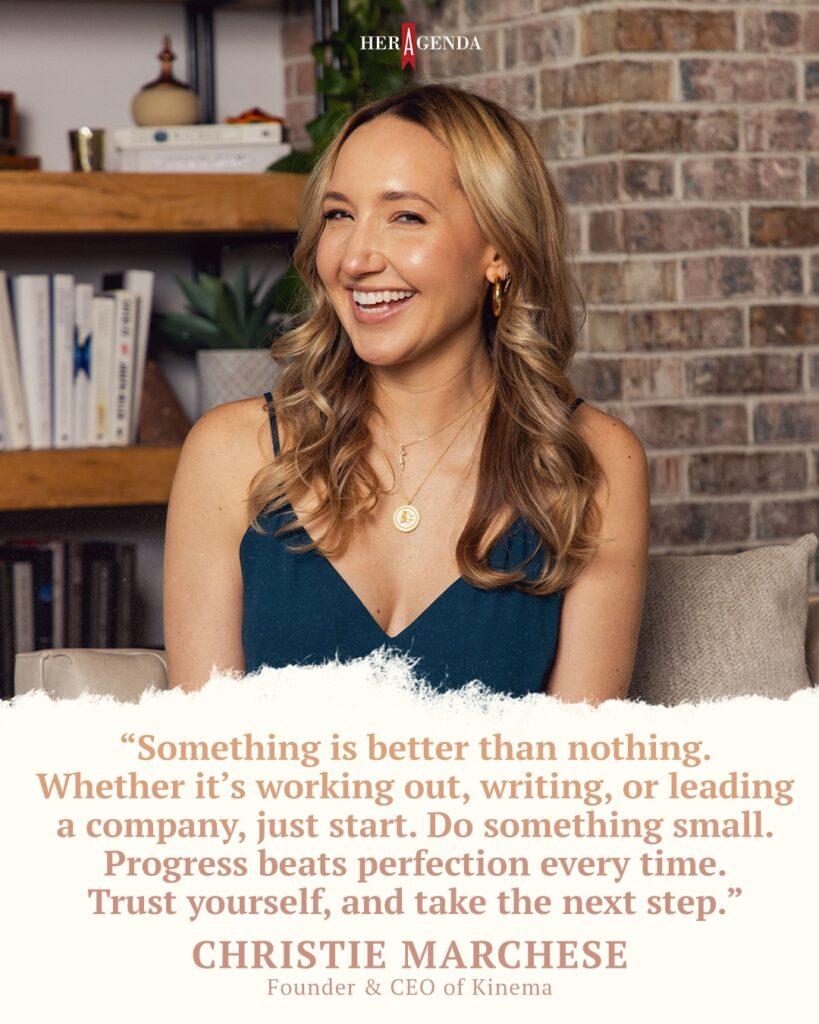
Christie Marchese: I have two. The first: You have everything you need. It’s a reminder that even when things feel chaotic, the tools, instincts, and relationships to figure it out are already within you. (Marika Frumes gave me that one!) The second: Something is better than nothing. Whether it’s working out, writing, or leading a company, just start. Do something small. Progress beats perfection every time. Trust yourself, and take the next step.
[Editor’s note: This interview has been edited for length and clarity.]