




Diversity, innovation, and culture are plainly reflected in the career journey of Founder and former Advertising and Marketing executive Crystal Foote. As the Founder & Head of Partnerships of the award-winning advertising technology company Digital Culture Group, Crystal has carved out a lane for herself in the evolving Ad Tech industry.
Her early foresight while building her career led her to start her own business in 2023, where she oversees a full creative, engineering, and operations team, all working to provide their Fortune 50 and Fortune 500 clients advanced marketing and advertising solutions to effectively reach their audiences. Crystal Foote has been recognized as a 2026 AdExchanger Top Woman in Media & Ad Tech, an Inc. 500 Woman Founder, and featured in Ad Age and Forbes for her work in the ever-evolving industry, but her keen eye for innovation continues. Crystal created Digital Culture Group’s latest tool, the AI-powered platform Audience Resonance Index (ARI), which has garnered significant recognition for its innovative, first-of-its-kind technology, aimed to help brands clarify and respond to what ads and messaging audiences truly resonate with.
Crystal understands being the first-of-its-kind as a Black woman in this particular industry, but does not intend to be the only one.
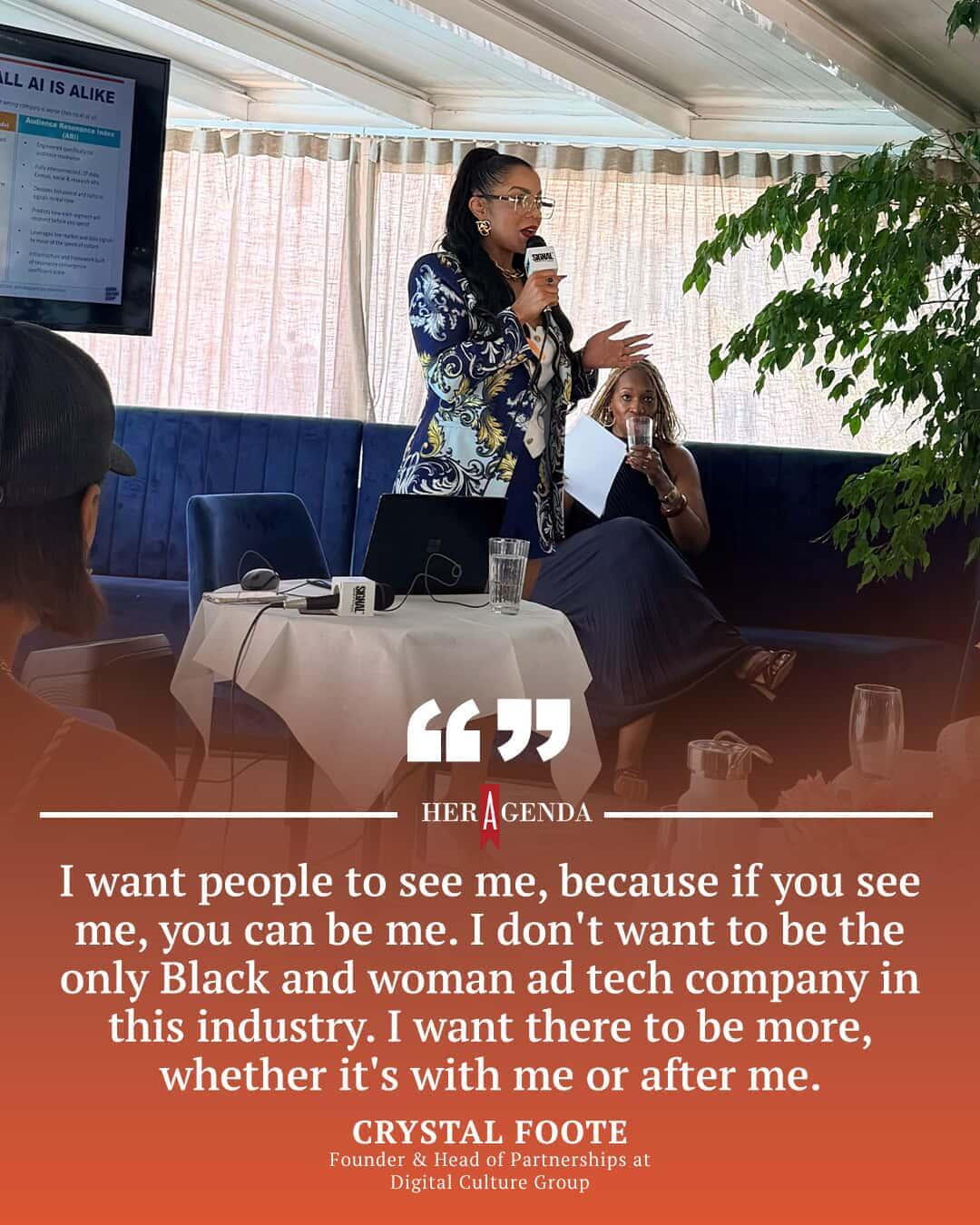
“I want people to see me, because if you see me, you can be me. I don’t want to be the only Black and woman ad tech company in this industry. I want there to be more, whether it’s with me or after me, but I don’t want to be the only one.”
With Her Agenda, Crystal discusses starting her own business after years in the Advertising and Marketing industry, how she balances her personal identity and values professionally, and what culture means to her and how her business, Digital Culture Group, reflects that.
Her Agenda: Walk us through your journey building a career in Advertising and Marketing for close to two decades and how it led you to become an entrepreneur. Did you always have a desire to start your own business?
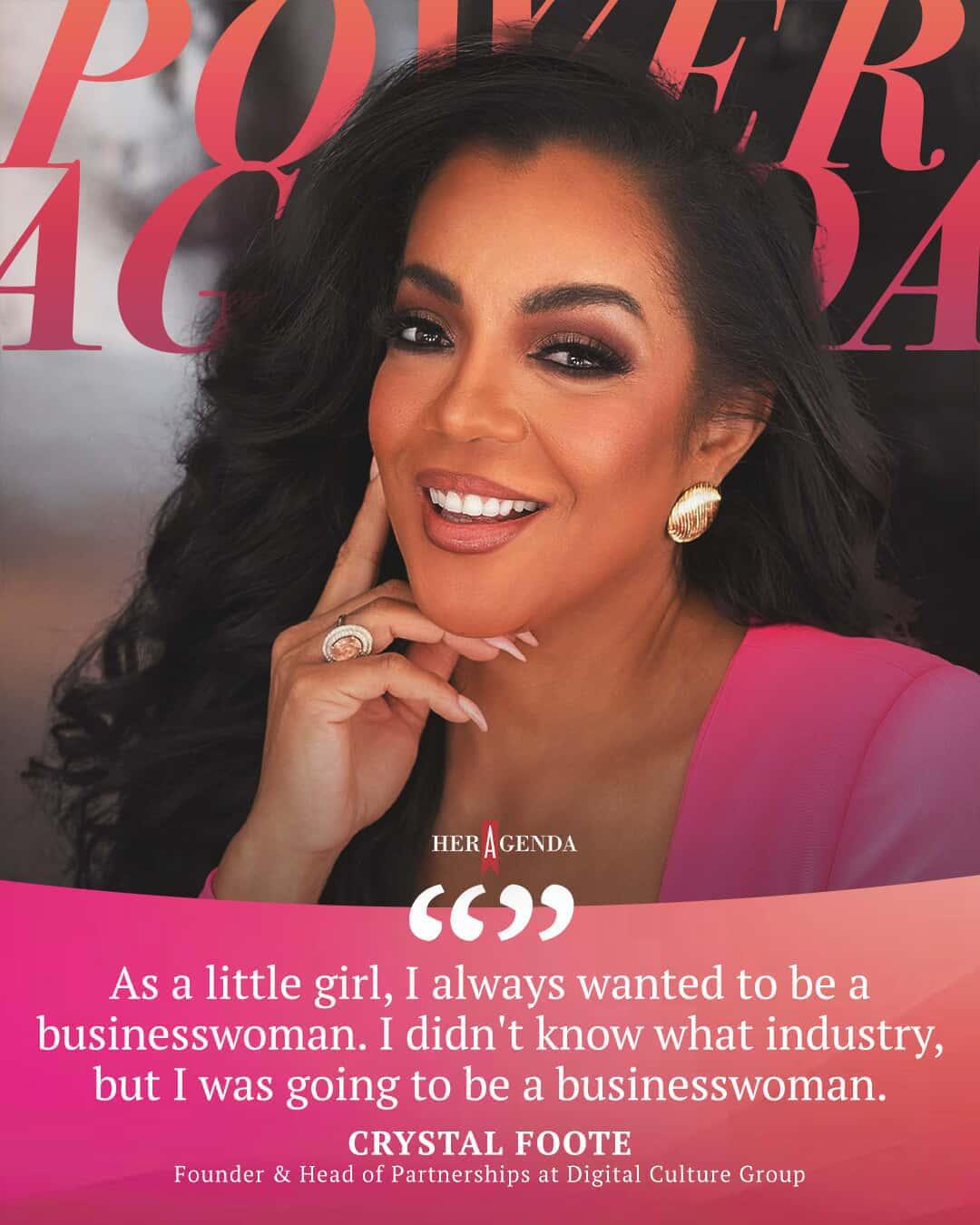
Crystal Foote: I’ve always been surrounded by entrepreneurs. My dad was an entrepreneur. His siblings are entrepreneurs. My grandmother had a full-time job as an occupational therapist and still had her side business of bridal gowns that she would make and sell. So, I’ve always been surrounded by entrepreneurs and always loved how they navigated their industries: very intelligent, innovative, and savvy. As a little girl, I always wanted to be a businesswoman. I didn’t know what industry, but I was going to be a businesswoman.
When I was in high school, I saw [the movie] ‘Two Can Play That Game,’ and I saw Vivica A. Fox play a character, and she was a high-level executive at an advertising company. She was the only one who looked like her at that company, but she was so graceful and eloquent in everything that she did. The way she carried herself from a corporate standpoint was very intriguing. And [her career field] mixed both the analytical and creative sides of the brain because it was marketing. I didn’t know anyone in marketing when I was growing up.
When I went to St. John’s University [in New York], I studied Marketing as a concentration and Business as a major, and when I graduated, I got a job at an ad agency from a career fair at my school, and that was my first job in advertising. I worked for a lot of brands in between, and then moved down to Atlanta because I needed more work-life balance; in New York during that time, I was working until midnight. So I started at an agency [in Atlanta], and I realized that the culture was very different in Atlanta than in New York City. So I said, ‘What can I do? Let me learn more about the tech side of the business,’ because as an agency person at that time, it wasn’t technical; you’re really just the liaison between the brand and activation teams at a publisher or at an ad tech company. So then I transitioned over to the sales side and started learning more about the technology and how it worked. I started really building my own relationships.
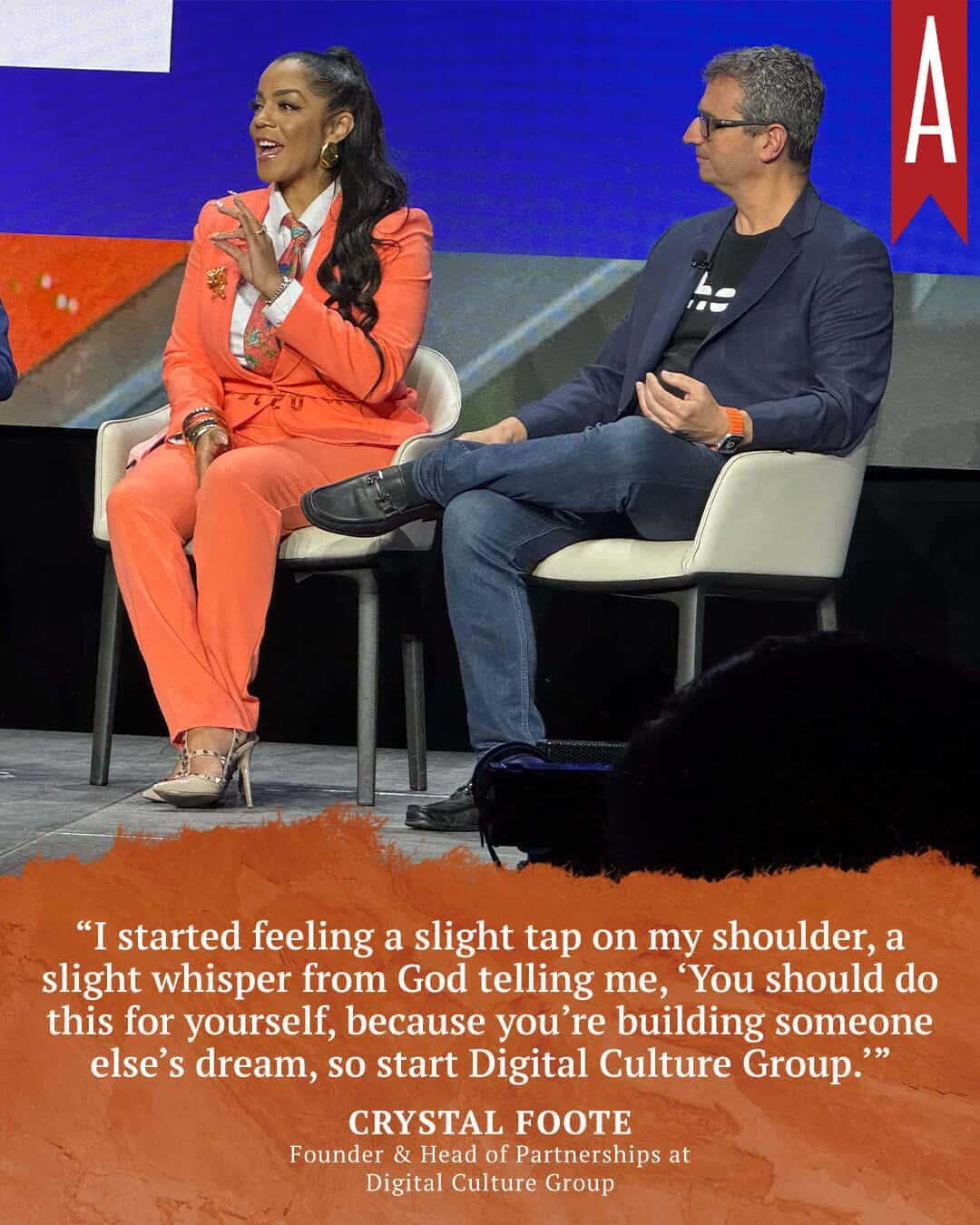
When you’re on the sales side of the business, people are buying from you — your personality, how you’re delivering, the trust they have in you, but they’re going to give you this budget, and you’re going to deliver on it based on the KPIs that you promised them that you would hit. After doing that for so long, I started feeling a slight tap on my shoulder, a slight whisper from God telling me, ‘You should do this for yourself, because you’re building someone else’s dream, so start Digital Culture Group.’ I was terrified. Just like Vivica A. Fox [in Two Can Play That Game], I was going to be the only one looking the way I look in the ad tech world. It’s one thing being part of a company and being the only one, because you have HR protecting you and they’re supportive. But starting your own company, looking very different from how everybody else looks? That’s different.
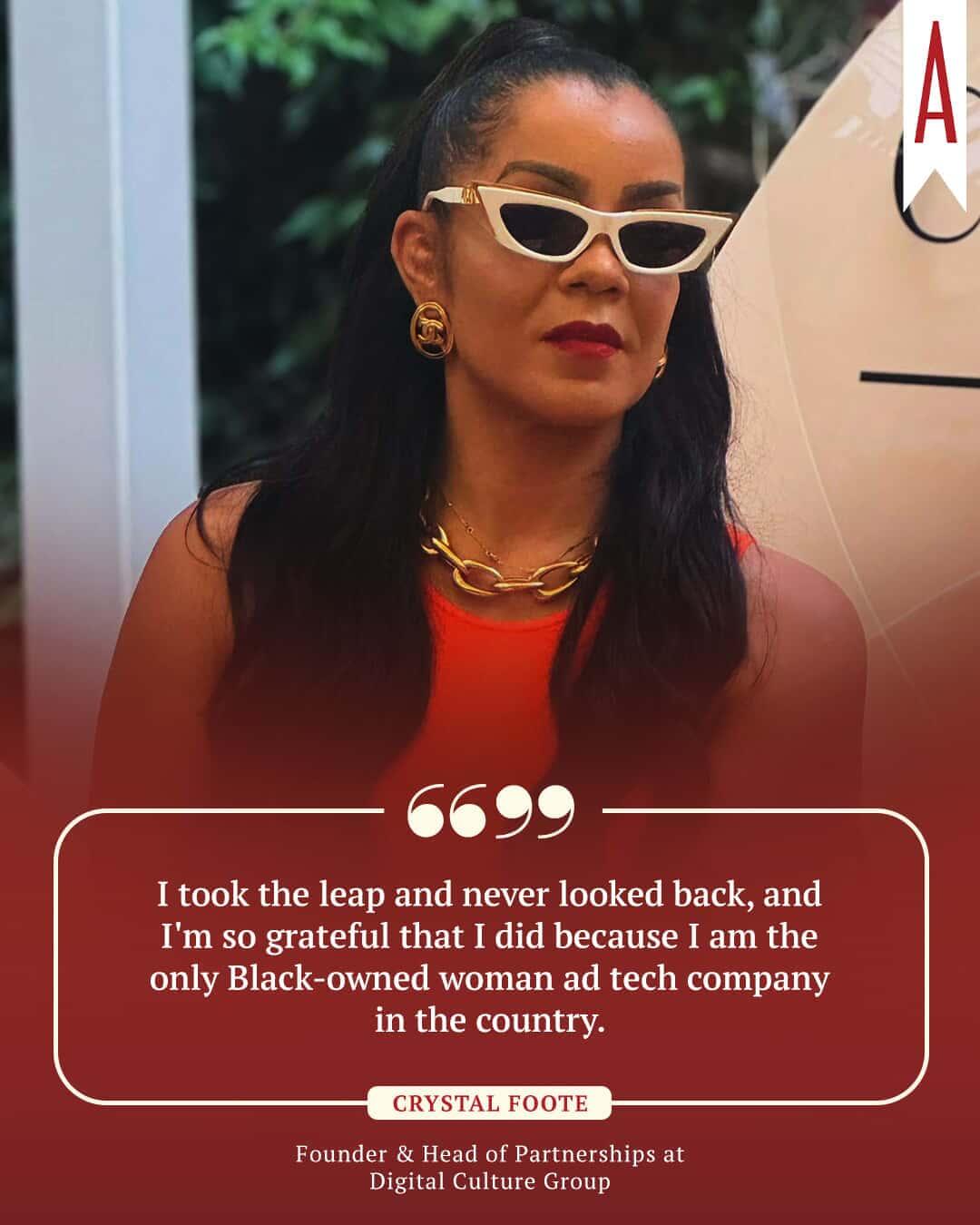
God told me to do it, and I know that I have a purpose for this, because when I was working at the agency side and other ad tech companies, I was already building solutions and already being that visionary within their walls to create things. So I took the leap and never looked back, and I’m so grateful that I did because I am the only [independent] Black woman-owned ad tech company in the country. We are also validated by some of the largest organizations, like Newsweek, with the most innovative AI tool. I was supposed to do this; this was my calling. And I’m having so much fun doing it. We are breaking down stereotypes and walls and the sky is not the limit for us.
Her Agenda: You had the foresight to transition to the tech side of the advertising business. What skills and lessons have you taken with you from your career in Advertising that helped you build Digital Culture Group, and how did that shape the way you run your business?
Crystal Foote: Don’t take it personal. That can really make or break somebody. The type of comments that I receive when I’m pitching Digital Culture Group and when I talk to certain people who don’t expect me to be on the other end of the Zoom call, and the disrespect and the bias that I have to go through can be overwhelming to someone who’s not used to that. You cannot take it personal. And for someone like myself who’s very passionate, I had to learn that early on. At the end of the day, you need to carry this decorum where you have to swallow it. Be stern enough, but not to the point where you’re going to use words to harm that person. I had to learn that I need to focus on the prize: keep it focused on business and not based on the personal. I had to keep it separate; having this almost separate identity as a business owner versus my personal life has really helped me be stronger in what I do.
Her Agenda: How do you balance and maintain your identity in your industry as a Black woman businesswoman and entrepreneur, specifically as the founder of a company built around authenticity and culture?
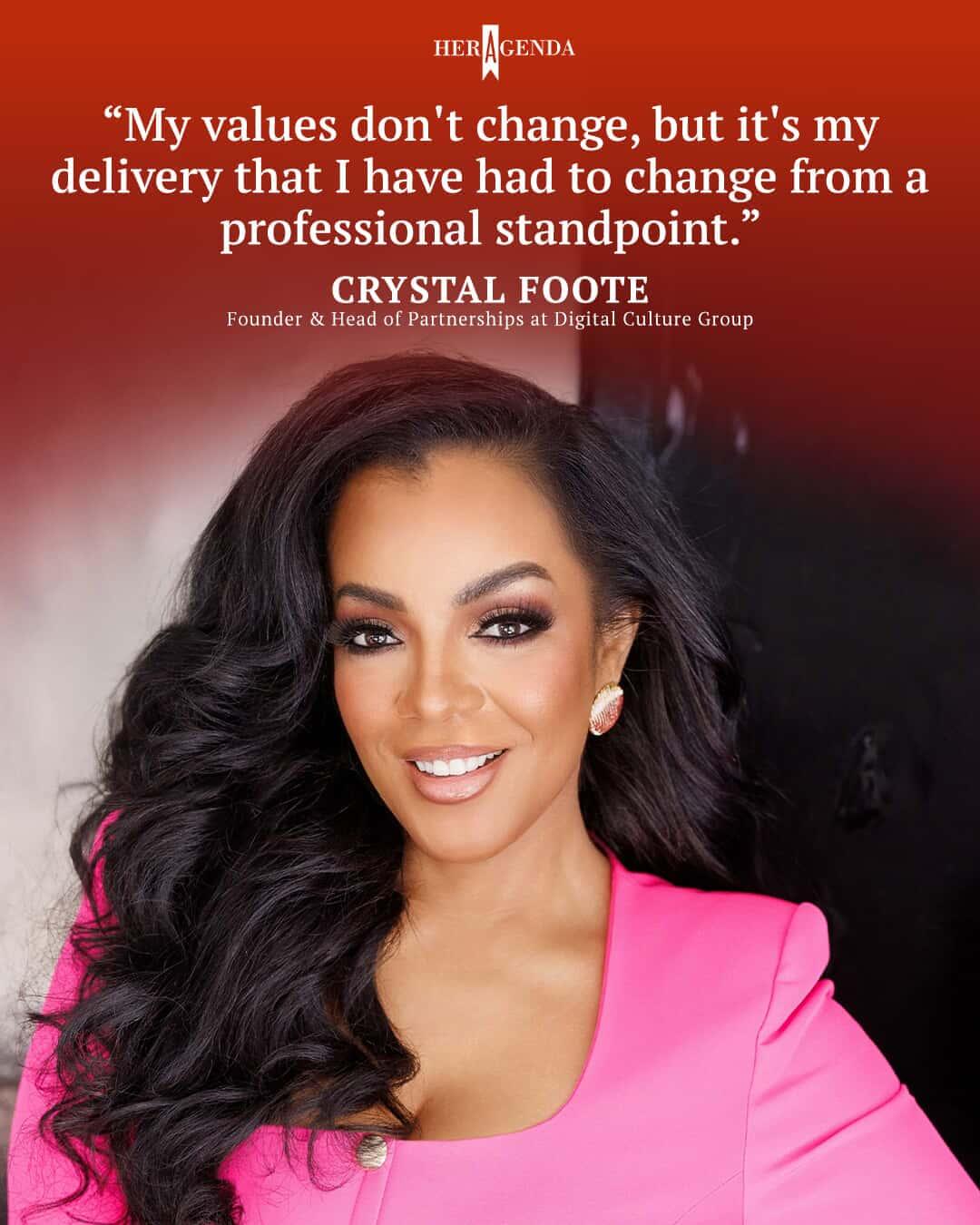
Crystal Foote: My values don’t change, but it’s my delivery that I have had to change from a professional standpoint. I think it’s a lot of education, more so than I have to do, whereas on my personal side, I don’t have time for education when I have ignorance at my doorstep. I’m going to tell you like it is. But from a professional standpoint, I deal with people who either don’t know because they weren’t educated or are being ignorant, or they have bias, but I use that moment as an educational piece.
It’s interesting because I didn’t really understand how much I had to separate [my personal self], but look at entertainers like Beyoncé. Beyoncé talks about Sasha Fierce. That is a different character that she has to put on stage. And it’s hard. I have two children, I have two dogs, I have a husband, and when I have to pick up and travel [for work], I can’t be mommy at that time. I have to be on go mode.
Her Agenda: Since founding Digital Culture Group in 2023, your company’s offerings have grown, embracing AI with its new tool, ARI (Audience Resonance Index), introduced last year, helping brands optimize their strategy and resonate with their consumers in a more personal, authentic way. Did you expect the amazing reception it received this past year? What have been some of the expected (or unexpected) insights that the sophisticated tool has unveiled for some of your clients?
Crystal Foote: [Digital Culture Group] typically works with Fortune 50 brands and Fortune 500 brands, and they love our AI audience platform, ARI (Audience Resonance Index). They love it because we’re hitting on a very important situation for them: their audiences sometimes are the same, but their interest in behaviors change based on political, social, and economic changes happening in the world. [Our clients] want to understand, ‘How can I communicate to that person today, not the person from last year?’ because that person from last year is probably looking at your brand very differently based on those three factors alone. Then also, who are your emerging audiences? What’s their mindset? And based on their mindset, how are we using that to make sure we’re doing the right targeting, the right creative messaging, the right tactics to reach your audience? A lot of that was guesswork before ARI was created.
ARI is hard to copy because its IP is from a woman that’s diverse and focused on all audiences, making sure that there is no type of bias in the coding. And so the feedback has been amazing. A lot of things have happened since two years ago. One woman who was probably buying luxury and traveling a lot; she might have been a part of the 600K Black women who are no longer employed, so how are we talking to her differently? That’s still an audience, but how are you shifting the conversation to make sure that we’re in alignment with her lifestyle right now?
Her Agenda:An important tenet for your company, Digital Culture Group, and in what you do seems to be focused on culture. What has your experience been like personally and professionally with culture and diversity that has shaped the mission behind your business? And how important is it for you to reflect that in the services Digital Culture Group offers?
Crystal Foote: I feel like people have their own definitions of culture, but then there’s also a thing where it seems only a certain group of audiences can have culture and no one else. Everyone has their own individual culture. For me, the definition of culture is a commonality a group shares. I am a wife. That is a culture in itself, because when the mom and the wife groups get together, we can share what we’re going through together and if there’s anything that can make our lives better. That’s the commonality that we share. That’s culture right there. Within our own ethnic and racial cultures, there’s some commonality there as well that we share that other groups don’t understand. And for [Digital Culture Group], when we’re looking at culture, we wanted to make sure that the brands that we’re working with resonated with the culture of that audience as it related to their brand. That’s the best way to really be authentic with audiences: when you align with culture.
Also, people don’t talk about the parent-child group. The parent-child group is so important because, as a parent, you influence your children to buy certain products. Brands only think about the moment sometimes.
Her Agenda: As a seasoned professional in the Advertising industry, what changes have you seen in the industry in the past few years, and what are brands getting right and maybe wrong right now in their brand marketing?
Crystal Foote: I think what brands are getting wrong is that they’re relying too much on big data to solve their problems. Around 10 years ago, Anthropic and OpenAI did not exist. They were newer, disruptive companies that are worth billions of dollars, and people were signing up left and right to use them. I think that [advertising] executives need to understand that if you’re trying to reach your audience, look at the startups, specifically the startups who are winning a lot of awards and who are working with Fortune 50 brands because they have a lot to offer that big data can’t offer because of red tape, procurement, all of the things that we can turn around in a day, if not a week.
Her Agenda: What does the future hold for Digital Culture Group and for you as a businesswoman?
Crystal Foote: One of [Digital Culture Group’s] goals is to be a household name to agencies that we’re not working with or that we are working with and to brands who are really trying to connect with audiences. Nielsen came out with a study saying, at the very least, 40% of brands are reaching unintended audiences. That’s scary and a lot of money being wasted every year. I would love for brands and agencies to do some due diligence. You have Google; you have LLM models that can tell you, based on your challenges, what partners you should be reaching out to and what emerging startup companies you should be looking at and talking to right now. Just do a little bit more research.
I know people are sometimes against AI and agents, but it hasn’t replaced anyone on my team; it has only strengthened our work. It removes human error, and then we look at it and we remove the AI error. It makes our company a lot better, and I’m really excited for it.
In the future, from a professional standpoint, I want people to see me, because if you see me, you can be me. I don’t want to be the only Black and woman ad tech company in this industry. I want there to be more, whether it’s with me or after me, but I don’t want to be the only one. That’s not what my goal is.
Her Agenda:What advice would you give other Black women professionals looking to start their own business and take a chance on themselves?
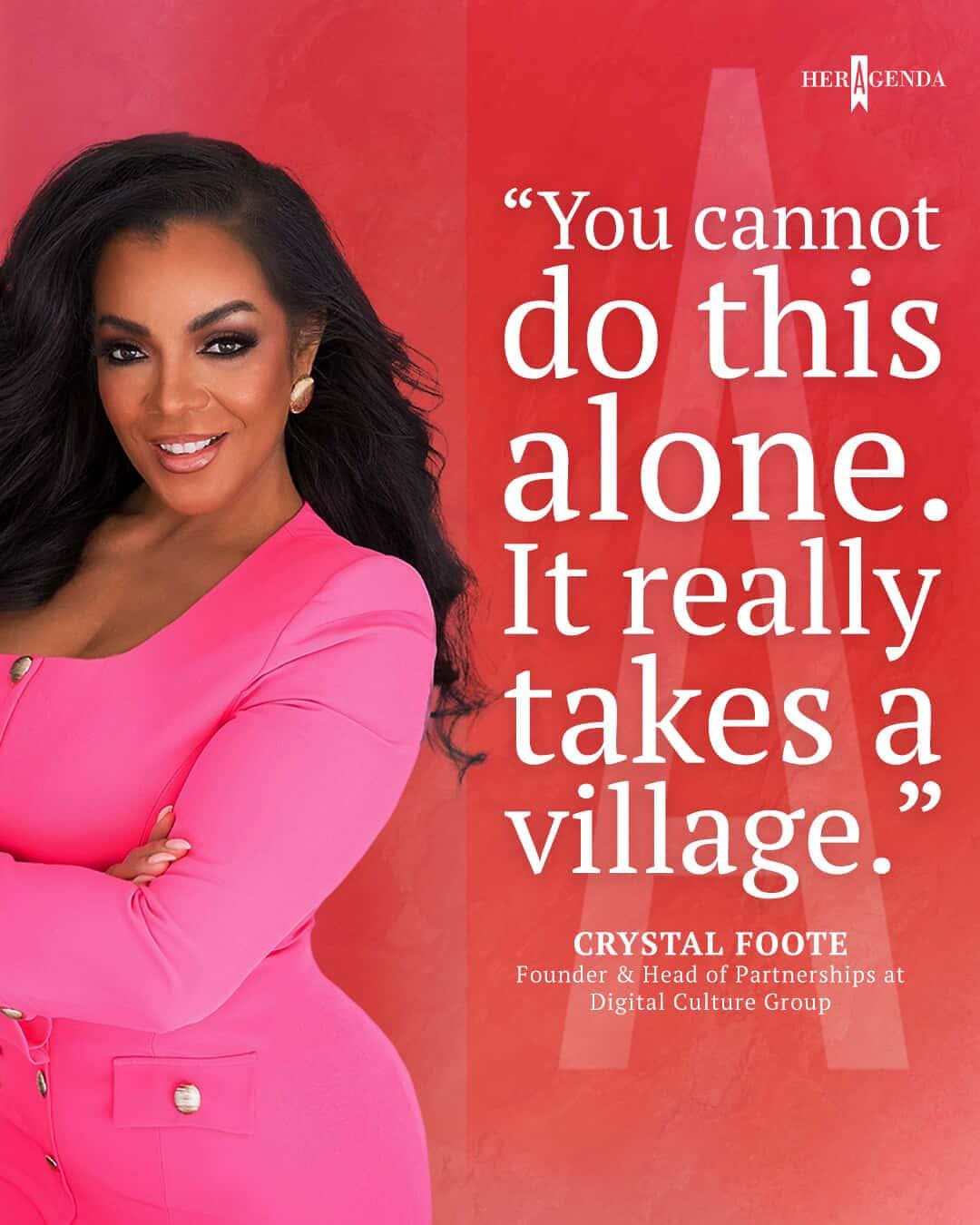
Crystal Foote: Find the right partners to scale your business. You cannot do this alone. It really takes a village. [Digital Culture Group] scaled so fast because I found the right partners. I encountered wrong partners in the interim, but we got past that really fast. Find people who complement what you do and who uplift you. You’re not going to reach success as fast as you think by doing it on your own. Sometimes when I hear the phrase ‘self-made,’ you’re not really by yourself. It takes a team. You really have to make sure you find the right partnership to scale, and you show up to things that matter most, because your time is money.
Also, keep your chin up. That’s what my great-grandmother used to say. You’re going to go through some things, and it’s not going to be easy all the time, but understand your purpose and understand that if this is for you, then keep reaching up and keep on doing it. Don’t let anyone deter you.
[Editor’s note: This interview has been edited for length and clarity.]