
Elizabeth Frederick: An Agent Of Change Leading The Nonprofit World





Nonprofit leader and youth justice reform advocate Elizabeth “Liz” Frederick had no idea she would embark on a decades-long career when she first joined Avenues for Justice. Avenues for Justice is an alternative to incarceration program in New York City designed to help Black and brown youth, providing them with life-altering support to help protect them from the negative effects of the criminal justice system. Liz joined the organization in 2006 after what was supposed to be a 30-minute meeting turned into a two-hour conversation with Avenues for Justice co-founder Angel Rodriguez. After learning under her mentor, Angel, and contributing to the organization in all capacities, the John Jay College of Criminal Justice graduate took the helm as the new executive director in 2024. Liz now leads the movement, continuing a 47-year-old mission of giving second chances.
HA: Tell me about Avenues for Justice, its purpose, and your role in the organization
Liz: Avenues for Justice is an alternative to incarceration, a nonprofit organization. When you hear me saying ATI, that’s what that is: an alternative to incarceration. We work with youth and young adults ages 13 to 24 throughout New York City. We’re in all five boroughs, and we provide free court advocacy and higher-up program enrichment services. We have two populations. The first population is our court-involved population. These are young people who have legal matters in court, are going through the criminal justice system, and have contact with law enforcement. We help them with their court mandates because most of them come to us through the criminal justice system, where judges, attorneys, and the DA’s office mandate them into our program. The second population is our preventative population. I’m moving away from using the term “at risk” because it implies they’re at risk of failure. In addition to the legal services that we provide for our young people, once they’re mandated to our program, we have two community centers in the Lower East Side and in Harlem where all of our higher-level programming takes place. The beauty of HireUp, or its importance, is that we really want to stabilize our young people beyond their legal matters and provide a continuum of care for them. Our HireUp program focuses on three main components. The first one is job readiness and workforce development. We have programming to prepare our young people for internship placements, which we hope will lead to long-term employment in industries that they typically would not work in.
Many of our young people are used to working in hospitality, food and beverage, and retail, which have high turnover rates. We’re trying to get them into new industries such as clean energy and construction. We offer certifications in all of our programs, community centers for OSHA, flaggers, food handlers, security, and we pay for all of those certifications. We partner with local BIPOC women-owned businesses throughout New York City for the internship placements for our young people. We pay stipends for young people from funding we secure. The internship placements are for eight weeks, 15 hours per week. We pay a stipend of 17 hours per week for our young people. When I came to Avenues for Justice, I was pursuing my master’s at John Jay College of Criminal Justice and writing a thesis on juvenile delinquency. My professor connected me with the co-founder and executive director, Angel Rodriguez, and I came to the courthouse because our main courthouse offices are inside the Manhattan Criminal Court building. It was supposed to be a 30-minute conversation, but I think I was there for about two hours, and I was just so moved by Angel Rodriguez’s passion that I left that evening knowing that I wanted to be part of the AFJ movement. I’ve worked with the organization for 20 years in all capacities.
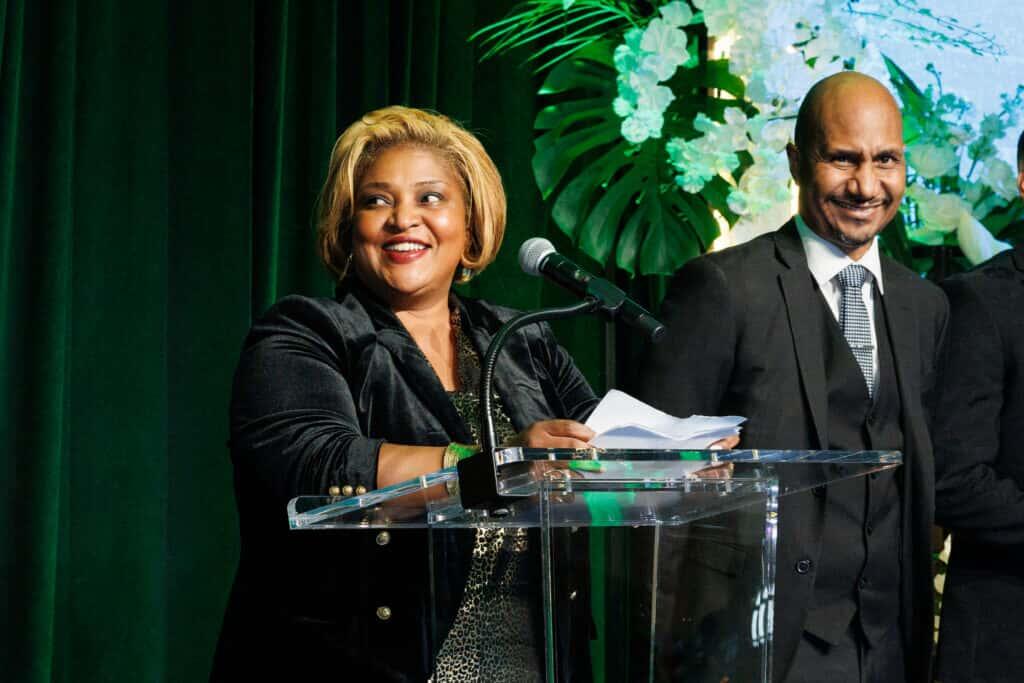
HA: What was it like for you when you finally got into the leadership role, the role that you’re in now?
Liz: When I look at my professional trajectory and the spaces I’ve been in, I have to say that, as a black woman in the criminal justice field, I had to carve out these spaces for myself, particularly in development and fundraising. Historically, when you look at the African-American or black community, fundraising is something we’ve been doing for a long time to sustain our communities. For me, it was really important to look at the root causes of why our young people were entering the criminal justice system: it was all due to the resources they lacked and the systemic barriers they faced. The beauty of Avenues for Justice, we’re a very small team. There are 12 of us, but we all live in the same communities as our young people, so we understand what is going on and what is needed to create equity in those communities.
For me, becoming executive director and leading the organization forward was about understanding the root causes of mass incarceration and the impact that it has on our communities. It’s also about changing the narratives of who our young people are. Ninety-four percent of our young people are not reincarcerated after enrollment in our program. They’re more than just data points. These are young people who have real stories. Around PR and media, it’s changing the narrative of who our Black and brown young people are. I’m sure you know firsthand that when you read these headlines, they’re so sensationalized and they paint our young people out to be gang bangers and thugs, and they’re really not. What our young people need, particularly in New York City, is just access, exposure, and opportunity. That is what I’m trying to provide as a leader and executive director of the organization.
HA: What are some of the testimonials you have received from the youth who have participated in your program?
Liz: Every year, we host an Impact Awards dinner to celebrate a program graduate. A program graduate is a young person or young adult who has successfully completed our program, course-corrected, and come out successful. At last year’s event, we celebrated a young woman named Catherine Australia. Catherine Australia, was mandated to our program, facing serious jail time. What we try to do at Avenues for Justice is that when young people come to us with serious offenses, we work with the court system to either get their charges reduced or dismissed, or get them a youthful offender status. They have to be below the age of 18 for youthful offender status, and that means that we’re successfully able to get their records sealed so that they’re not stigmatized with that for the rest of their lives. Catherine came to us facing serious sentencing and charges. She worked diligently with her court advocate, came to our centers Monday through Friday, was really engaged in the programming, and completed three internship placements.
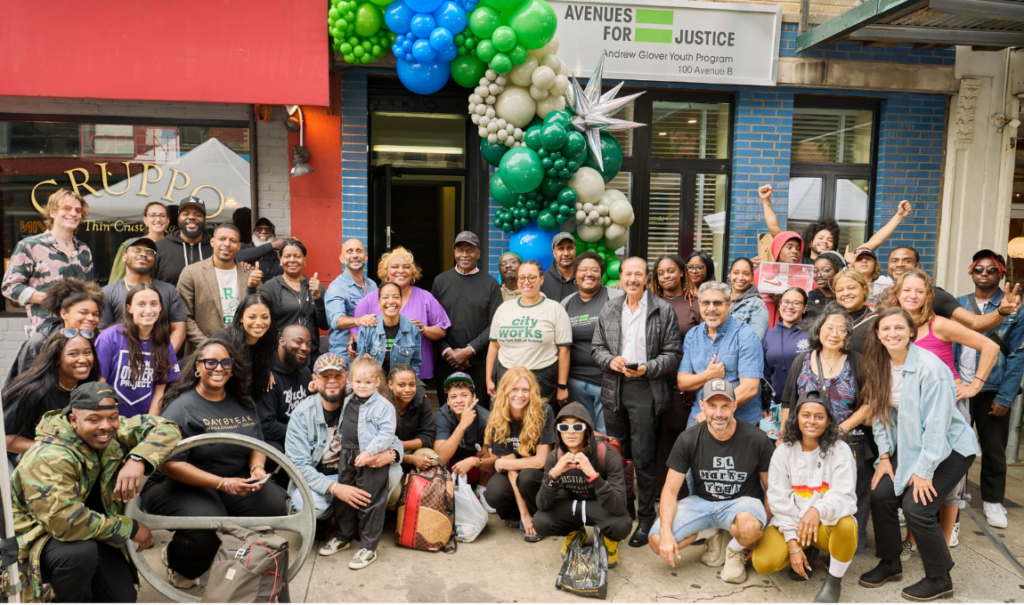
She is now working for the Department of Education as a teacher’s assistant. She was raised in a family of eight in a three-bedroom apartment in the Bronx. Last year, she was able to get her own apartment. Had she gone in, I believe Cat was 20, she would have been coming out and would’ve missed the prime of her young adulthood. In just a few years, she’s accomplished so much, and that ties into our mission, which says that incarceration should be the alternative, not the norm. Young adults like Cat should have the opportunity and not be defined by one or two mistakes that they’ve made. Through our enrichment and wraparound services, they can change the trajectory of their young lives. We have many success stories.
HA: What is the key to setting the youth on the right path and introducing them to reform through the organization?
Liz: The first step in the path to force correcting is accountability. We have a trial period for any young person who comes through our program for at least a month, because we want to make sure that young person is accountable to themselves, their families, the court advocates, and the program. To the criminal legal system, we provide progress reports to judges and attorneys, so accountability is number one. Number two is the determination to want to see better for themselves. We want them to be active agents in their individualized action plans and take ownership, because we’re not going to do the work for them. Once they do take ownership, there’s a level of satisfaction, because I’ve seen young people come into our program with the mindset that this is too much work. After a few weeks of programming, you can see a difference in their demeanor and their excitement. To me, the best part of my work is when a young person comes to me and says, “Liz, I did it.”
“I was able to finish and graduate high school or get my GED,” or “Liz, I completed two internship placements and the employer has now given me a full-time job.” “Liz, thank you, this program, Avenues for Justice, my court advocate, really helped me turn my life around.” It’s about accountability. A young person being accountable to themselves; us, as employees of the organization, being accountable to our young people, the communities we serve, and our stakeholders.
HA: What are the goals to expand the program in the future?
Liz: Two years ago, we celebrated 45 years of doing this work, and one recurring question was: Where do you see this organization in the next 45 years? Honestly, I don’t want to see this organization in existence because we will have figured out as a society, as a country, the long-term effects of mass incarceration on families. When people think about mass incarceration, they’re only thinking about the individual who goes through that process, but they’re not taking into account the damage that it does to families. When I think of expansion, I want expansion to be that we don’t need programs like Avenues for Justice because our first reaction is not to incarcerate young people. Rather, we should provide them with the resources they need. We should be providing them with a better educational system so that our young people are not left behind, are not getting kicked out of school, or are just not feeling schoolwork. We should be creating platforms where they can access the resources, whether it’s education, healthcare, or have real pathways to long-term employment. We served close to 700 young people last year. I see us serving even more this year because, you know, again, without getting into politics, we’re living in a very law-and-order society where the natural inclination is to be punitive. I really want to see us move away from being a punitive society toward one that truly empowers our young people, because they are our next generation of leaders.