








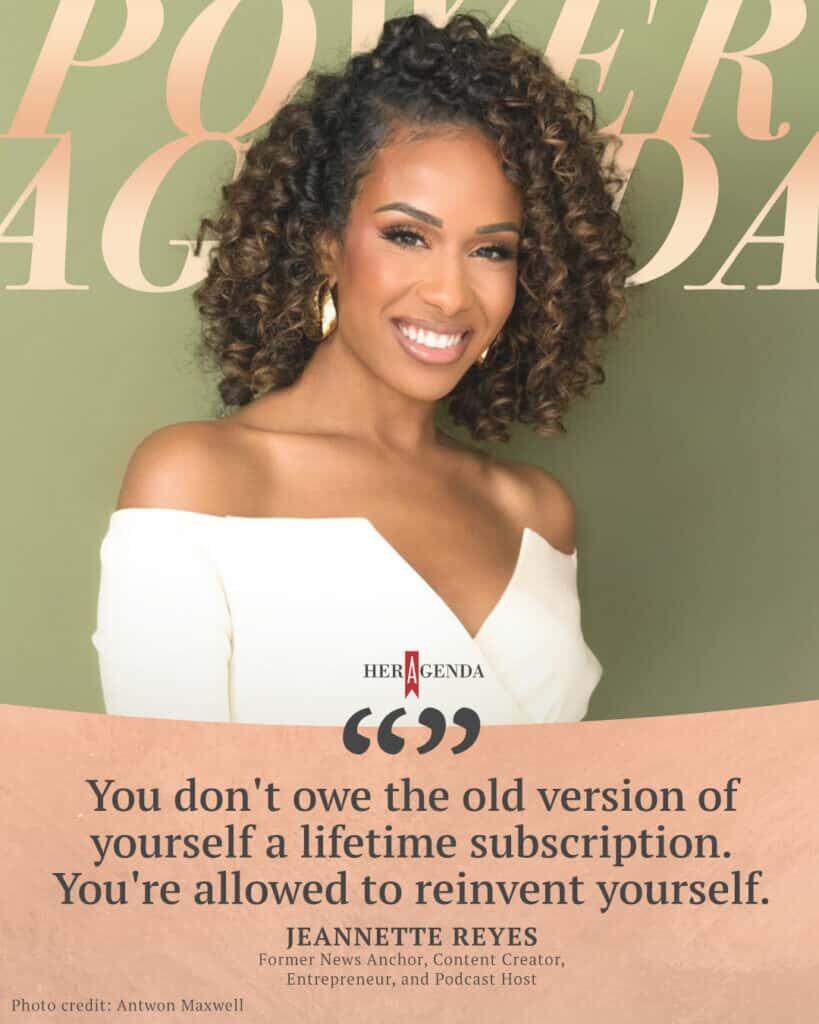
“You don’t owe the old version of yourself a lifetime subscription. You’re allowed to reinvent yourself.”
After 12 years as a news anchor, Jeannette Reyes walked away from traditional journalism to build something she could own. Jeannette gained widespread attention for her work with networks such as FOX and ABC, primarily in the DC area. The former news anchor, also known as “Ms. News Lady,” decided to pivot and launch the AWF The Record podcast in 2024 alongside co-host Mona Koser Abdi, an award-winning journalist and media expert.
With over 100,000 subscribers and 4 million total listens across all platforms, the duo dives deep into topics such as modern womanhood, mental health, relationships, and media. Combining girl talk with journalistic rigor, AWF The Record features prominent guests such as fashion designer Sergio Hudson and Jay Manuel, the creative director of America’s Next Top Model. Coming from the fast-paced environment of a news desk, Jeannette found it important to have a space where she could tell stories and give them more depth, texture, and nuance. A proud first-generation Dominican, Jeannette draws on her culture and identity to tell stories that feel personal and specific to her audience. With more than 2 million social media followers, Jeannette has built an audience by sharing openly, including her experiences navigating IVF and PCOS, making her a trusted voice for women going through the same. She’s an example that it’s never too late to start a new path.
Her Agenda: How did you discover your love of journalism, and what was your journey like throughout your career?
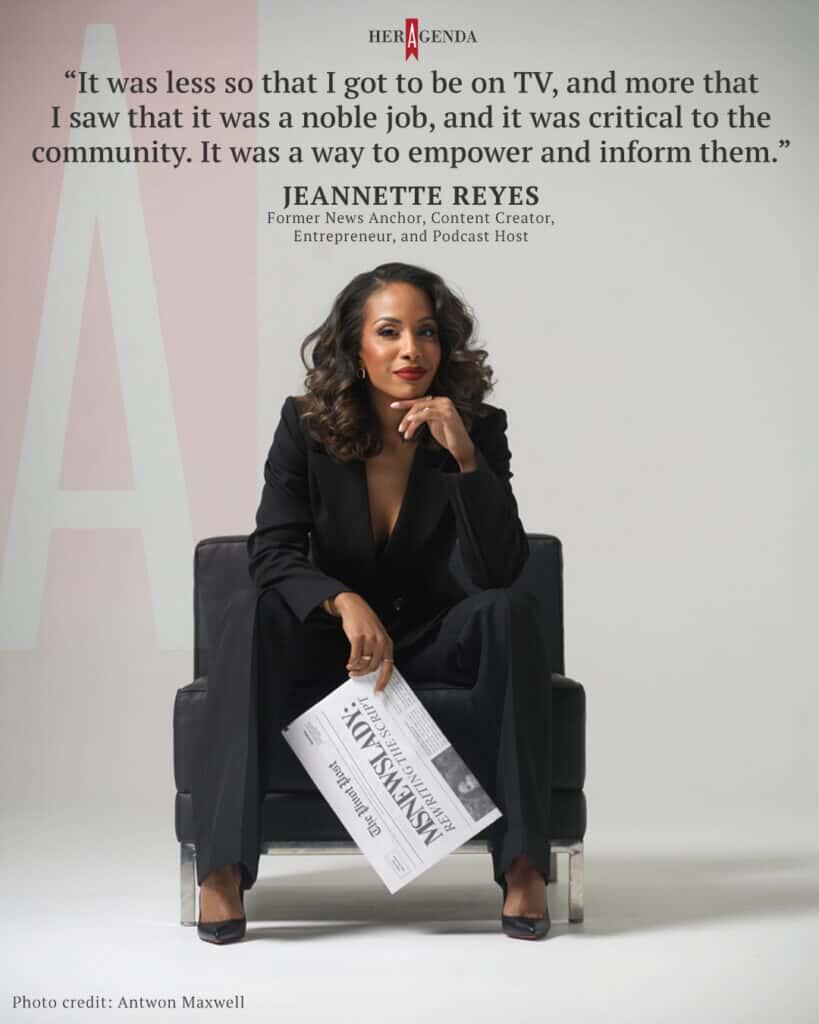
Jeannette Reyes: I discovered my love for journalism through my late father and my mom, but especially him. He was a news junkie and watched Univision. It was Spanish news, and he never missed a newscast. He was constantly reading the newspaper and was also a history buff, so he appreciated the news. More than that, I saw, given that they were immigrants and I was a child of immigrants, the way they depended on the news to keep them informed about what was going on in their community and back home. It was less so that I got to be on TV, and more that I saw that it was a noble job, and it was critical to the community. It was a way to empower and inform them.
Once I got to college, I initially wanted to be an attorney, and then I switched my major to broadcast journalism and started in Little Rock, Arkansas, back in 2012, then went to Washington, D.C. Then I went to Philly as an anchor and back to D.C. as an anchor, and that was my final job in the news industry.
Her Agenda: What did your 12-year career in journalism teach you about yourself?
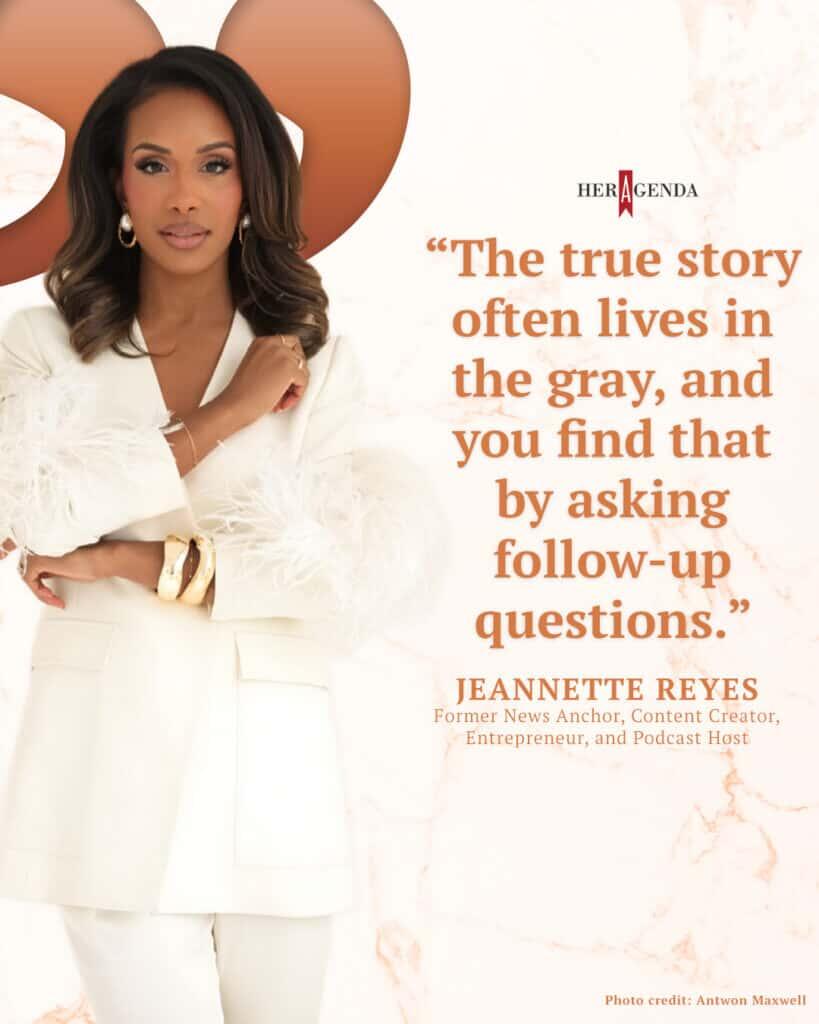
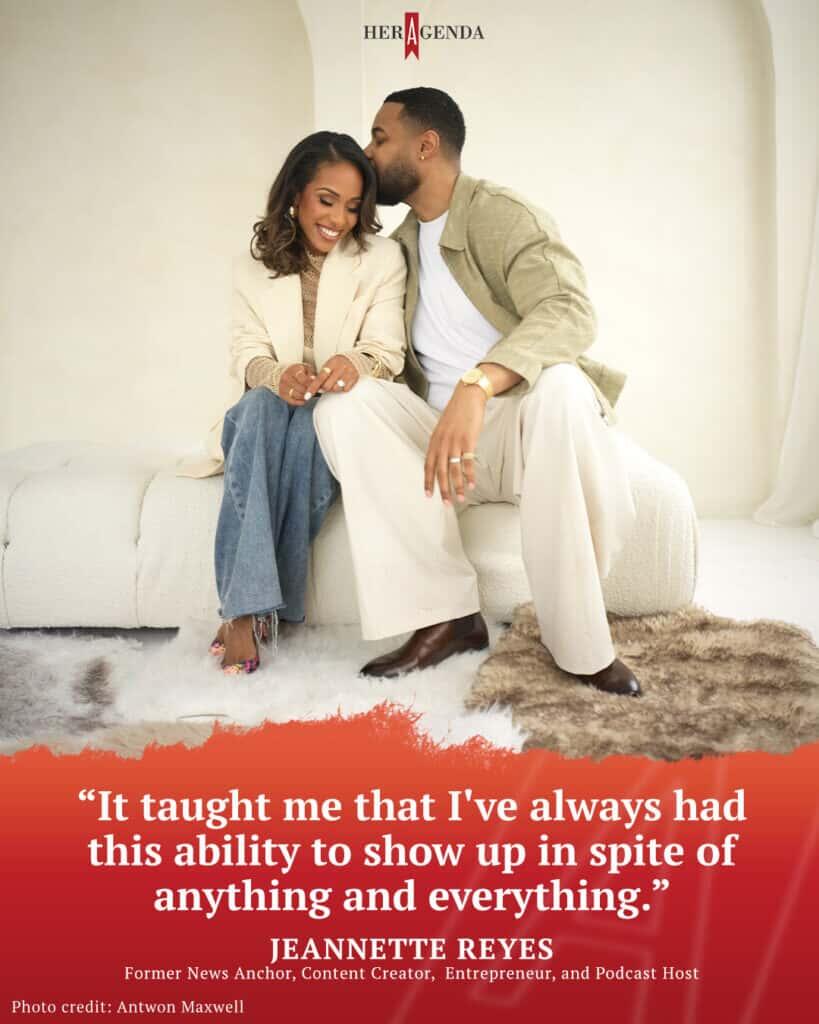
Jeannette Reyes: I would say that it taught me that the story is in the nuance. I think we assume that life is black and white or that there’s good or bad or there’s two sides and everything’s very binary. It taught me that the true story often lives in the gray, and you find that by asking follow-up questions. Rarely do you get the answer or the story in the questions that you’ve initially set out. It’s in actively listening, asking follow-ups, and digging further. It’s in the sometimes uncomfortable pauses. It applies anywhere in life, whether it’s your friendship or your relationship, or everyday conversation, to pay attention to the nuance and be an active listener. Don’t be afraid to ask those questions. It also taught me that I work well under pressure when there’s a hard deadline. The news is on at five, whether you like it or not, whether you have the story, whether your package or your report is done, you’d better be up there saying something. It taught me that I’ve always had this ability to show up in spite of anything and everything. It’s a valuable skill to have.
Her Agenda: What is a particular story that you remember vividly covering and that had an impact on you?
Jeannette Reyes: I would say Philly was my toughest market. I would say when you go to Philly, you leave a true journalist. It was one weekend where two young children were killed as a result of gun violence. I was outside the hospital reporting on the passing of the second child. I got really emotional on air. Even now that I’m talking, I’m getting emotional. It was an 11-month-old. I was visibly affected on air. I wrapped up my report and thought I had failed. I couldn’t separate myself from the story. I was so nervous about opening Twitter and Facebook to see what viewers might say or what my news director might say. I was surprised that people were very encouraging, but it was nice for them to see the humanity in a reporter. I’m not saying that when a reporter isn’t showing emotion, that they’re not being human. I think it’s us trying to do a good job. When you show emotion, when you show that you’re affected by the story, it shows your humanity. It shows that you feel connected to your community. It showed me that I needed to do a better job of processing what I was reporting on and that I couldn’t ignore the fact that I was being affected by it. That was probably the most pivotal part of my career. I couldn’t keep running from how the stories I was covering were affecting me. That is precisely what made me a good journalist.
Her Agenda: How did your Awf the Record podcast come to be?
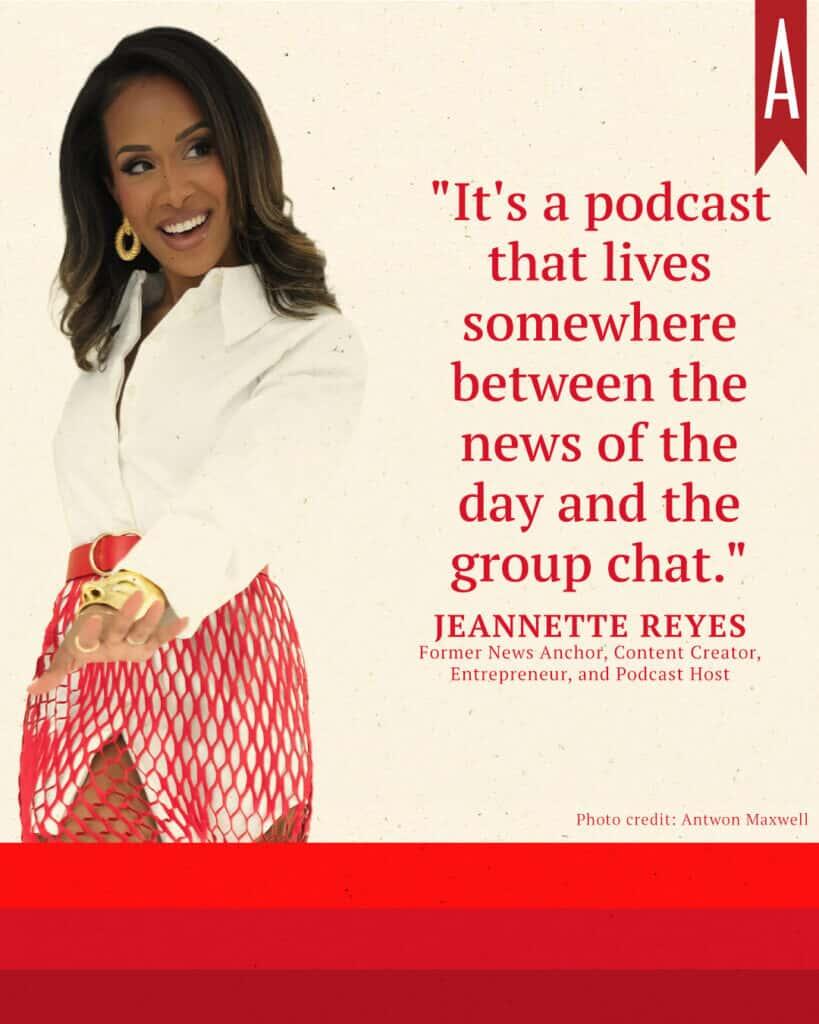
Jeannette Reyes: It came to be through my co-host and me, Mona Koser-Abdi, who is a former ABC News correspondent and anchor, and now is a correspondent for Extra TV. She and I first discussed it back in 2019, talking about how we wanted a way to nuance many layers, and we realized that many stories weren’t covered with as much depth as we wanted in the news. Obviously, time constraints were a factor, but also stories from our own communities, communities of color that either weren’t covered to the extent we wanted to or weren’t covered at all. That’s how Awf the Record initially came up. We weren’t able to actually do it until we left the news several years later. 2024 is when we launched. Our tagline is that it’s a podcast that lives somewhere between the news of the day and the group chat. Basically, it’s our way of talking about topics that are in pop culture or that you and your girlfriends are texting about in the group chat. You want a little journalistic rigor, depth, nuance, and substance; you don’t typically get that on other podcasts.
Whether it’s Jay Manuel from America’s Next Top Model, you might, on the surface, just talk about how crazy the show was and how chaotic and toxic it was. There’s also the issue of sexual harassment and bullying and toxicity and bulimia and anorexia. Several heavy topics go beyond pop culture and deserve serious questioning, follow-up, and accountability. That’s what we do on Awf the Record.
Her Agenda: How do you feel about the podcast market now? I know we have so many, and technically, they’re not all run by actual journalists
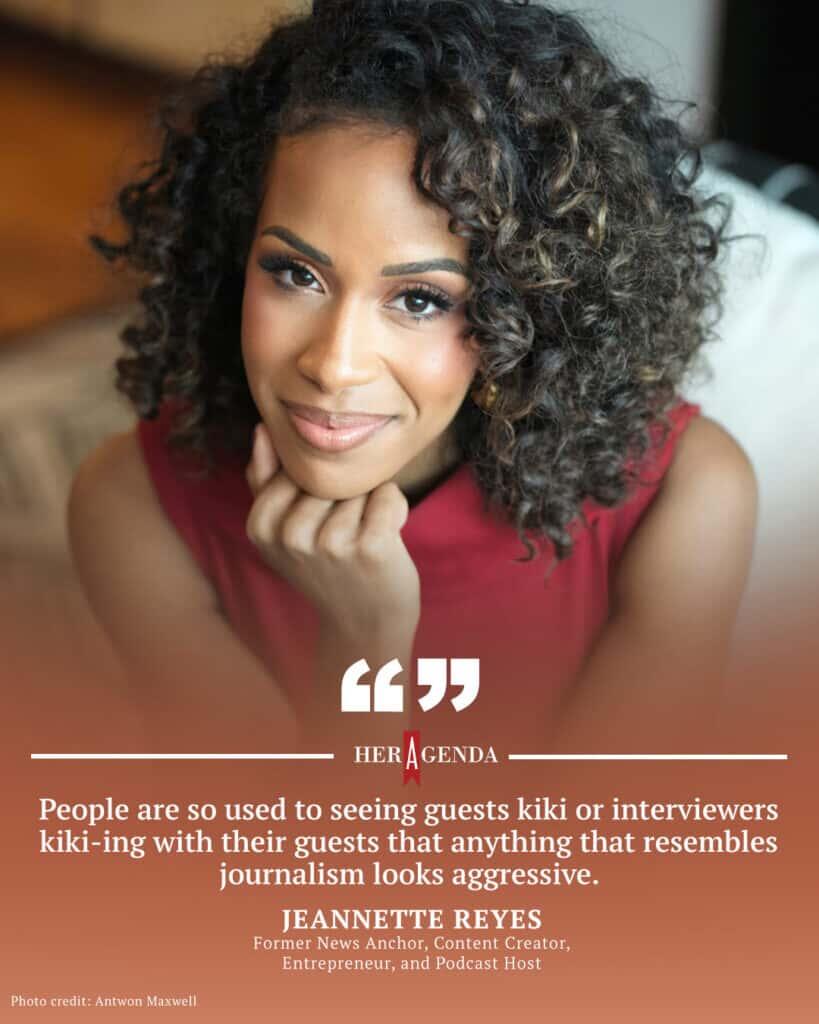
Jeannette Reyes: I think it’s great that we are in a space where people can share their opinions, and you don’t have to have a degree. I actually think there’s a time and place for it. I think it’s great entertainment to see other people who share your opinions or maybe show you a different perspective. I think the issue comes when we assume that just because someone has a microphone or is doing an interview, they’re automatically a journalist. I think the problem with that is that it lends too much credibility and weight to something that is supposed to be more entertainment than anything else. One of the things we’ve seen is that when you have a journalist asking a follow-up or pushing back, it’s seen as combative, whereas this is actually what journalistic rigor looks like. This is what we grew up watching with Barbara Walters, Oprah Winfrey, and Walter Cronkite. That’s what journalism is. People are so used to seeing guests kiki or interviewers kiki-ing with their guests that anything that resembles journalism looks aggressive. That’s where I think we’re getting into tricky territory. I don’t mind people having podcasts, mics, and doing all of that. There needs to be a distinction and a clear distinction between the two.
Her Agenda: What inspired your pivot from traditional journalism?
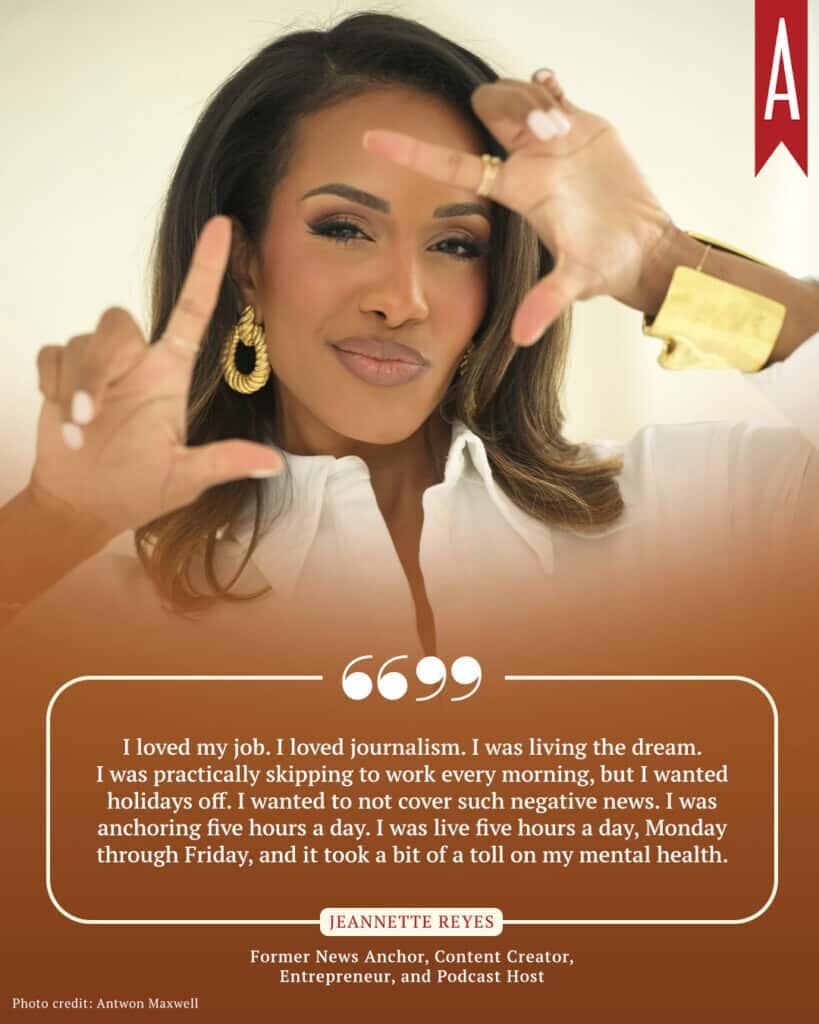
Jeannette Reyes: What inspired my pivot was a desire for ownership, freedom, and flexibility. I loved my job. I loved journalism. I was living the dream. I was practically skipping to work every morning, but I wanted holidays off. I wanted to not cover such negative news. I was anchoring five hours a day. I was live five hours a day, Monday through Friday, and it took a bit of a toll on my mental health. It wasn’t because of work toxicity or because I didn’t like my job. All those reasons are valid. For me, it was freedom, flexibility, and a bit more levity in what I was talking about. It’s the best decision I’ve ever made.
Her Agenda: Tell me about your journey with IVF and PCOS. How has it affected and/or motivated you?
Jeannette Reyes:I have PCOS, it’s polycystic ovary syndrome, and long story short, it basically means that it makes it very, very difficult to conceive. Your periods are irregular. We tried for a little over a year, then decided we needed some outside help. We did IVF, and we were very fortunate that we were successful after one round, but it was difficult, especially coming from family and being around people who I didn’t really see struggle with that. It made it seem like something was wrong with me, but what I did learn was two things: first, the importance of self-advocacy, which I had mentioned to my doctor, who was great. I never felt dismissed, but when I brought up that I think I might have PCOS, she wrote it off because I didn’t fit the profile. Typically, you’re overweight, you have excessive facial hair, you struggle with depression, and I didn’t have any of those factors. I pushed some more, and once I got tested, I had the classic signs. It was very, very obvious that I had it. Had I not pushed for it, I wouldn’t have gotten diagnosed, and I wouldn’t have taken the steps to go the route of IVF, as the timing is very important with that. The second is having more discussions around your family’s health history.
Once I told my mom that I was officially diagnosed with it and I described what it was, she was like, ‘Oh my goodness, I think I have that too.’ Had I known that much earlier, I would have gone to the doctor earlier. I would have gotten tested earlier. I think particularly in families of color, we need to have more open and honest conversations around our family health history so that we are empowered and can then make important decisions. That’s what I want people to know: that time is of the essence, and you don’t want to lose that time simply because you didn’t know. You don’t know what you don’t know.
Her Agenda: What advice would you give to women who are feeling these symptoms, who are telling their doctors, but they’re not being listened to?
Jeannette Reyes: Find another doctor. I think sometimes we write it off and think, “Okay, maybe I’m just being dramatic,” or that the doctor doesn’t have to be a mean, rude person. My doctor was very sweet, and I felt very supported, but she just didn’t think I fit the profile. Get a second opinion, get a third opinion. Having a doctor with a history of working with patients with this diagnosis is also really helpful because they can spot patterns. Someone with a history of dealing with patients with PCOS could have enough history to go off of to know that not everybody fits the profile. It doesn’t hurt to get checked out.
Her Agenda: Are you looking to pivot to other things in the near future?
Jeannette Reyes: I would say the biggest thing is probably the podcast. It’s my way of exercising the skills and passions I’ve always had for storytelling. I was able to flex and exercise that in traditional journalism as a news anchor, telling stories and having conversations with people in a way that informs or inspires an audience. And Awf the Record does that as well. It’s just in a different way. It’s more on my terms. It’s shedding light on stories you might not see in traditional media. It offers nuance and depth you wouldn’t see in many other places.
In everything I do, I think the biggest thing I want to keep showing is that you don’t owe the old version of yourself a lifetime subscription. You’re allowed to reinvent yourself. Put simply, do whatever the hell you want. There could be no rhyme or reason other than I just feel like it. This isn’t fulfilling anymore. I just don’t feel like it anymore. That’s reason enough.
[Editor’s note: This interview has been edited for length and clarity.]