









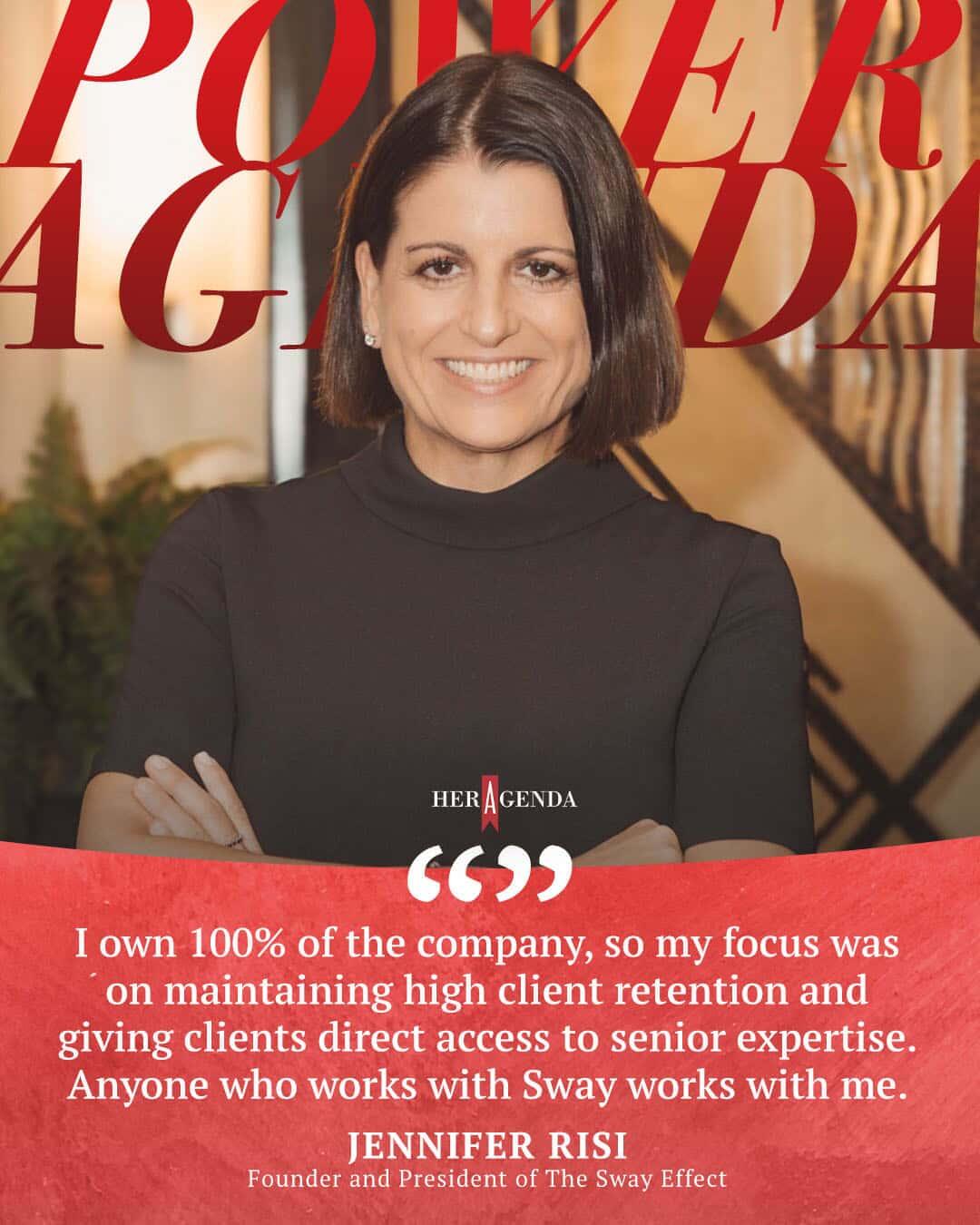
Jennifer Risi, a seasoned communicator and marketer, is flipping the script on the traditional agency model with The Sway Effect: a network agency that pairs each client with hand-picked specialists instead of one fixed team. She leads every engagement herself, so clients get her senior-level attention directly, without the hand-offs of a bigger shop. She helps ambitious brands tell their stories and solve high-stakes communication problems. Together with her team and network companies, she delivers expert-driven strategy without the bureaucracy of traditional agencies.
Jennifer has built out meaningful communication strategies for a range of brands, including Stanley 1913, a global company, and Kindred, a hospitality startup. In these roles, she has produced tangible results, increased customer engagement, built a good online reputation, and created reliable momentum for the brand.
In this interview, Jennifer Risi discusses the vision behind her agency, Sway Effect, how it started, and how she built it to a million-dollar company. Jennifer also shares what she’s learned being an entrepreneur, how her previous role at Ogilvy prepared her for this, and emphasises the importance of diversity and inclusion in their communication process. She shared the idiosyncrasies of her agency’s network marketing approach, which include radical honesty and access to an array of creative experts. She also touched on the benefits and challenges of Artificial Intelligence in our current media landscape.
Her Agenda: You served as the Worldwide Chief Communications Officer at Ogilvy. Could you talk about that experience and how it shaped your decision to launch your own agency?
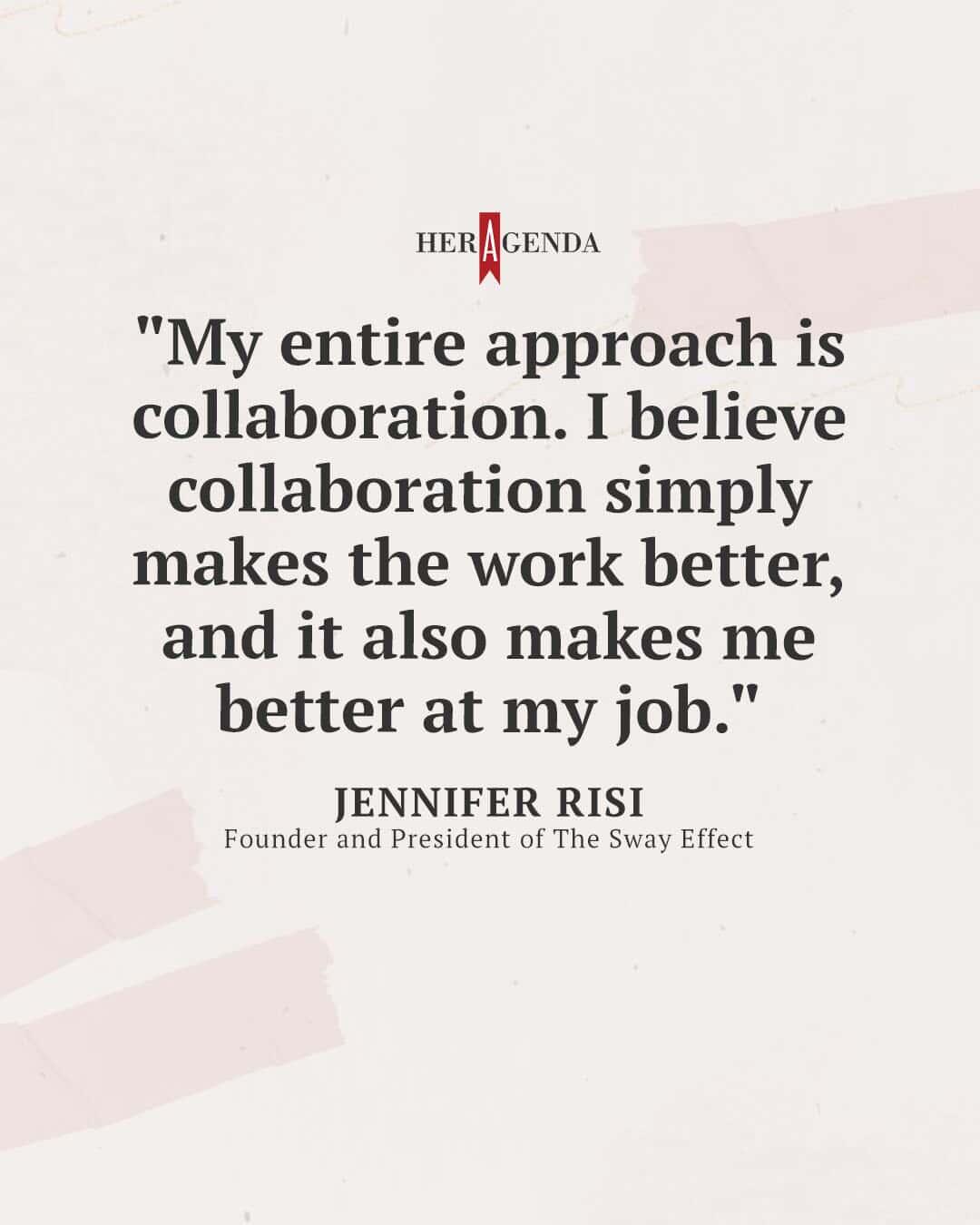
Jennifer Risi: When I started out, I didn’t really have a plan. I just knew that I wanted to leave my big agency job because I learned about glaring gaps that were not being addressed. There was a need from the brands I worked with for more agile, collaborative, purpose-driven agency models. These bigger shops had become so big that they got away from the work. So for me, it was really about how do we create a model that brings the best and brightest talent together, which was why I created a network. The Sway Effect is a network model, and when we started, we had six agencies, and now we have over 50. And the other thing is, I really wanted to champion D&I. I know that, seven years later, folks are getting away from D&I, but for me, it’s very central to how I work. I also advise my clients to make it central to their business strategy because inclusion just makes the work better. You can’t really have five white guys brainstorming a product for women of color, and I had seen that in my previous job.
Her Agenda: How does Sway Effect’s network company model work?
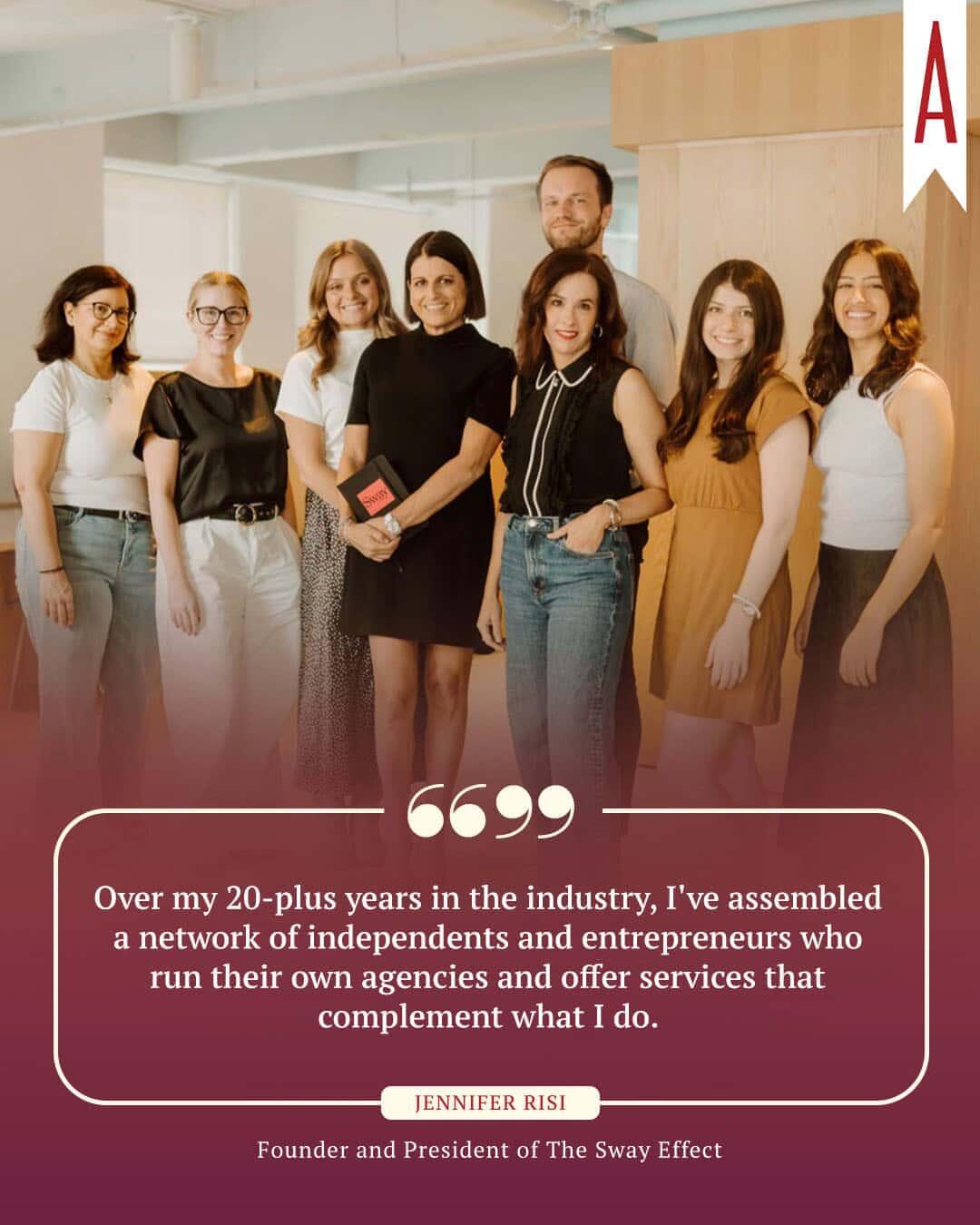
Jennifer Risi: I’m the PR expert, but our clients come to us wanting access to people who do creative campaigns, brand strategy, digital, and CSR. Over my 20-plus years in the industry, I’ve assembled a network of independents and entrepreneurs who run their own agencies and offer services that complement what I do. So no matter what the brief is, I can bring together the right team to deliver for the client. One of my first clients was Becton Dickinson in 2019. They needed more than PR; they wanted internal and external communications, CSR, and integrated communications. So, I assembled a team of experts, and we beat Edelman and Ogilvy for the account.
Her Agenda: So how did you grow the Sway Effect from a small business to a now million-dollar company?
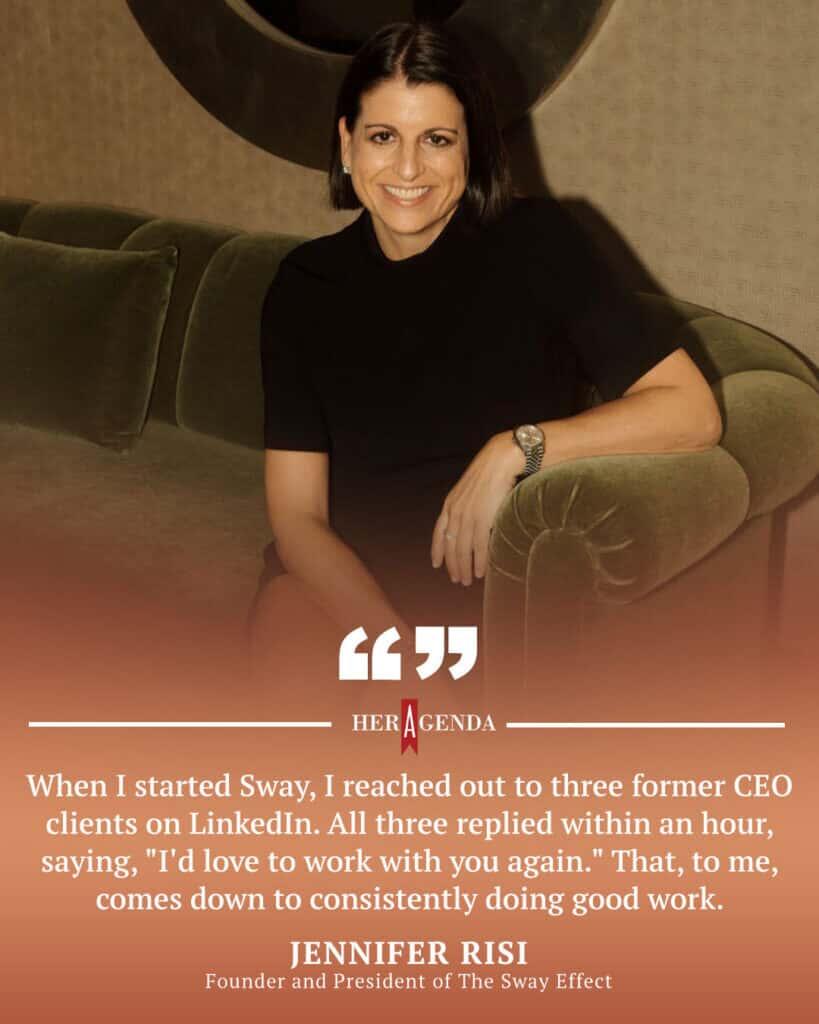
Jennifer Risi: I invested in the brand from the beginning. One of the first things I did was hire a branding agency to build a proper brand, with the Sway Effect design, colors, and brand guidelines. I also bootstrapped the business entirely myself. I own 100% of the company, so my focus was on maintaining high client retention and giving clients direct access to senior expertise. Anyone who works with Sway works with me. I grew the business by doing good work, and most of our clients have stayed with us since the beginning. Around 90% have been with us for more than five years, which is rare in PR. I think that’s because they see us as a strategic partner rather than just a vendor. I also invested in building the brand publicly. I hosted a major launch event, invited the right people, and even went on TV the day we launched. That helped establish Sway from day one, but what really gave us a strong start was the network I’d built over the years. When I started Sway, I reached out to three former CEO clients on LinkedIn. All three replied within an hour, saying, ‘I’d love to work with you again.’ That, to me, comes down to consistently doing good work.
Her Agenda: How are you pushing boundaries and changing the dynamics of PR? What does good public relations look like today?
Jennifer Risi: It’s no longer about chasing volume or media hits. It’s about driving business outcomes and protecting long-term corporate reputation. We’re helping redefine what great PR looks like, especially in an environment where it’s easy to cut corners with AI and other tools. I always joke that AI is a good C+ student; it can improve efficiency, but it doesn’t produce the best work on its own. I want to challenge my peers to do more and do better. PR should directly support a client’s business goals. It’s not just about securing coverage; it’s about what that coverage actually does for the business. That’s how I challenge myself and my team to think every day.
Her Agenda: What role does earned media still play in today’s media landscape, especially with algorithms and AI shaping how people consume information? Why does it still matter, and what shifts in the communications industry should business leaders be paying attention to?
Jennifer Risi: I think earned media is having a real moment. In fact, it’s never been more important because it provides objective, third-party validation for a brand’s story. In an era of AI and growing skepticism, that credibility matters even more. AI-driven search results rely heavily on non-paid sources. According to Muck Rack, around 85% of AI search results come from earned media. So when I talk to clients, I tell them that investing in PR today delivers even greater value because earned coverage increasingly rises to the top in AI search results.
Her Agenda: So looking ahead, what excites you most about the future of the communications industry, and what qualities do you think the next generation of leaders will need to succeed?
Jennifer Risi: People ask me every day how I think AI will impact what I do. My answer is that nothing will replace the value we provide to our clients. You’ll always need the human touch. AI can help with tasks like building press lists or monitoring the news, but it can’t replace advising a CEO through a crisis or developing the strategy that lands a major feature in The New York Times. Journalists tell me all the time they can spot an AI-generated pitch from a mile away. What excites me most is the democratization of storytelling through AI, combined with the industry’s growing role as a trusted strategic advisor to the C-suite. My job has never been more important. If anything, PR has a bigger seat at the table today than it did even a year ago.
Her Agenda: Diversity, equity, and inclusion seem to be central to your business strategy. Why is DEI so fundamental to your approach, and how does it strengthen creativity and the work you deliver for clients?
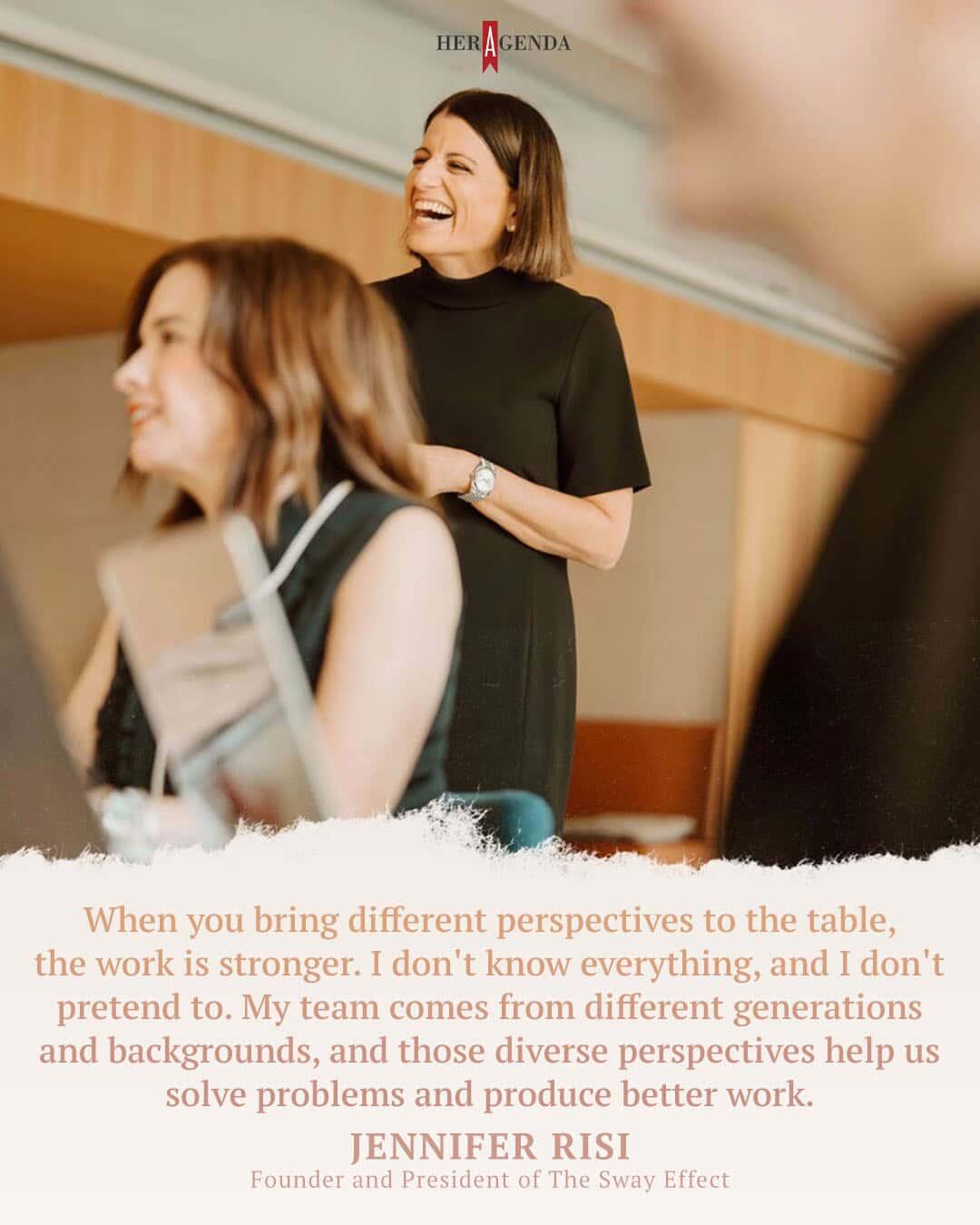
Jennifer Risi: It’s simple: it makes the work better. When you bring different perspectives to the table, the work is stronger. I don’t know everything, and I don’t pretend to. My team comes from different generations and backgrounds, and those diverse perspectives help us solve problems and produce better work. With everything happening politically and organizations scaling back their DEI commitments, we’ve chosen to double down on ours. And if someone doesn’t want to work with us because of our values, that’s okay. There will always be others who do.
Her Agenda: Yeah, that actually leads into my next question. With the growing backlash against DEI in the U.S., especially from the highest levels of government, how do you think companies can continue to implement DEI initiatives successfully?
Jennifer Risi: I’ve been saying this since I started Sway. I went on TV the day I launched the company, and one of the questions I was asked was about Uber because, at the time, they were in the spotlight. Their former CEO was still there, and they were dealing with a lot of DEI question marks around how they ran their business. The anchor said to me, ‘What can Uber do to prove they’re serious about everything they’re doing now?’ I said they should set some metrics, and then we should look back a year from now. If we look back a year later, let’s see what they’ve actually done to make the changes they’re saying they’re going to make. It can’t just be a PR stunt. Are they really changing the business? That goes back to your question. To me, it’s very much about identifying metrics from an inclusion and DEI perspective that are linked to business objectives and putting them into leaders’ KPIs. If KPIs are not attached to a leader’s or a business’s objectives, nothing will change. If your bonus or your salary isn’t linked to doing it, then it won’t become a priority.
Her Agenda: So now let’s talk about AI. AI is having a major impact on the communications and journalism industries. What do you think about that? Where do you think agencies should embrace AI, and where do you think they should resist it?
Jennifer Risi: AI is not going to replace us, as I said earlier. AI can help our PR teams be more efficient, freeing up teams to do more strategic work. So, where can agencies embrace AI? Predictive crisis management is one area. I do a lot of crisis work, and I leverage AI to help monitor real-time sentiment and model crisis scenarios. It allows me to see where the news is heading so I can develop the right strategies and be prepared when a story breaks. Another area is hyper-personalized media relations. I use AI to research journalists, the types of stories they cover, and the sentiment of their reporting. That helps me write a better pitch. The last area is advanced sentiment and ROI analytics. It’s about using AI to track behavior change, brand attribution, and message resonance across millions of data points. It can help us process data and become more efficient, but you still need a human being to interpret that data and develop the strategy.
Her Agenda: You’ve collaborated with a lot of brands, from Stanley to PopSockets, and you also mentioned Becton Dickinson earlier in this interview. How do you approach building and maintaining strong client relationships—from winning new clients to earning their long-term trust?
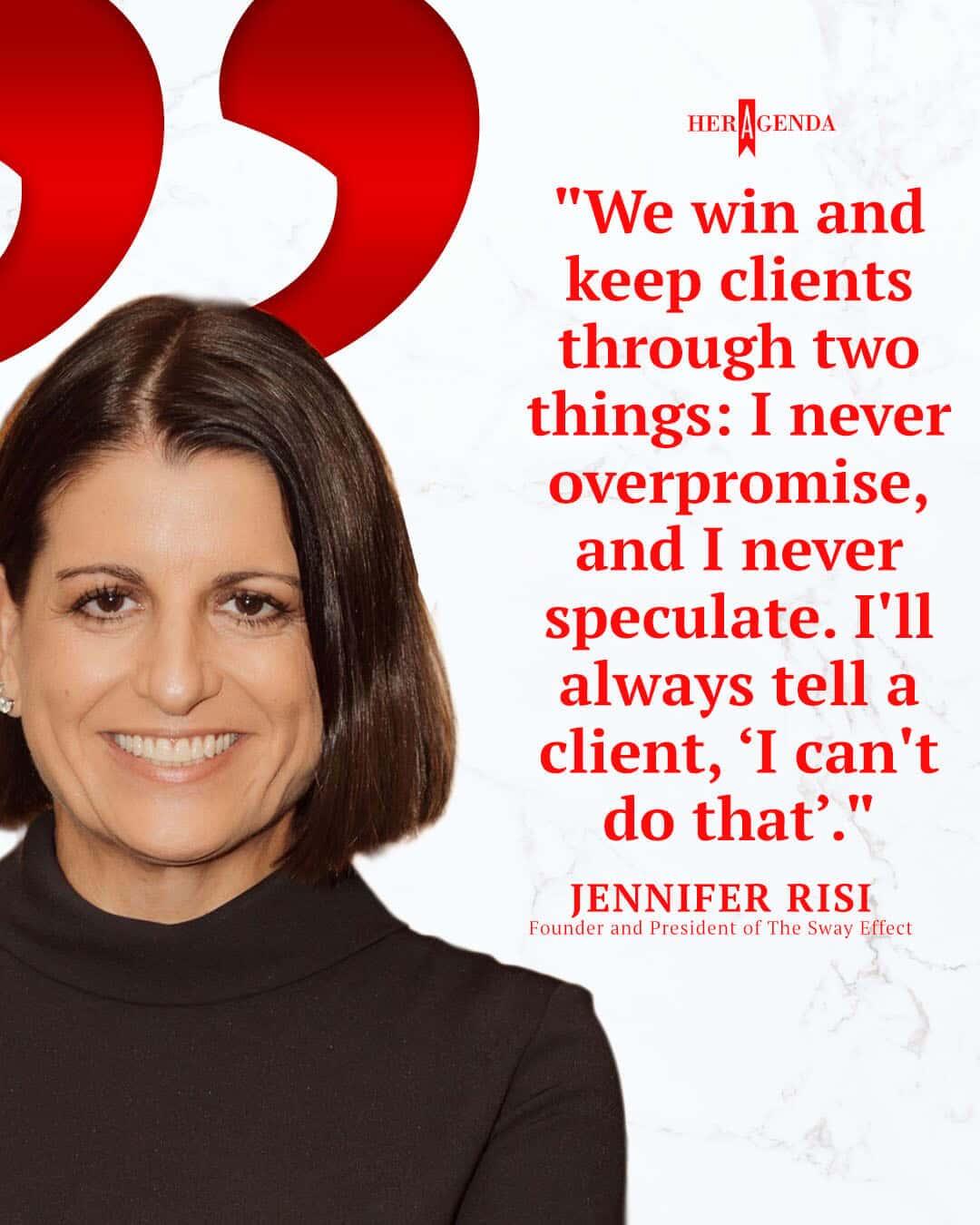
Jennifer Risi: Well, I think we win and keep clients through radical honesty. Sometimes that’s a good thing, and sometimes it’s a challenge. But I believe you are who you say you are, and your actions need to reflect that. When people hire me, I’m the same person they met on the day they decided to hire us, all the way through to the day we might no longer work together. I’m extremely consistent. I’d also say we win and keep clients through two things: I never overpromise, and I never speculate. I’ll always tell a client, ‘I can’t do that.‘ And if they say, ‘Well, someone else said they can,‘ I’ll respond, ‘Then hire them, because I can’t.‘ But I always offer an alternative: ‘Here’s what I can do.’ I think overpromising, first of all, leads to anxiety, and it also sets you up for failure. So why do that? The second thing is that what you see is what you get. When you come to Sway Effect, you get me. I lead all the client work, and I’m involved in every client engagement. That’s why I’ve kept the team the size it is.
Her Agenda: When it comes to your clients and the work you do, what has been your most notable and memorable creative campaign?
Jennifer Risi: Well, some of the recent work we’ve done is for Becton Dickinson. We’ve done a lot of work around helping educate women that cervical cancer is one of the most preventable cancers in the world. If you’re tested, it’s highly preventable, but if you’re not, it can be deadly. That type of work meant a lot to me personally.
Another client I work with is Stanley 1913. I handle their corporate communications and issues management. My role is helping them navigate challenges like the lead crisis and product recalls. I’ve helped make sure the brand is protected and positioned well so it can continue growing while the fun campaigns, like the collaborations with Kacey Musgraves, Post Malone, and Lionel Messi, can happen. My job is to manage the difficult moments so the good moments can happen.
The third example is a brand called Kindred, which we recently started working with. Kindred is a home-swapping platform. Think of the movie The Holiday, where Cameron Diaz and Kate Winslet swap homes; that’s essentially what Kindred does. We’re helping bring that concept to the United States and build people’s comfort level with opening up their homes and participating in home swapping. We’ve helped the client raise capital, but we’ve also helped grow its community of users on the platform. More recently, we launched their Women’s Circle because so many women travel on their own, and safety is a major concern.
Her Agenda: My second question is about the collaborations you do with other companies. I think the most recent one I saw was your collaboration with M&C Saatchi Group North America. How do you approach collaborations like that? What makes a partnership successful, and what do you look for when deciding to work with another company?
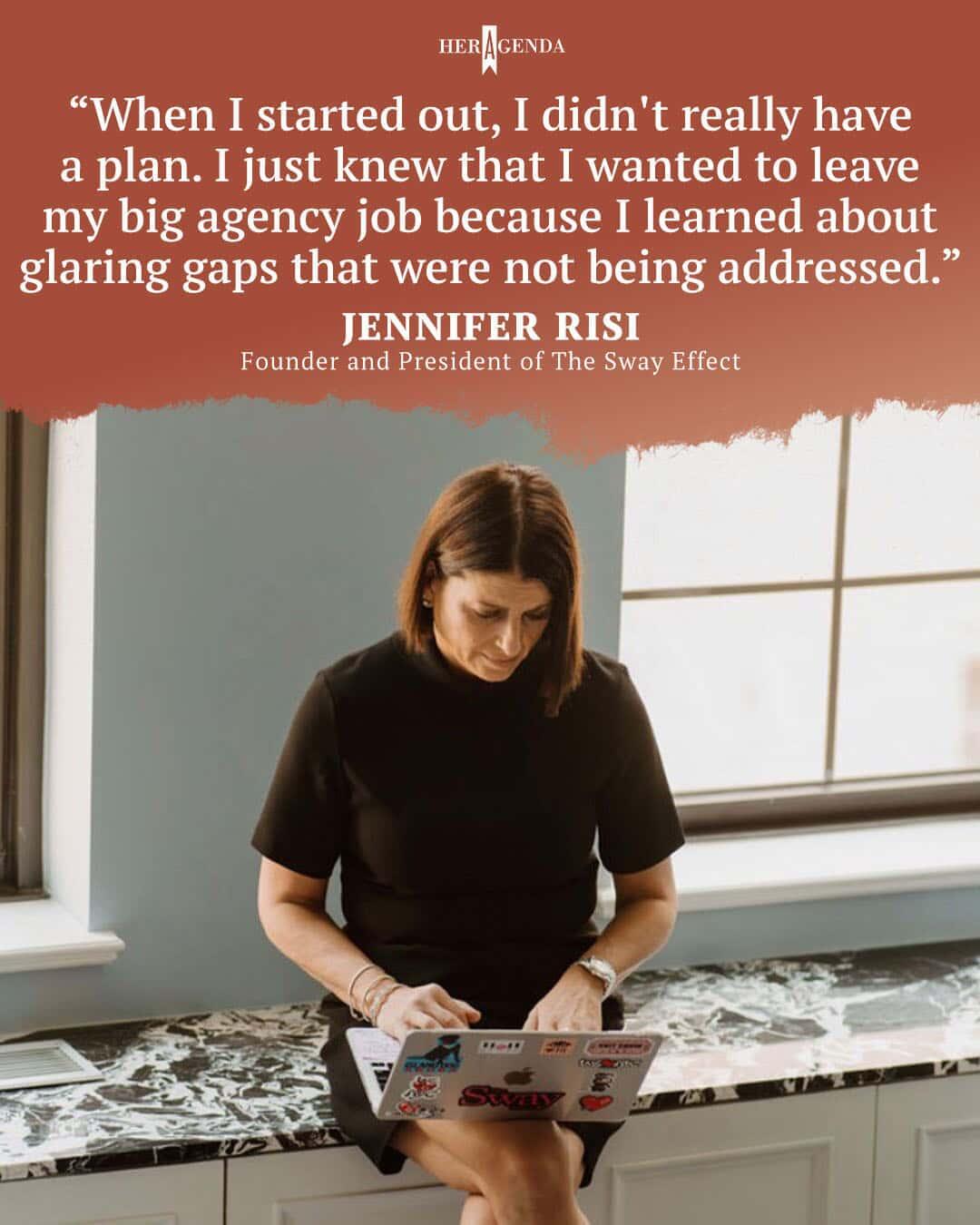
Jennifer Risi: My entire approach is collaboration. I believe collaboration simply makes the work better, and it also makes me better at my job. We treat partner agencies as equal partners, and we integrate them as co-owners of a shared client challenge. We evaluate the client’s problem first and then recruit the right team to be part of solving it. Every agency sits at the same strategic table and has a direct line to the client. I don’t need to own the relationship, even if the client came through me. We all share it. Anyone who hoards information or tries to own the relationship is a red flag. There’s shared accountability, shared success, and shared investment. If things don’t go well, we solve the problem together. It’s a collaborative team environment.
Her Agenda: How has your approach to leadership evolved since founding this Sway Effect?
Jennifer Risi: Leaving Ogilvy enabled me to transition into more of an entrepreneurial facilitator, someone who orchestrates and brings together the right teams to address a client’s challenge. It’s about knowing my craft while also bringing the right people to the table for the brands I work with. It’s not just about me; it’s about doing what’s right for the business.
Her Agenda: Independent agencies have gained significant momentum in recent years. What do you think clients are looking for today that may be different from five or 10 years ago?
Jennifer Risi: Well, I think clients were always looking for it, but they felt safer with the bigger agencies because they had larger infrastructure, and there seemed to be less chance of them running into an issue they couldn’t handle. Now, I think they’ve realized there are a lot of boutique and up-and-coming agencies that can do everything the holding companies can do, and sometimes even more. Clients are really looking for agility, commercial accountability, and direct access to senior leaders like me. The shift toward independent agencies is being driven by a rejection of the slow, layered holding-company model that dominated the industry for so long. When I worked at Ogilvy, it could take weeks to get a decision made. It was just too slow, and that doesn’t work anymore.
So I’d say the first reason is speed and radical agility. Markets shift quickly, and agencies need to pivot instantly, launching tests and iterating campaigns in days rather than months. If something happens in the news, we have to respond immediately. I was in a meeting this morning where a CEO was preparing for an interview with Fortune, and the entire conversation shifted because of what happened in the news over the weekend. You simply have to be able to do that.
The second reason is the elimination of the bait-and-switch. I go to the pitch, and you get me. At many larger agencies, the senior executive pitches the business, but then the client is handed over to a junior team. Nobody wants that anymore.
And third, it’s about consolidated, cross-functional expertise. Managing multiple agencies can create gaps, so clients increasingly want one partner who can bring everything together across a cohesive, multidisciplinary team. With us, clients get the best of both worlds. I came from the big holding-company world, so I understand how it operates, but I also know what it takes to be an independent practitioner.
What is your personal motto?
Jennifer Risi: Listen to your gut. It’s always right.
[Editor’s note: This article has been edited for length and clarity.]