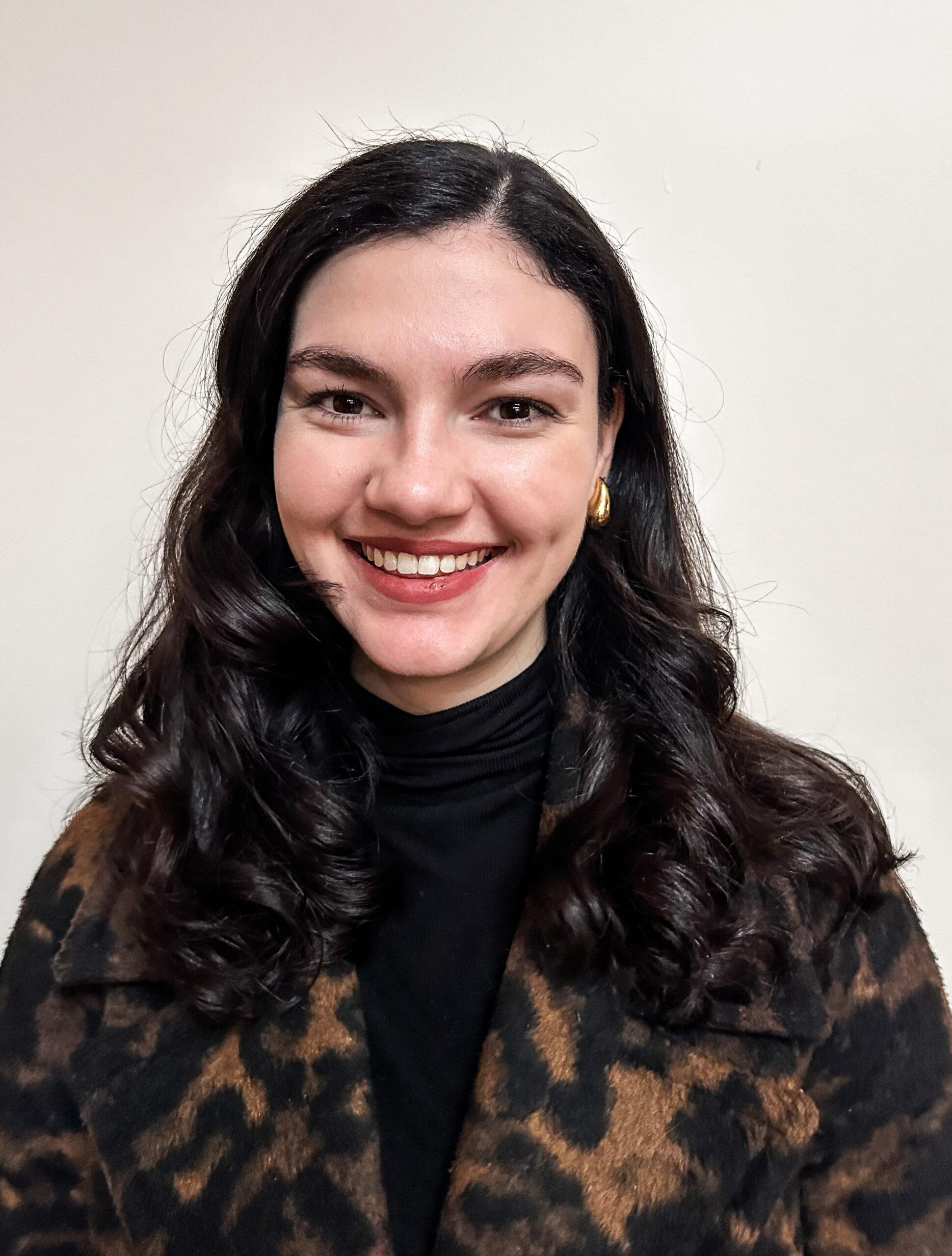






When Kara Ball was a child, she transformed her basement into a pretend classroom. She had a teacher’s desk, stacks of handouts, and her siblings as students because even as learning felt twice as hard, her passion for teaching was undeniable.
Today, Kara is an academic officer, PhD researcher studying gender inequity in STEM, and nationally recognized advocate reshaping how students with learning and thinking differences experience science and technology education. Nearly 20% of school-aged children experience learning or thinking differences such as ADHD or dyslexia.
Her work bridges lived experience and research, translating what often stays academic into practical, scalable solutions for classrooms across the country.
From navigating her own diagnoses of dyslexia, dyscalculia, ADHD, and autism to becoming an academic officer and PhD researcher, Kara has built a career focused on designing learning environments where neurodivergent students are no longer accommodated as an afterthought, but centered from the start.
In this conversation, she shares how she transforms classrooms into spaces where students who think differently thrive, how receiving the Bezos Courage and Civility Award amplified her mission, and how she is scaling her impact through Understood For All, a leading non-profit organization, to reach thousands more learners.
Her Agenda: Can you share your personal professional background and what first drew you to a career in education?
Kara Ball: I grew up as a student with learning and thinking differences and always felt behind in school. Everything was twice as hard as for me, but I loved school — so much so that I actually had a pretend classroom in my basement. I had a teacher’s desk, and I would hoard all the handouts from my teachers, take them to my pretend classroom in the basement, and I would make my poor siblings and my dad suffer through my summer school and weekend schools.
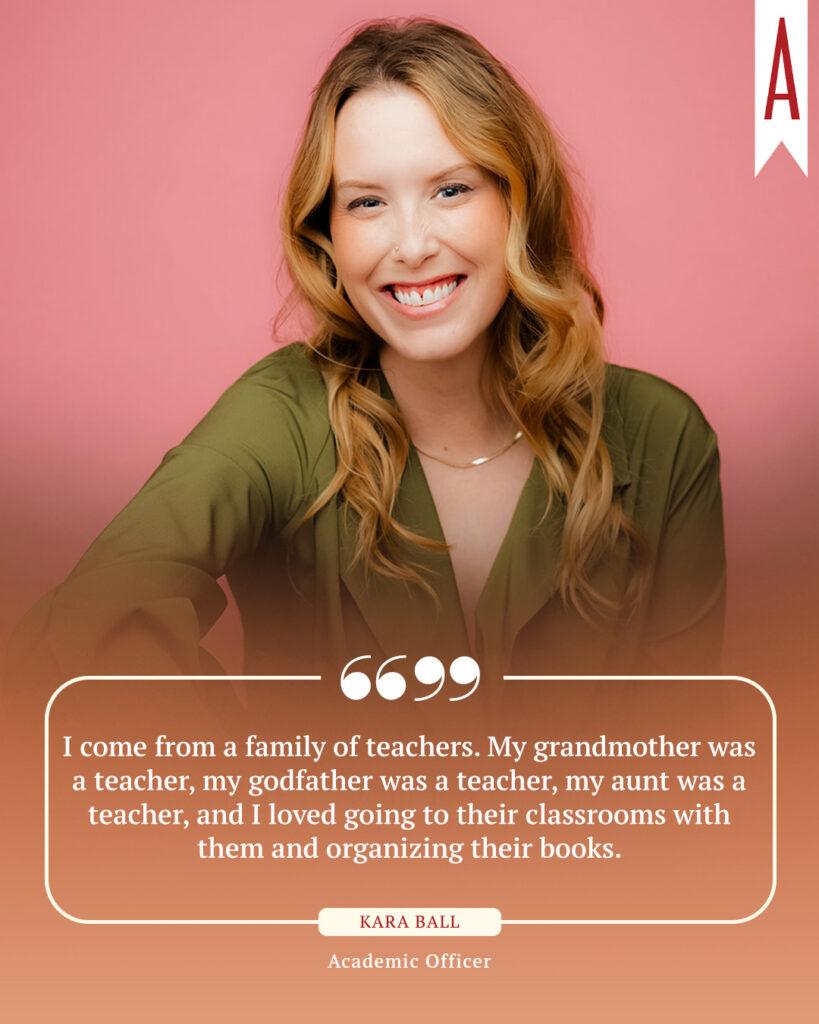
What I ended up discovering is that teaching felt really natural for me, even when learning didn’t. I come from a family of teachers. My grandmother was a teacher, my godfather was a teacher, my aunt was a teacher, and I loved going to their classrooms with them and organizing their books.
I also really valued the support that they gave me outside of school to help me not fall significantly behind my peers. I wanted to grow up and be like my grandmother. I wanted to be a teacher. By second grade, I knew that’s what I was going to do. I wanted to pursue that. I became a camp counselor. I would teach swimming lessons. I worked in a daycare. I did all of the steps to becoming an educator, even when school was really, really hard.
Early in my childhood, I was diagnosed with dyslexia and dyscalculia, but didn’t have my autism or ADHD diagnosis until adulthood — something that’s really common for women. Those diagnoses really shaped my path into education. They also helped me to understand my personal experiences and what my students would go through. Together, they inform how I show up for my students.
Her Agenda: You were honored with the Bezos Courage and Civility Award. What did that recognition mean to you personally and professionally?
Kara Ball: Personally, it’s deeply meaningful. It acknowledges all the work that I do, both as an educator and as somebody with learning and thinking differences.
Those invisible things, advocating for students who are misunderstood or overlooked, but also as a PhD researcher who’s studying gender inequity in STEM education and looking at how early opportunities can help encourage people to persist and pursue — not just STEM careers.
It’s also about being problem solvers and seeing the future as something that they can make and create. Being able to use this grant to be able to fund the work that we already started with Understood For All and taking something that might have lived on a bookshelf as research and being able to scale the impact for even more students, especially those with learning and thinking differences, is incredibly important.
Being able to provide more resources is something that I’m really excited about.
Her Agenda: How do the values of courage and civility show up in your day-to-day work with students, educators, and communities?
Kara Ball: Courage to me is continuing to push for students who sometimes are really easy to dismiss as just not knowing or understanding, because I was that kid in the classroom.
I always describe my learning experience as like a puzzle. So if you look at the puzzle pieces on the front of a box, you get the big picture. [But] I was a student who was caught in the details, all of the pieces. So if a puzzle comes with 500 pieces, I need to lay them all out. I need to organize them. I need to put them into patterns and into groups in order to understand the concept.
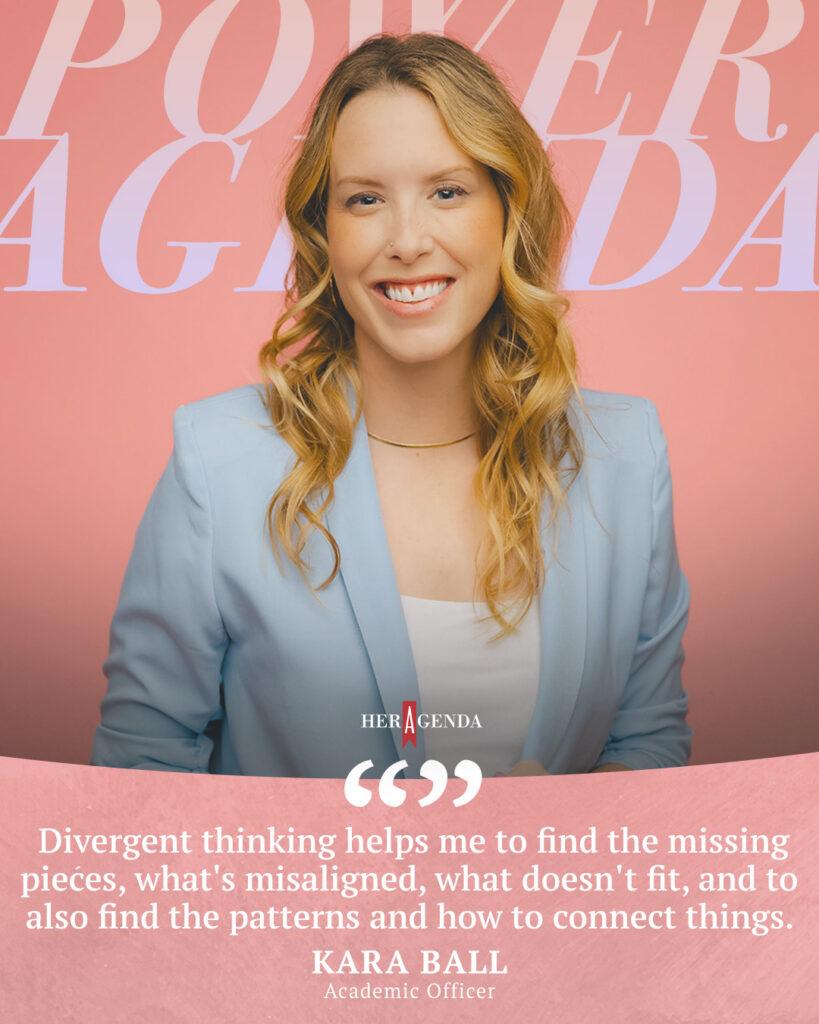
I find that today, even in my work, I still am somebody who’s in the pieces and can’t just work with the big picture. However, that divergent thinking helps me to find the missing pieces, what’s misaligned, what doesn’t fit, and to also find the patterns and how to connect things.
Being able to think like that helps students with learning and thinking differences, as somebody who had an Individualized Education Program, who became a academic officer, and an advocate as an adult, is really where the courage comes from.
Civility is the idea that doing this work helps us to build an understanding rather than a defensiveness around it. It’s that balance of being able to support the students who learn and think differently in the classroom.
Her Agenda: You’ve spoken openly about being underestimated early in your education. How did those experiences shape your confidence and sense of purpose?
Kara Ball: It was really hard to have those kinds of teachers, especially in mathematics, which is one of the hardest subjects for me.
If I didn’t answer quickly or if I didn’t answer in a way that was expected, then the assumption is that I didn’t know the concept. Rather, when I just needed more time to process, I needed more detail, I needed the pieces, I just needed to be able to explain things differently. That wasn’t an opportunity that was often presented to me.
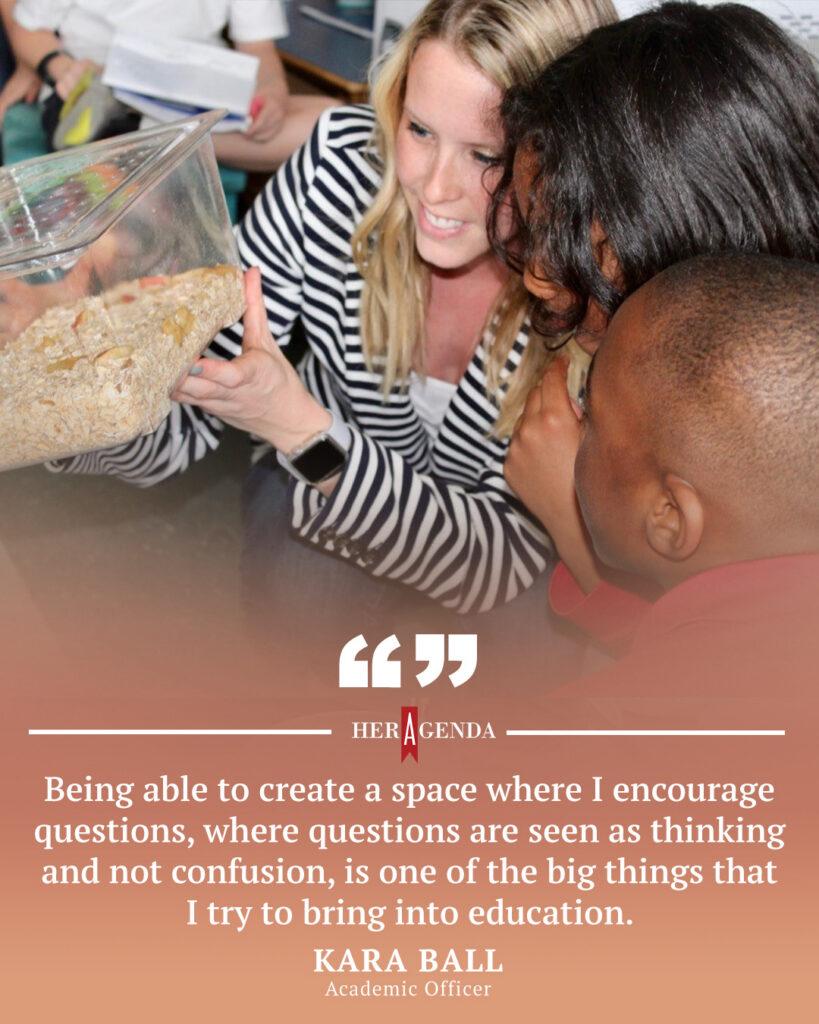
I’m somebody who always wants to ask the questions. It’s how I made sense of the world then, and it’s still how I make sense of the world today. Being able to use STEM education as a lens to help students who learn and think as I do, but also all students, being able to create a space where I encourage questions, where questions are seen as thinking and not confusion, is one of the big things that I try to bring into education. It’s one of the things that was underestimated about me, that she’s asking all these questions because she doesn’t understand. I’m asking questions because I’m trying to seek clarity and to understand everything going on.
I’ve always had this unquenchable thirst for learning, which is my version of autistic hyperfixation. If I see something that I don’t know, I have to look it up. I want to read the book, go to the museum, and I want to see if I can learn how to do it.
Although my teachers always just thought I came across as stubborn and asking too many questions, and wasn’t doing the work, and wasn’t doing it as expected, and that was really, really hard. School became really hard, I didn’t feel like I belonged, I didn’t feel like I fit in.
Her Agenda: In what ways has being underestimated like that influenced how you advocate and support students today?
Kara Ball: When I get a chance to advocate for my students, I always try to look at what their strengths are and try to identify where that divergent thinking can help us.
I had a student who was always getting in trouble for hacking our computers in the school, and I ended up teaching them for multiple years, and I was thinking, okay, so he’s really good at computers. Has anybody thought about tapping into that? I was able to get our principal to give him a special job in the school building, where he became our IT support.
Anytime a teacher couldn’t figure out how to get the printer to work, or couldn’t get the HDMI cable to connect to the Promethean board, why don’t we call the student down and have him fix it? All of a sudden, he stopped messing with the computers and started fixing them.
Just seeing that there are strengths in everybody, sometimes we just have to tap into them and celebrate them. That’s the thing I look for. The thing I love doing in my classroom is looking at possibilities instead of predicted outcomes. What are the possibilities for the things that our students are capable of? It’s not what I assume they should be able to do, but what are they actually capable of doing?
Her Agenda: Why is inclusive hands-on STEM education so critical for students with learning and thinking differences?
Kara Ball: Inclusive STEM education is important because those students are typically always going to be your divergent thinkers. They’re really good at persisting, because for me personally, as somebody who experienced STEM with my dad, I already knew how to fail and come back from it, to learn from my mistakes, to try, try again… that trial and error iteration.
When I taught STEM education, my students who had learning and thinking differences, who had IEPs, were resilient. They had great, really incredibly creative ideas. They were willing to try things. They weren’t afraid of failing, whereas my other students were hesitant. They didn’t want to make a mistake in front of their peers. They were worried about what everybody would think.
They had to have all the information and the right information, and they were focused on perfection, where my neurodiverse students were like, let’s try this. They would ask, ‘have you thought of that?’
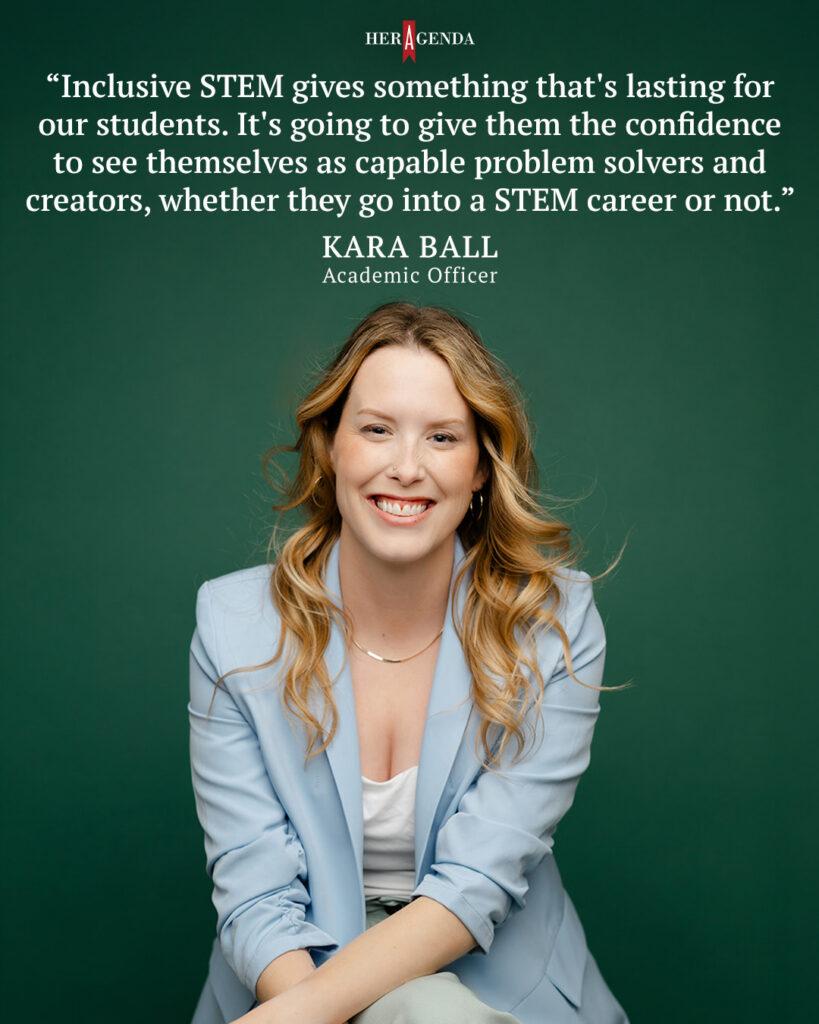
One of the things that I love about STEM education is that it’s not about a career. Inclusive STEM gives something that’s lasting for our students. It’s going to give them the confidence to see themselves as capable problem solvers and creators, whether they go into a STEM career or not.
Her Agenda: What barriers do these students often face in traditional STEM learning environments, and how can educators work to remove them?
Kara Ball: STEM is abstract, and that can be really hard if you’re somebody who needs to see all the pieces and needs to have all of the information. My STEM classroom was also noisy, and there were a lot of sensory experiences. The 3D printer’s running over here. It smells like waffles. It’s loud. They’re expecting you to do something with slime or a sticky material. There are a lot of steps. There are a lot of things that are moving, and because it has the space group creativity, this group might be doing one thing over here. This group is doing something different over there, and you’re allowed to get up and move around the room, so there have to be supports in place.
You have to have the option for them to wear gloves if they don’t want to touch something that is slimy. I’m an anti-sticky person as well, so I would always model wearing the gloves. I have headphones and earplugs. I have designated spaces for where materials go. I have the engineering design process on the board, and showing where they are in the process. I have checklists that they can check to make sure they’re meeting the criteria, and these aren’t things that benefit my students who are neurodiverse. These are things that benefit everybody in the classroom, and help them to be able to see themselves as those problem solvers.
I like to use criteria and constraints as guardrails. Criteria is what you have to do to meet my requirements. Constraints are kind of the boundaries. Do you have a time limit? Is there a material limit? Those are bookmarks, and everything that comes in between those two is where the creativity exists, and my neurodiverse students are so creative, and I love that I can create that space for them.
Her Agenda: You chose to designate your Courage and Civility Award funding to Understood For All. What made this organization the right partner for this investment?
Kara Ball: It was the easiest choice. I’ve been working with Understood since 2019. I started with them as a teacher fellow and stayed on as an expert.
Understood always centers around the lived experience of people who learn and think differently, and translates that understanding into actual, practical supports for family and educators. I wanted this investment to go somewhere that could immediately support students, and we could scale that impact, and Understood does this every single day. They provide free expert vetted resources that support people with learning and thinking differences like ADHD and dyslexia, and 70 million people in the U.S. have learning and thinking differences, so that impact is going to be significant.
Her Agenda: How do you think the grant will help expand inclusive STEM resources and reach more students, educators, and families?
Kara Ball: This is going to allow us to expand the work we already started with $5 million on inclusive STEM education. We’re going to be able to get resources to more educators so that they have the tools that they need, so that more students can actually access learning experiences that build that confidence and the sense of belonging.
Our focus is on early meaningful STEM experiences because when students feel capable early on, they’re far more likely to persist, and we’re really excited to be able to start using the time this year to plan that out, and then to start creating those resources in the coming years.
[Editor’s note: This interview has been edited for length and clarity.]