









Journalist turned attorney Kimberly Russell combines her passion for storytelling and law as the force behind multi-million-dollar civil rights victories. The daughter of two journalists, Kimberly’s foundation is firmly rooted in media, law, and civil rights, leading her to create her own firm, The Russell Firm, in 2024. Throughout her career, Kimberly has interviewed civil rights icons, including James Meredith. She has collaborated with firms on major lawsuits, including the Johnson & Johnson case and the landmark civil rights trial on behalf of Officer Mohamed Magassouba. An advocate for equity and equality, the DC-based attorney has dedicated her career to making sure that everyone has their voice heard in court.
Her work on a larger scale has contributed to more than $80 million in verdicts and settlements across 10+ jurisdictions, earning her recognition from the American Bar Association, the Mississippi Business Journal’s 50 Leading Business Women, and others for her devoted leadership and advocacy.
In this interview, Kimberly spoke with Her Agenda about how journalism has helped her career as an attorney, starting her own firm, and what fuels her enthusiasm for law.
Her Agenda: Can you tell me about your journey from the media to law?
Kimberly Russell: I grew up in a household of journalists. My dad was a news producer and then a news director, and my mom was an investigative reporter who later became a TV anchor. They worked at the same news station in Columbus, Georgia, where they met. I studied communications and became a news producer for the ABC affiliate in Tulsa, Oklahoma, before I went to law school. I then decided that I wanted to go to law school and worked overnights as a morning show producer. I then became a law student in 2016, so I was studying for the LSAT while I was working overnights and applying to schools.
Her Agenda: How has your background in journalism helped you navigate your career as an attorney?
Kimberly Russell: It’s been incredibly helpful, and it has set me apart as a litigator. Because I started out as a journalist, as a news producer on the morning shows, I had to get really good at quickly synthesizing a lot of complex information and then making that explainable to the general public in a short amount of time. Every night, I would go in at 10 p.m., and start figuring out how I wanted to stack my show. I would research, I would write, and then I would have everything ready to go for the anchors to read by 3 a.m. That directly translates to how I litigate my cases. Those skills have allowed me to figure out who my audience is, whether it’s a juror or a judge, and how they’re going to receive the information, and how I get them to understand and care about the issues that I am advocating for. It’s been hugely helpful in framing narratives and framing how cases go forward. It’s also been really helpful in understanding research and complex litigation because I work in a lot of complicated areas of law. I’ve done everything from civil rights to work with the EPA (Environmental Protection Agency) and then litigation involving complex torts. Being able to get up to speed on scientific issues and civil rights issues quickly is a huge skill that journalism has helped me build.
Her Agenda: What do you find to be a key ingredient to having a successful career in law, and why?
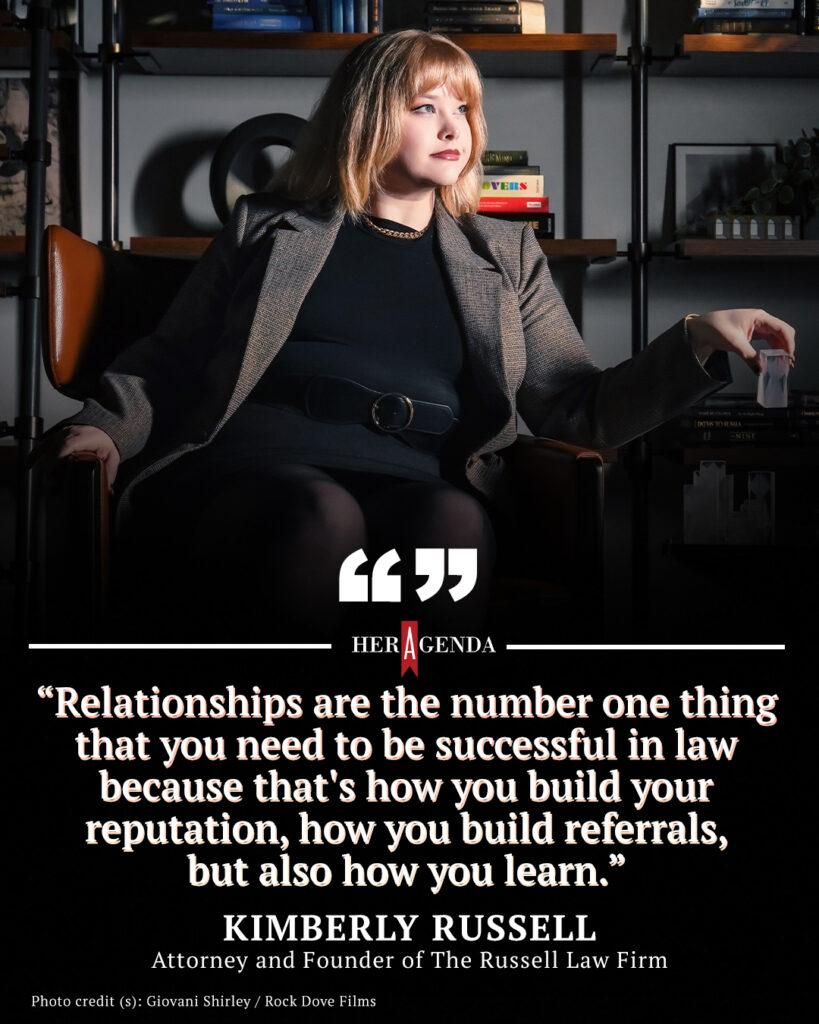
Kimberly Russell: Relationships. Relationships are the number one thing that you need to be successful in law because that’s how you build your reputation, how you build referrals, but also how you learn. I wouldn’t be who I am today without the friends and mentors that I’ve had, who have given so much of their time to talk to me about different things I need to do to become a better attorney. It’s important to treat everyone with dignity and respect, whether it’s your friends who are attorneys, judges, staff, or opposing counsel. The only way that you can come to great resolutions in cases is when you are working in a way that respects and uplifts everyone.
Her Agenda: Can you tell me about your law firm, the Russell Law Firm, and when you started it?
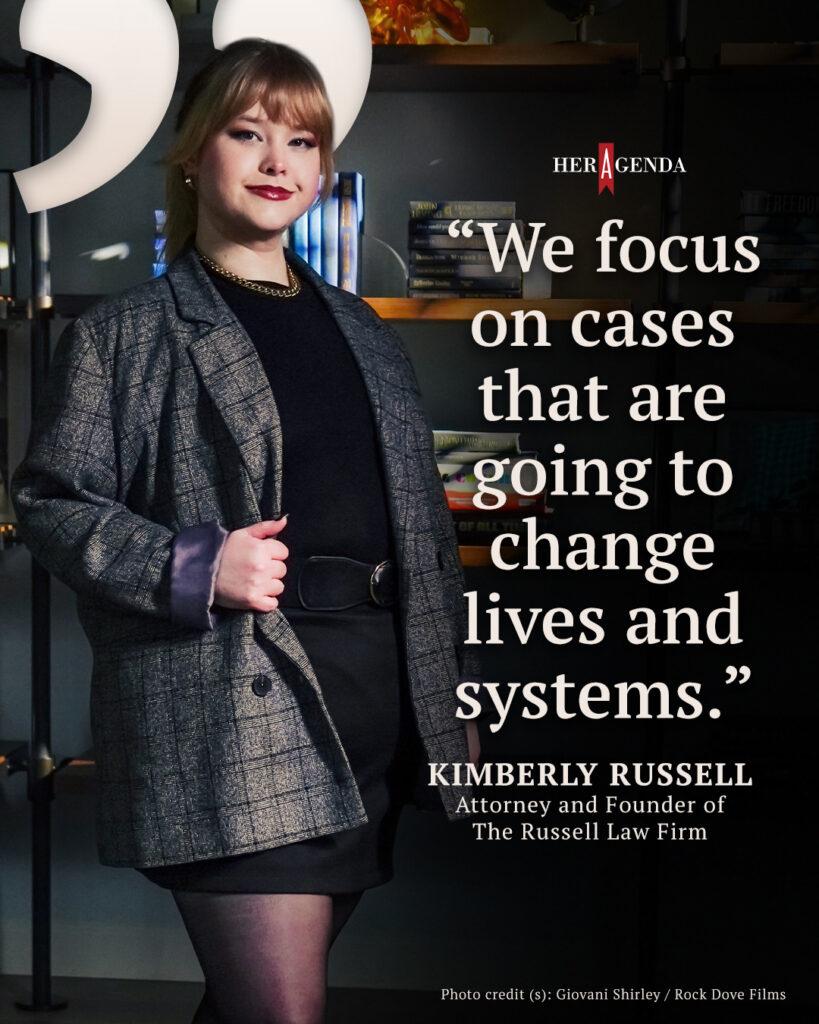
Kimberly Russell: The Russell Law Firm is still fairly young. We started in May of 2024, and it’s really been me in my living room. I’ve now started to expand and hire people. I’ve built a seven-figure practice dealing with eight-figure damages cases. We focus on high-impact litigation that lives at the intersection of really, really impactful high stakes. What I mean by that is, and not to sound duplicative, is that we focus on cases that are going to change lives and systems. That often requires a more coordinated approach beyond just high-stakes litigation. We’re looking at the entire game board of how does public policy impact this? What is going to play out on a press stage? How do we implement strategy, and who do we talk to and pull in to get the outcome that we need? We want to focus on taking more cases that are about framing the narrative and helping people get the best outcome that they can in that way.
Her Agenda: You were second chair counsel on a civil trial regarding Officer Mohamed Magassouba. What was that case like for you?
Kimberly Russell:In September, we had a civil rights jury trial in Maryland, and it was a case involving discrimination and retaliation, and the jury awarded a $2.3 million verdict in favor of Officer Magassouba. As a result of the litigation that the county faced in this capacity, it forced a lot of systemic change across the police department as far as leadership, which is exactly why I do the litigation that I do.
I want what we do to have a lasting impact beyond just the lawyering that I do. Being a part of that jury trial was a lot of hard work, but it was a lot of fun, and it was a huge honor to be a part of something so big. We got to help Officer Magassouba reclaim his reputation that had been tarnished. We got to give him his day in court to stand up against the people who have mistreated him.
Also, getting to work with first chair Jordan Hallett was incredible because I got to see and be a part of developing strategy in a way on trials that I hadn’t been a part of yet. We got to be really creative with how we were developing opening statements, the technology that we were using. It was an incredible opportunity to collaborate in this specific way of systemic change through a whole game plan of the high visibility of the case.
Her Agenda: What has starting your own firm taught you about yourself and your work ethic?
Kimberly Russell: I’m the master of my own destiny. Before I opened my firm, I didn’t see owning a business in the cards for myself. I felt like it was the right move for me to do. Ever since I did it, I can’t see not having a seat at the leadership table going forward. This has taught me that I thrive within strategy and high-level coordination, and that my creativity is my biggest strength. It’s been a hard-fought process to agency and ownership. It’s created a monster, if you will, of how much I enjoy doing things in a way that I see will get the job done. That has been so much fun and freeing to be a part of.
Her Agenda: What is your goal or hope for the Russell Law Firm within the next few years?
Kimberly Russell: We aim to expand our operations, which includes establishing a presence in Pennsylvania. We will always have a presence in D.C. because the firm operates nationally. I am barred in two different jurisdictions and admitted to several other federal courts. Our sweet spot is national complex litigation. We would like to establish a presence in Pennsylvania going forward.
From there, we want to be known as trusted advisors and attorneys who can strategize on the entire game board. When we’re looking at somebody who comes into the door, whether it’s a retaliation case and we’re looking at the reputational damages, or we’re looking at advising a nonprofit on how they’re being targeted for the services that they offer. We want people to know that we are here to handle those really complex, high-stakes, reputational issues in a way that sees everything. We’re not just looking at what discovery requests are due tomorrow; we’re looking at how this serves your overall end goal.
Her Agenda: What would you say was a major milestone in your career?
Kimberly Russell: The jury trials were huge milestones for me in completely different ways. With the Magassouba verdict, that was me getting to sit in the driver’s seat, or at least in the passenger side, being able to put some pedal to the metal on that one. Being able to assist with everything from opening statements to voir dire to thinking about how my journalism experience helps shape this narrative in front of this jury? Getting to have that hands-on experience of shaping the trial was just unbelievable. I think about how much I enjoyed being in that space and how I’d like to have more cases that go to trial or assist on more cases that go to trial.
I also think a lot about my time in Pittsburgh, and about the people and all of the respect for the process of the rule of law there. I think about how that was the first time that I really experienced this system that we have in motion. I remember sitting in that courtroom and just appreciating what it meant to be able to litigate and to be able to have your case heard.
Her Agenda: What is an aspect of your career that you found challenging, and how did you overcome it?
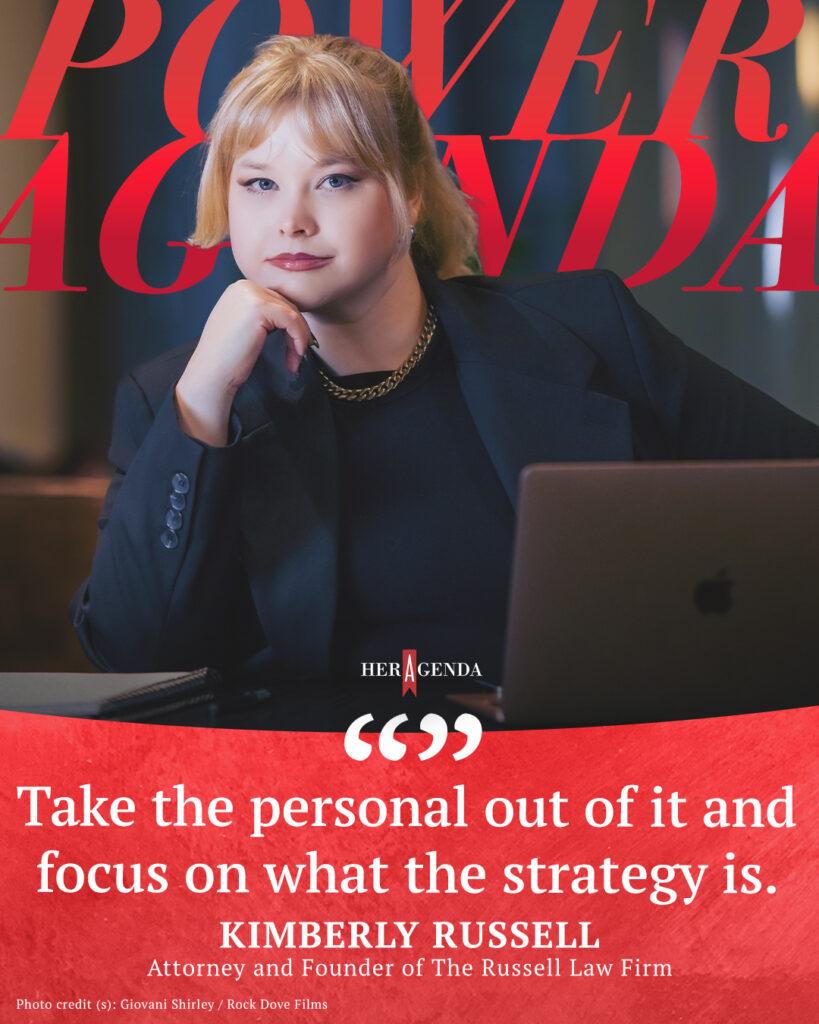
Kimberly Russell: There’s always a new thing to figure out. The key to overcoming those challenges is to take a step back and take the emotions out of whatever the response is. If you’ve got an unfavorable ruling from a judge, take a minute to lick your wounds and then come back and say, all right, what’s our next step? If you’ve got really aggressive opposing counsel that’s sending you a lot of emails, you need to take a step back and say what’s actually going to further my goal for my client here? Let’s take the personal out of it and focus on what the strategy is.
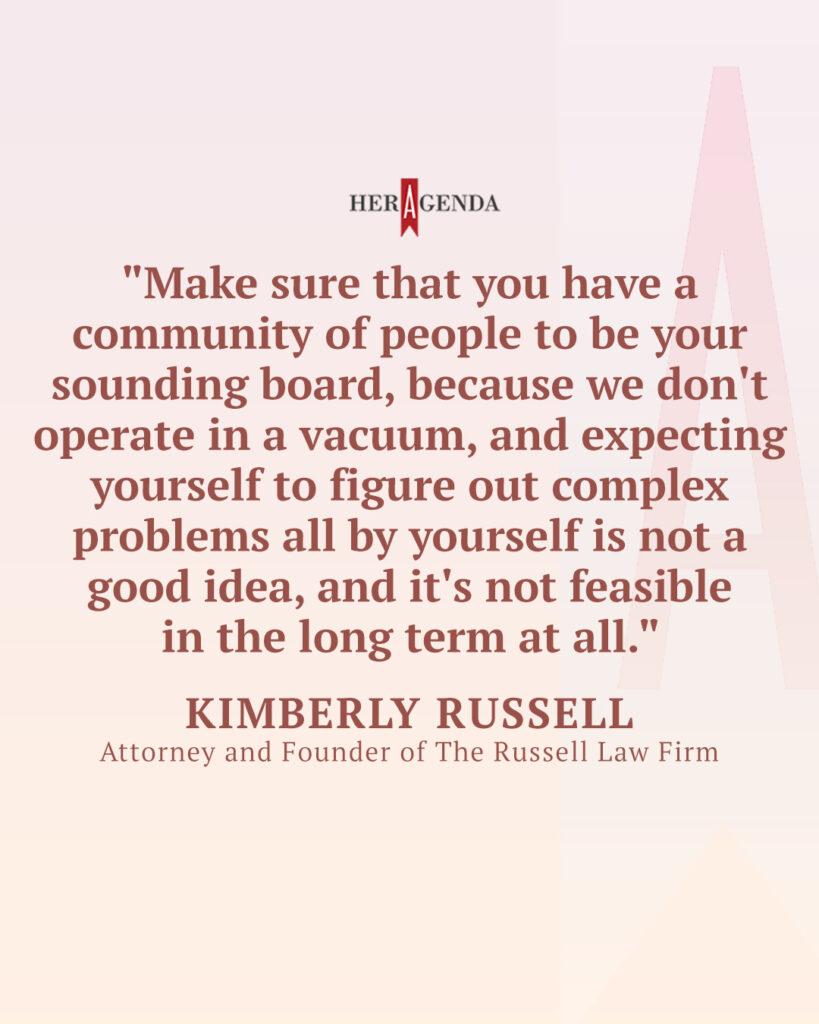
For me, it’s always taking that step to breathe before you respond and think about what the long-term goals are. The other really important part is [to make] sure that you have a community of people to be your sounding board, because we don’t operate in a vacuum, and expecting yourself to figure out complex problems all by yourself is not a good idea, and it’s not feasible in the long term at all.
Her Agenda: What fuels your passion for law?
Kimberly Russell: I’m a perpetual advocate for equity. I am somebody who wants to make sure that every person has as equal a footing as possible. I think that our system, however flawed it may be, is a fantastic tool to make sure that everyone has their day to be heard. Sometimes it takes a lot more to be heard in court. It’s not always an instant moment. Litigation takes a long time to get to trial, but it gives people a fighting chance. We litigate against people who hold the power. We litigate against the corporations of the world that have made bad decisions and caused irreparable harm to the everyday working person. We litigate against people who were supervisors and employers and have ruined people’s lives in an illegal way. We bring cases to protect communities from dangerous conditions and environments.
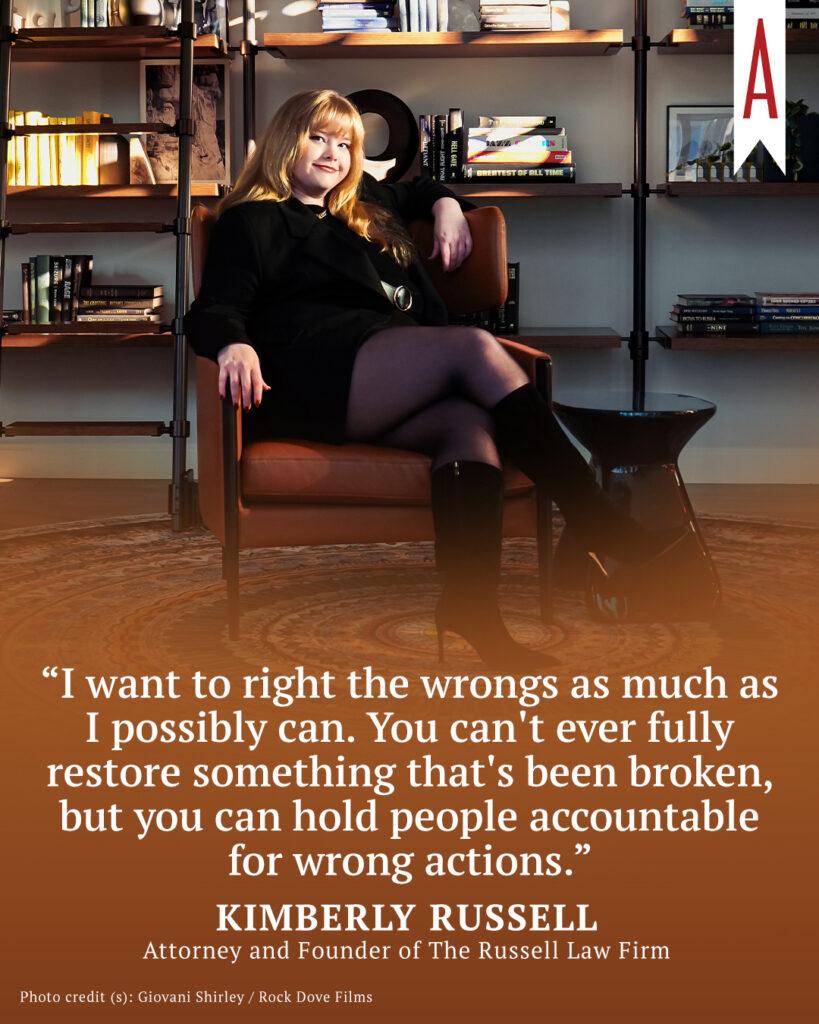
We do all of this to make sure that each of those people, whether you are a nonprofit facing an uphill battle, an employee who has been discriminated against, or a first-generation athlete who is trying to navigate how to work a system with your brand and reputation, we are constantly trying to give people a better leg up than where they started. We want to make sure that they have their day in court. That is what drives me and motivates me in each of my cases. I want to right the wrongs as much as I possibly can. You can’t ever fully restore something that’s been broken, but you can hold people accountable for wrong actions.
[Editor’s note: This interview has been edited for length and clarity.]