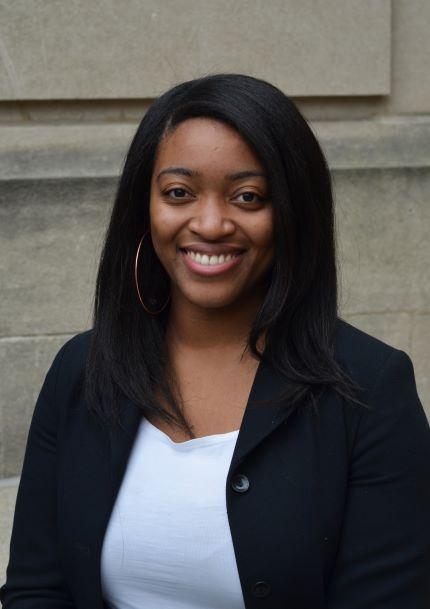










Bestselling author, internationally renowned speaker and co-founder Rebecca Soffer wants to let you know she’s just like you and wants her work to reflect that. Even as a bestselling author, a former producer for The Colbert Report and a co-founder of an online platform, Rebecca Soffer’s current professional path was borne out of something personal and universal to everyone: the long arc of grief after loss.
“I was working in daily TV for Stephen Colbert at the Colbert Report, and my mom was killed in a car accident. I was 30 years old, and I was building my life up, and all of a sudden, I lost the most important person in my life and in a very violent, sudden way. It was very traumatic.”
Seeking community to help navigate her grief, Rebecca saw a need for a space that could help make her grief feel less isolating. She and co-founder Gabrielle Birkner founded Modern Loss, an online publication serving as a platform for creative, diverse and relevant content on all types of loss and grief. There, writers share their personal and varied experiences with loss with essays and relevant resources that readers can connect with and create communities of support around.
Her platform extends beyond her dotcom, as Rebecca shares her experiences on the Modern Loss Substack, a top Health and Wellness Substack publication with 24K readers, and in her bestselling book, The Modern Loss Handbook: An Interactive Guide to Moving Through Grief and Building Your Resilience. She also co-authored Modern Loss: Candid Conversation About Grief. Beginners Welcome.
She shares with Her Agenda why Modern Loss exists, how grief can be met with empathy and humor, the importance of community building and how we can show up for ourselves while coursing through grief in our daily lives.
Her Agenda: Tell us more about the purpose of Modern Loss and what it means for you and for your readers looking to navigate loss and grief?
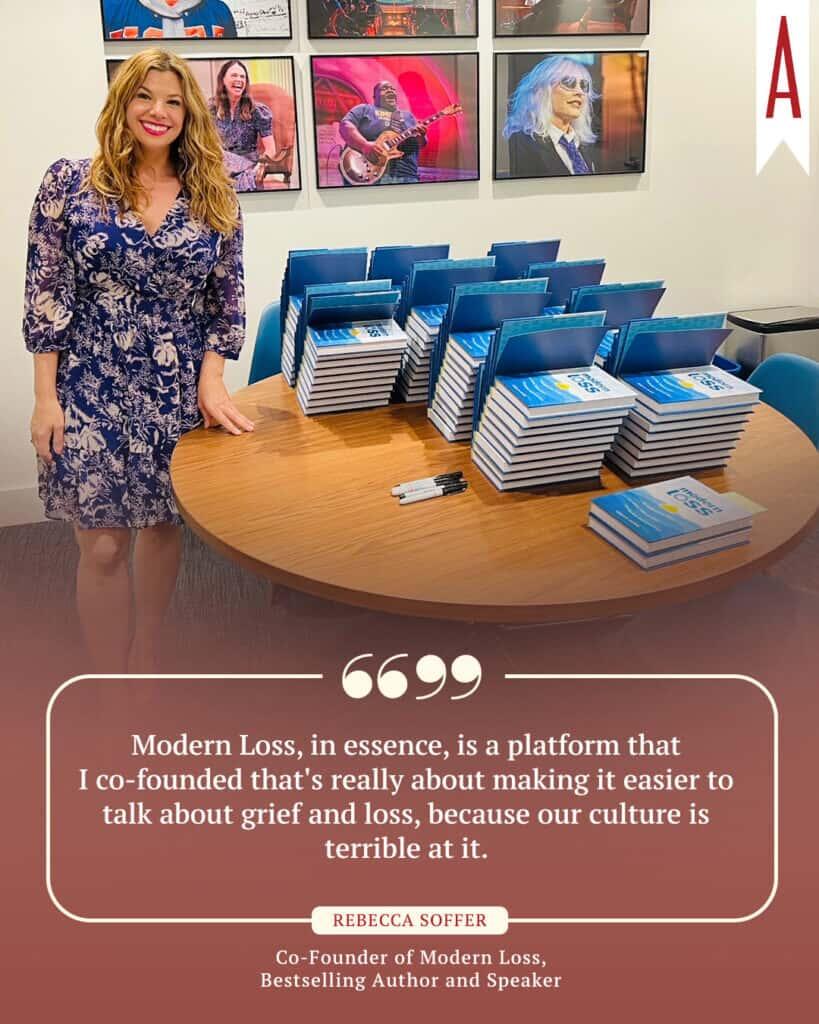
Rebecca Soffer: Modern Loss, in essence, is a platform that I co-founded that’s really about making it easier to talk about grief and loss, because our culture is terrible at it. We create content, community, and resources that meet people where they actually are, which is usually in the middle of something very hard and very messy.
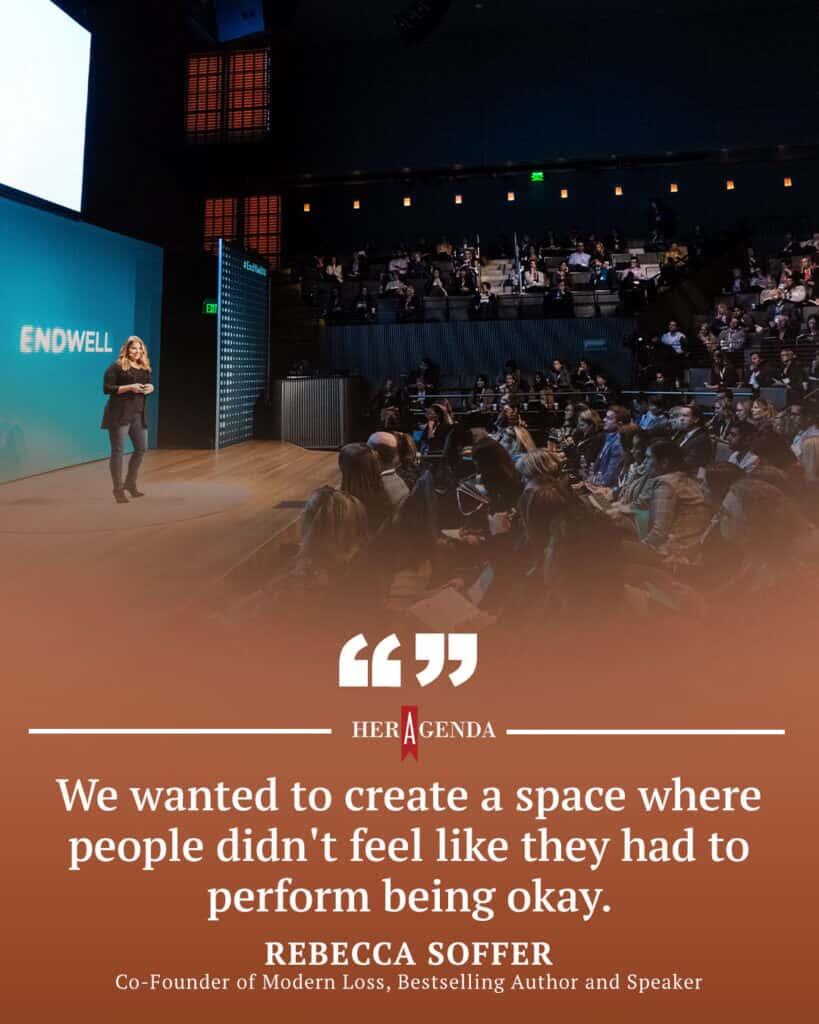
You’re always living with different aspects of grief and loss as your life goes on and as you move through different phases of your life and take on different identities and different challenges and different joys. So, I started [Modern Loss] because the purpose of it was always to normalize grief and loss as a part of life, not something to fix or get over or pathologize like it’s an illness that you have to treat, but something to actually integrate. We wanted to create a space where people didn’t feel like they had to perform being okay.
Her Agenda: I was surprised about the breadth of content you can find on Modern Loss. What are some of the common themes you’ve come across in speaking and writing about grief, loss and resilience?
Rebecca Soffer: Grief and loss really can relate to so many things. Primarily, [Modern Loss] talks about death [as] loss of people, infertility, pets, etc., but also, we talk about anticipatory grief, like what is it like to caregive for someone who has a long-term illness? What is loss as it relates to identity shifts or pandemics? We deal with so many layers of loss and grief, and I just wanted to normalize this conversation because we normalize every other topic in the world, so why not this?
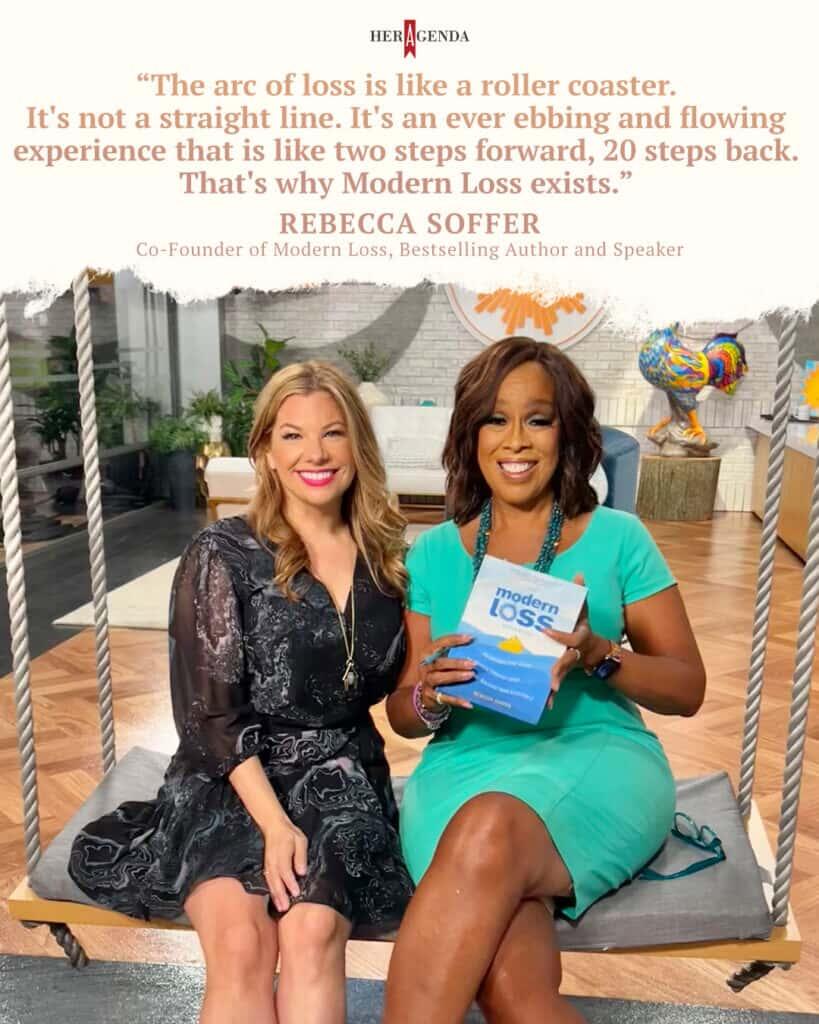
The arc of loss is like a roller coaster. It’s not a straight line. It’s an ever ebbing and flowing experience that is like two steps forward, 20 steps back. That’s why Modern Loss exists.
Her Agenda: When you embarked on your journey as an author of two books as well as with Modern Loss and the Modern Loss substack, were you surprised by its impact?
Rebecca Soffer: I knew there was a need. I felt it personally. My mom died when I was 30 and my dad died when I was 34. Both parents within four years. It wasn’t my life plan. I just felt, personally, after losing my own parents and being so young still, that there must be a place that was outside of a religious community or a psychologist’s office.
I knew that there was a need, but I don’t think you can predict when something you build touches a nerve that broadly. You just hope you’re making something real, and something useful, and something really authentic. And then what happens is the audience tells you whether you got it right. I knew grief was understood, but I didn’t know how hungry people were for permission to just be honest about it and let it all hang out.
Her Agenda: You’ve built a community with Modern Loss that contributes with their own personal stories to support each other, share the site’s resources and attends your events. How important is community building to the ethos of your platform, Modern Loss?
Rebecca Soffer: [Modern Loss] does two things at once. It breaks down the taboos and stigmas around grief that keep people silent, and it also just makes the burden feel lighter, like you’re not carrying this alone anymore; other people are holding pieces of it with you.
I think that grief can get so isolating because we’ve been taught to keep it private and tidy, and community just blows that open. Suddenly, you realize other people are carrying similar things. And then there’s almost like this physical sense of the weight being shared and divided up and carried among all these other shoulders, even if their shoulders are readers who you’ll never see, but you know they are there.
It’s really just about me providing the invitation to people [with Modern Loss]. I’m not just leading Modern Loss, I’m also a member. I’m getting as much out of this community as anybody else is. The hope is that people might become a little bit more empathetic and understand how to become better support systems, not just to others but also to themselves when they go through something hard. We really are trying to change a stigma here.
Her Agenda: We love that empathy and humor play a role in how you approach grief on the Modern Loss platform and in your books, because that topic can be taboo and uncomfortable to talk about at times. Is that how you’ve always approached grief? How does your platform Moden Loss balance that?
Rebecca Soffer: I’m all about humor as much as possible. My background is in comedy; I worked in political satire. I’m also a journalist. So, I don’t do everything with levity, but there are multiple ways you can serve up topics people should engage with because they’re important to understand. Using humor, even at times in a self-deprecating way, sends a message that we aren’t trying to be the “experts” in the room. We’re just in it with you. It’s a human experience.
I feel that [humor is] a real community builder, because people bond when they’re kind of giggling. They feel a little more relaxed. They also feel less crazy in their situation, like they’re not the only ones going through it. And also, it breaks down barriers. It makes people more willing to connect with each other.
Her Agenda: How does grief show up in busy lives, particularly for women professionals? What are some of the best practices busy professionals, women specifically, can deal with grief and loss while managing their daily lives?
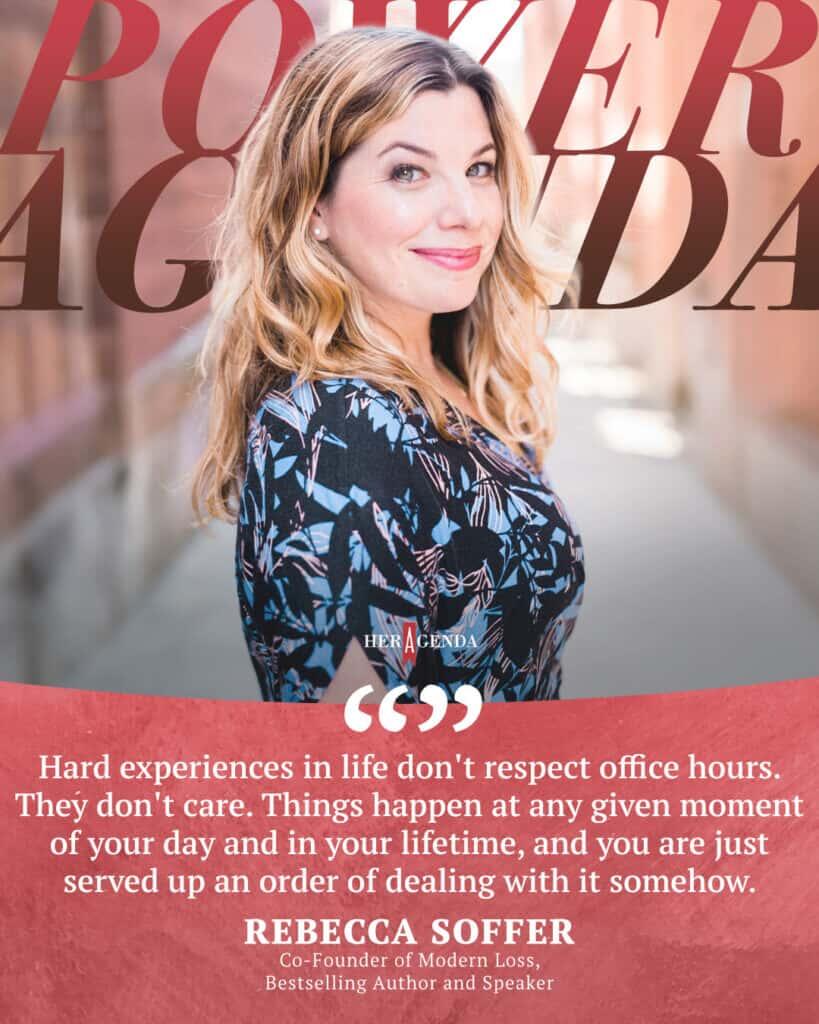
Rebecca Soffer: My mom died when I was 30. I also was hungry, I wanted to move up. I wanted to succeed. I wanted to have wins. I wanted to feel fulfilled professionally and creatively. The reality is is that hard experiences in life don’t respect office hours. They don’t care. Things happen at any given moment of your day and in your lifetime, and you are just served up an order of dealing with it somehow.
The best advice that I can always give [busy women professionals] is first, in giving a lot of talks to managers, how [they] can manage more with empathy, because in the end, it actually creates a higher employee retention. We’re going to tend to burn out a little less if we feel like we have the invitation to go speak to our managers or whoever it is we check in with at work about things like temporary flexible schedules or a version of time off, be it paid or unpaid, or productivity hours. Our productivity hours can change. We might need more breaks. We might need to do hyper-focused work and then take time away from that work.
I always encourage people to go easy on themselves. This is a universal experience, and it’s a tall order to ask somebody to perform at their utmost potential when they’re going through the worst of it. I also encourage people to try and self-advocate, because it’s very hard for managers and other types of bosses or even teammates to intuit where a colleague is in their mind, in their heart, and in their body when they’re moving through something hard.
The reality is, we have to become more comfortable speaking up for our needs. You have agency. And we should use it, because if not, we all know that companies are more than happy for you to keep showing up all the time.
Her Agenda: What do you want users and supporters to take away from the Modern Loss platform and the resources they can find to engage with its content and your work?
Rebecca Soffer: [Modern Loss] started as an online magazine, but I also write a well-read Substack. The magazine contains thousands of original essays and resource pieces, and I really think that people can find something very meaningful for themselves in the magazine. The Substack newsletter is where I use my own voice, share my thoughts on what’s going on in the world and how I’m reacting to certain things that are happening in current events. I also interview notable people who are doing amazing things within the umbrella of loss and grief and mental health and creativity, such as Anderson Cooper.
I have two books: one is called the Modern Loss: Candid Conversation About Grief. Beginners Welcome, and the newer one, called The Modern Loss Handbook: An Interactive Guide to Moving Through Grief and Building Your Resilience, a bestseller in a third printing. I’m very proud of that one. And that book is something I really love, because I wrote it in the middle of the pandemic, when I, too, was just trying to keep my head above water. And so, my response to that was writing a book. I also do a lot of talks; I love speaking to organizations and corporations and nonprofits. I do a lot of talks with DEI groups and ERGs, discussing parenting, mental health, wellness and employee resource groups. Groups bring me in to speak with managers about managing with empathy, creating compassionate communities, etc.
It’s really, really hard to feel like we can be living to our full potential, whatever that means to you, if we don’t feel seen in our hard ‘thing.’ If we don’t feel seen and acknowledged and legitimized in whatever hard thing we’re going through, how can we realistically be expected to be compassionate to others or perform at full speed? You just spend too much energy in time trying to feel, trying to get seen. And with Modern Loss, we see you. It’s like, ‘The water is warm here; come on in. We don’t bite.’
[Editor’s note: This interview has been edited for length and clarity.]