








Networking is the key to unlocking success, yet many professionals lack the tools to build and maintain relationships.
Shelly Lombard was one of those people during her time as a finance expert for more than 30 years on Wall Street.
In 2022, she turned her area of weakness into a business that women professionals flock to for building networking skills. Schmooze started as a newsletter and expanded into a membership program that offers mini-masterclasses led by experts who talk about networking in June 2024.
“I was not an expert on networking, but I became a resource on networking,” Shelly told Her Agenda. “I launched Schmooze because I want to change women’s approach to networking – to make it a lifestyle – and to give them the tools & techniques to do that.”
For Shelly, professional relationships led to new opportunities that she was not seeking. For women searching for a job, professional relationships can be the difference between landing your next role or not.
In our conversation, Shelly Lombard gives us a peek inside moments in her career when she missed opportunities as a result of not networking, ones she’s gained because of it, and why it matters for the next generation of women professionals.
Her Agenda: What early experiences in finance most shaped the way you think about professional relationships today?
Shelly Lombard: When I got to Wall Street, there were only a handful of women investing in distressed companies. We would go to dinner, like, every other month and talk about what we were investing in. But in terms of men in the industry, or women outside of that group, I was too naive to realize I should have [networked]. I was too shy, I was too introverted [and] didn’t know how to do it. And so I think my career on Wall Street, while it was fine, I think it would have been even better had I been more intentional and strategic about networking.
Then, after I left Wall Street, I started serving on corporate boards, and I learned that 80% of corporate board roles [were] found through relationships. So I realized that [networking] was something that women really needed to do. I hadn’t done it, but I felt like I wanted to start something to encourage and coach other women to do it, because I think it makes so much of a difference in your career.
Her Agenda: What was happening in your life that made you decide to launch Schmooze and focus on networking?
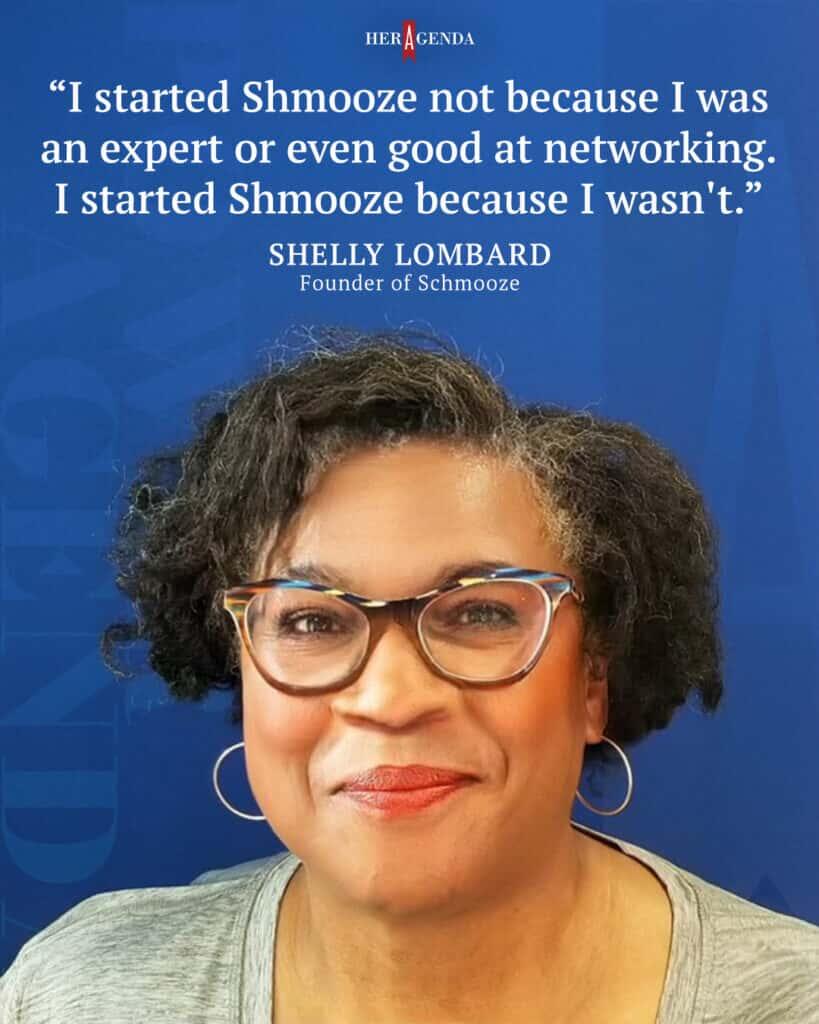
Shelly Lombard: I started Shmooze not because I was an expert or even good at networking. I started Shmooze because I wasn’t.
I was never very intentional [or] strategic about networking. My parents were teachers. They [told me] go to college, get a great job, work really hard, and that was the extent of it. Nobody told me anything about networking internally, managing your boss or internal relationships, and they definitely didn’t tell me anything about external relationships.
My goal with Schmooze was not so much to create a community as it was to change the way people network. I bring in experts, or people who’ve been through it, who do fireside chats and panels to talk about those issues.
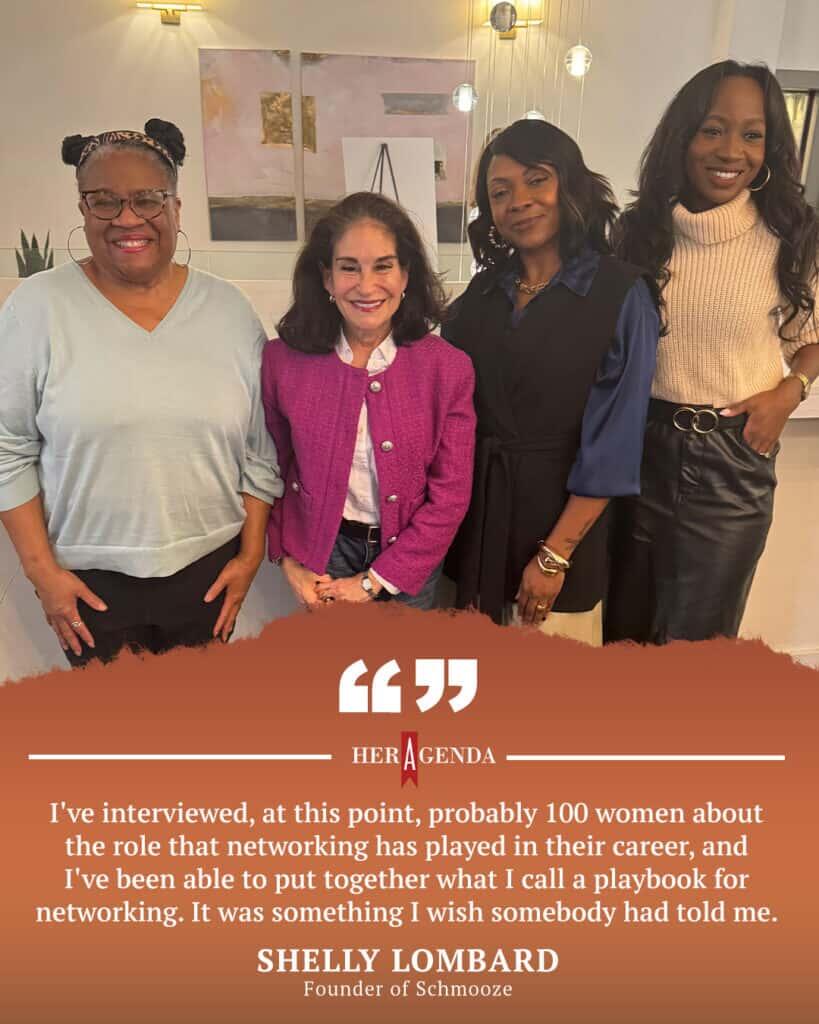
I’ve interviewed, at this point, probably 100 women about the role that networking has played in their career, [and] I’ve been able to put together what I call a playbook for networking. It was something I wish somebody had told me.
Her Agenda: How have you navigated the boys’ clubs of your career, or what advice do you give women to do that?
Shelly Lombard: Two pieces of advice. One, showing up when they’re having a bunch of drinks, you’re definitely gonna feel like an outsider. It’s a lot easier to do it one-on-one. The pressure of being the only woman in this environment, you don’t feel that when it’s one-on-one.
Two, the other thing that I didn’t realize is that curiosity is a relationship hack. There was a guy who gave me really great advice. He was the one who told me to get into distressed investing. I should have stayed in touch with him. Not because I thought he was gonna give me a job one day, but just because if he was insightful enough to give me that piece of advice, he probably could have given me more. And I didn’t. I was too shy, too introverted. And I didn’t have to be charming when I met him, I didn’t have to be knowledgeable, I just had to be curious about what he was doing, where he thought the market was going, etc, and he would have talked up a blue streak.
Another example of that was when the bank I was working with merged with another bank, there was a meeting for everybody, vice presidents and above. And I think I was the only Black woman in the room and as a result, the top guy – who was my boss’s boss’s boss’s boss – knew my face, and he knew me.
When he would see me on the elevator, he’d [say] ‘Hi.’ He would walk around the trading floor at night to see who was still working. I might still be there, and he’d [say] ‘Hi, Shelly’ and go back to work.
I never knew how to interact with him, or turn that into a relationship. He loved what he did, and if I had shown any curiosity about what the bank was doing, about what they were up to, about deals, etc, that would have helped forge a relationship with him.
Her Agenda: How did you get on your first corporate board?
Shelly Lombard: My first board role came through a relationship, [but] I was not networking to get on a board. Somebody that I knew [for] 35 years, an investor, had a large equity stake in a company, and he said, ‘Would you be interested in being on this board?’ Even though I wasn’t networking, it was a relationship.
To women now, who may want to be on a board in 5 years, or 10 years, or even women who are looking for a board role now, go back to those old relationships. Don’t let those relationships die out.
If you’re looking for a board role now, it’s [about] going back to some of those people you knew years ago and rekindling those relationships.
Her Agenda: Why is it relevant for women and people of color to be on a board?
Shelly Lombard: It [is] important for women to be on boards [because] It gives you a 50,000-foot view of a company. So you really understand not just your little part that you’re doing, but the enterprise.
The other thing is it gives you a chance to influence policy like maternity leave [and] DEI. If we’re in positions of influence to be able to influence stuff and maybe control [which outside companies your firm works with], then that’s very helpful to the women coming up behind us.
Her Agenda: What is your advice to women navigating this difficult job market?
Shelly Lombard: Schmoozing a network is not a quick fix for job hunting. You have to do it, but what I want to see [people] doing now, before you get forced out, before you get laid off.
It’s not a quick fix, but you will find a job faster than if you’re just sending resumes into the vacuum. Nobody can dismantle your personal network.
To the women who still have jobs and who are looking over their shoulders. Now is the time to network. Do not wait until the shoe drops; you have to be networking now.
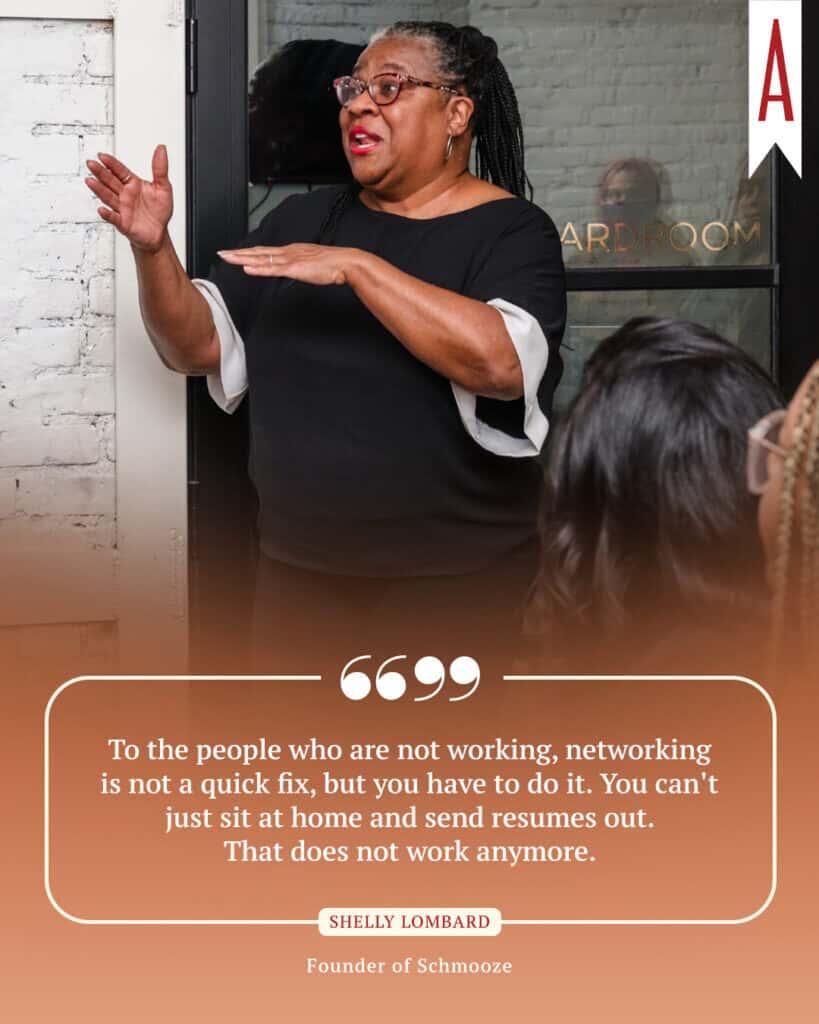
To the people who are not working, [networking] is not a quick fix, but you have to do it.
You can’t just sit at home and send resumes out. That does not work anymore.
Her Agenda: How did your networking and your growth in networking contribute to you starting your business or growing your business?
Shelly Lombard: It has been everything. I have been very strategic about trying to reach out to people.
I try to be strategic, but save room for serendipity. Sometimes you don’t know who somebody knows. If it’s not the right room for me [or] doesn’t align with what I’m doing right now, but the networking event is two blocks from where I am, I’ll go anyway, because [there’s] no telling who I’m gonna meet.
Her Agenda: What are some lessons you’ve learned as a business owner?
Shelly Lombard: Relationships change everything, and they’ve made it possible for me to have a business. People tell people about Schmooze, and because I’m visible, they invite me to speak on panels and speak on podcasts.
Being strategic, but leaving room for serendipity, inviting serendipity [and] being systematic and following up, and being seen is the reason I’ve been able to grow my following on LinkedIn, and the reason that Schmooze [and] I actually make money.
[Editor’s note: This interview has been edited for length and clarity.]