








Growing up in Bloomington, Minnesota, where according to the 1980 Census about 95 percent of the city was white, Asha Shivaji was acutely aware of her Indian American heritage.
Constantly fielded questions about her origins, she realized early on that 1980s marketing lacked the diversity to represent families like hers. These experiences shaped Asha’s identity and fueled her mission to bridge the gap in inclusive advertising.
Therefore, it’s no surprise the 42-year-old has co-founded the SeeMe Index in 2023 with Jason Klein and is the CEO of the company. The SeeMe Index is an AI-powered, data-driven, benchmarking tool which assists companies determine where they rank in the diversity brand marketing specifically within the beauty and health industries.
Today, SeeMe Index has highlighted vital industry gaps, such as showing that certified-inclusive brands on the index grew 1.5 times faster than competitors.
During this interview, Asha discussed her passion for diversity and how she sees See Me Index assisting with increasing inclusivity in the future.
Her Agenda: Where did you grow up?
Asha Shivaji: I was born in Minnesota, which people don’t often guess. I grew up in Minnesota until I was about nine. Then we moved to California. Minnesota was a really formative part of my childhood, and also, in retrospect, guided so much of what my life’s purpose has become in starting SeeMe Index and trying to drive a more inclusive world.
My parents were immigrants from India. My dad got a scholarship to go to the University of Minnesota for graduate school. As you can imagine, in the 80s in Minnesota, there was not very much diversity. I was quite different from a lot of the other people in my classroom who had families born and raised in Minnesota and looked a certain way and spoke a certain way. It became a part of my identity from an early age, where I had to explain a lot of who I was, why my name was different, why I looked different, what India was, and what India was about. For me, that need to explain who I was shaped so much. Growing up, I would look to TV shows, magazines, or books for someone who looked like me or had a name like [mine]. There was nothing like that then, and unfortunately, for a long time it continued like that, and I had to accept it. Once I grew up and became a marketer and started knowing that I could influence [it] in some way, it very much became my life’s purpose to try and change that and drive more representation of all different people.
Her Agenda:How did you know you wanted to get into marketing?
Asha Shivaji: I didn’t really know. I’m a trial-and-error person. In my early days in high school and college, I interned for a law office and had to serve people. That was scary. That pushed law out of the picture.
I interned in a lab at a hospital and found I wasn’t too keen on the liquids and things you see in a lab. Through trial and error, I found myself applying to internships in marketing. While at UCLA, I had the opportunity to intern first for Nike, ABC television, and Anheuser-Busch. Those experiences solidified my interest in the space.
Her Agenda: Why did you want to promote diversity?
Asha Shivaji: When I look back, it’s something that’s always been with me. Recently, one of my best friends from high school – her mom found an article about us in our town newspaper. It was about how we were co-leading Congressman Honda’s student advisory committee, [focusing] on diversity. In the article, we [talked] about how our high school didn’t have much diversity. It was important for students to have exposure to different groups to understand and learn how to work together and learn from one another.
I saw that article. It gave me goosebumps, because (diversity) has been part of my journey since day one. Sometimes, you forget the business of life, and (you get caught up with your career and school). When I was at Google, I had the opportunity to take on a 20% project. At Google, they encourage you to lean into something new or different with 20% of your time. The 20% project I took was leading our relationship at Google with the UN’s Unstereotype Alliance that works to eradicate harmful stereotypes in media and advertising. That experience was the first time in my more recent career where I got to lean into inclusion, diversity, and representation.
It lit me up. That 20% inspired me and made me re-find my passion for my career in marketing and what it can do with a larger purpose. It was the moment that made me think, ‘I need to do this at a larger scale and make this 100% of my work, not just 20%.’
Her Agenda: How can businesses be inclusive in their marketing?
Asha Shivaji: We try and encourage brands to (realize) you don’t have to be everything to everyone. A lot of times, brands feel intimated about where to start. They think of brands like Dove and its long-term journey with Real Beauty, and they’re like, ‘I can never catch up to something like that.’
It doesn’t have to look like a big-purpose effort. We encourage brands to think about who they want to show up for, and then to make sure they’re showing up across everything they do – like making sure those people are represented in their advertising, making sure they have products tested on (representatives of their audience), a shade for them, or a SKU that meets their unique needs…
Oftentimes, brands do one of those [things]. They don’t think about how disjointed the experience is for a consumer. This was my experience when I worked in beauty as a beauty marketer. There wasn’t a shade in the brand I could wear. That’s a terrible experience. The talent in the ad was meant to convey the [brand’s inclusivity] – how it would have the shade range. Then, if you’re a consumer, and you go to the counter, you can’t find the shade. You’re never going back to that counter again. It’s the worst experience for a consumer. We try to help brands understand where those gaps are.
Her Agenda: How did you get started working with Google? What was that like?
Asha Shivaji: I started my career in digital marketing, first working with Apple. Then, with Disney. At the time, digital was not the focus of marketing – which seems crazy now, but I guess that’s how old I am. Then, I decided to go to business school. After business school, I found myself in beauty marketing.
Through my work at Johnson & Johnson, when I worked across the beauty brand there, I worked closely with Google. My role at J&J was to help modernize and globalize how the beauty brands went to market. Through that close partnership with Google, I started to love the work we were doing.
I never would’ve thought, having left digital marketing originally in my career, to try and get into more traditional, brand-management roles, I’d find myself back in digital marketing at Google. It was fortunate that my beauty experience of working at big brands brought value to Google. At Google, I was leading strategy across our global marketing service teams. My understanding of what a brand needed, or what a marketer needed, was helpful in that Google ecosystem of developing solutions for them.
Her Agenda: How did you come up with the idea for SeeMe Index and tell me about the work?
Asha Shivaji: The idea for SeeMe Index was born out of two first-hand experiences. One, was the one I mentioned, when I worked on beauty brands, and the talent in the ads didn’t reflect the products we were making. I was the director of foundation and powder for a brand where we were putting that talent in the ads, and there wasn’t a shade I could wear. I was told to blend shades.
This wasn’t long ago. This was 10 years ago. Now, you think of a marketplace where 40 shades have become the status quo, and consumers demand more. I’m proud of where the industry has moved. Part of it was that experience. Part of it was at Google (with) my co-founder and I being in roles where we were exposed to the needs of different clients.
As I mentioned, I was developing new solutions for them. We would get the meatiest questions from clients, and a question that kept coming up was, ‘How do I know if I’m hitting the mark with X consumer group?’ or ‘How do I know if I’m winning the hearts and minds of this consumer group?’
We didn’t have a data-driven way to answer at the time. It bugged us. We thought, ‘[I]f we just had the data, then we could [show] people this how you could improve. It’s why we decided to start SeeMe Index. We felt for so long the idea of representation or inclusion felt mystical to people.’
Her Agenda:How is AI used?
Asha Shivaji: We’re using AI to help measure the content. When we look at representation in an ad, we look at who each person is. When I say ‘who,’ we break down not just that this is a woman or this is a Black person. We break down all of those eight identity dimensions. We not only look at who they are in the ad but the amount of screen time they get. That gets super interesting when we start seeing biases about how some different groups are cast. Brands are doing the right thing. They’re putting the person in the ad, but they’re getting such a small percentage of screen time.
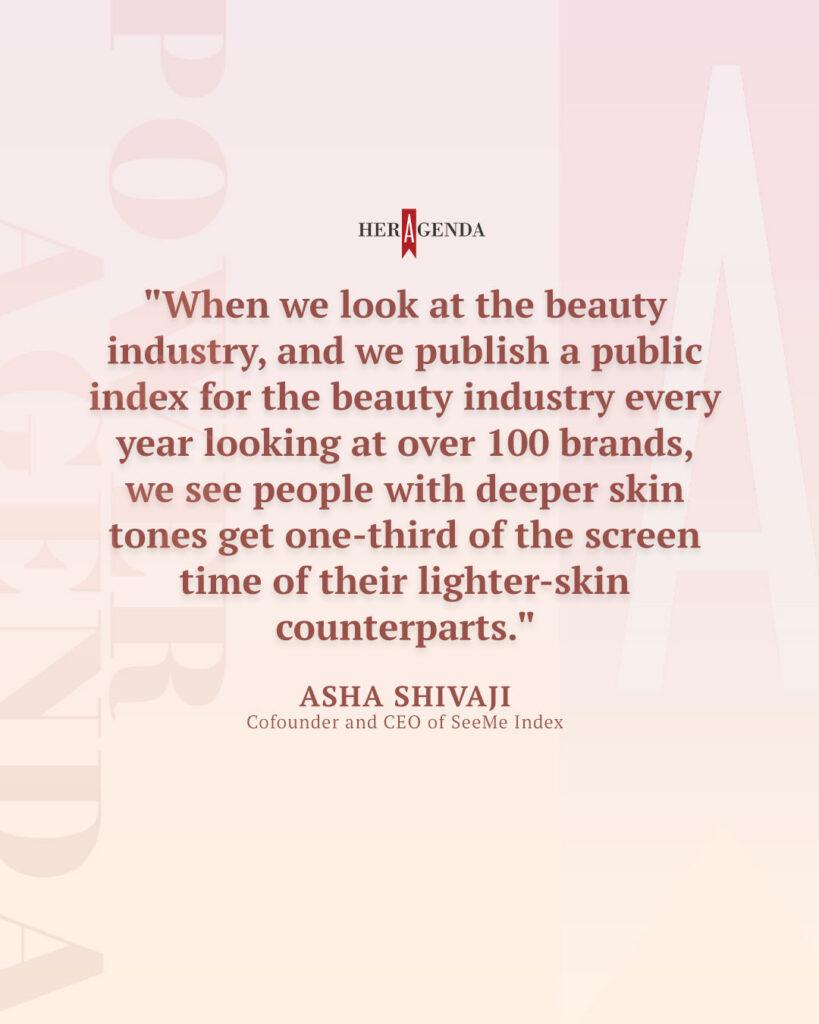
An example of that is when we look at the beauty industry, and we publish a public index for the beauty industry every year looking at over 100 brands, we see people with deeper skin tones get one-third of the screen time of their lighter-skin counterparts.
I say it over and over again, because I want brands to realize it. They’re well intentioned casting diverse talent, but then something is happening in the editing room where those people aren’t getting the equity of screen time.
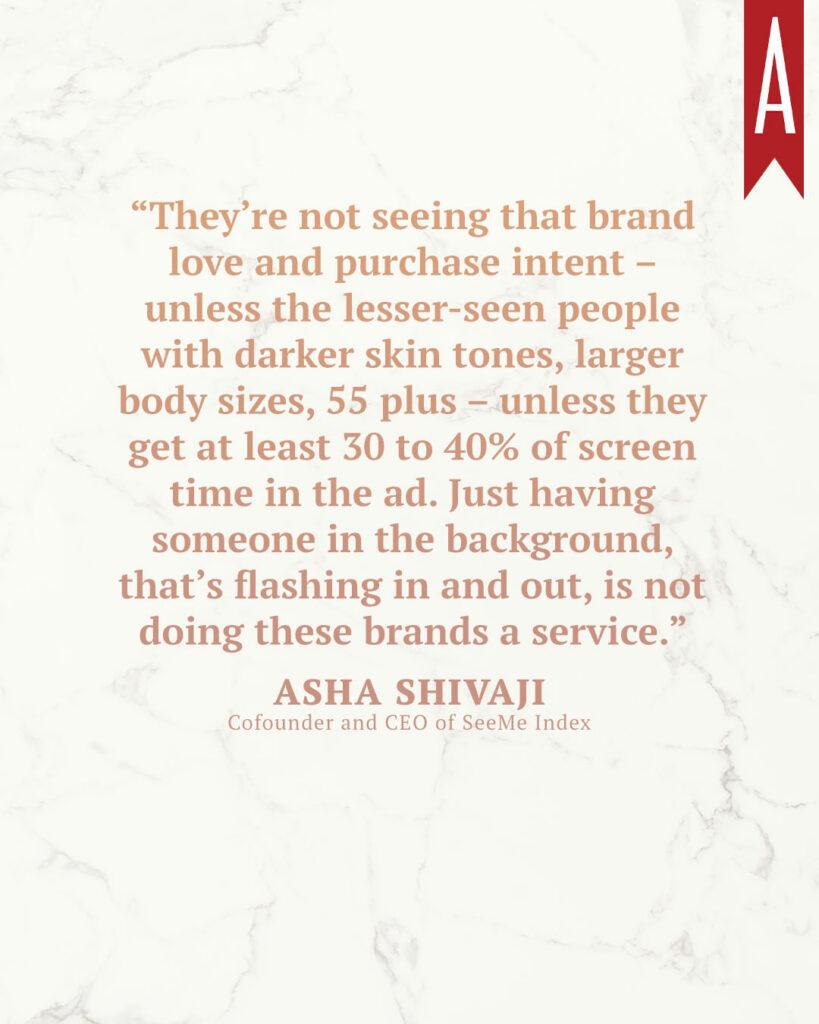
Our data also shows brands don’t see the impact. They’re not seeing that brand love and purchase intent – unless the lesser-seen people with darker skin tones, larger body sizes, 55 plus – unless they get at least 30 to 40% of screen time in the ad. Just having someone in the background, that’s flashing in and out, is not doing these brands a service.
Her Agenda:What success have you seen with the SeeMe Index?
Asha Shivaji: Some of the things we’re most proud of are the clients we are working with. We’ve publicly shared the stage with brands like MAC and e.l.f. that are leaders in the beauty industry. We’ve had triple digit growth in the number of clients, and our revenue, in our first two years of business.
Early on, we forged a partnership with Circana, a company specializing in sales data from different retailers. We partnered with Circana’s data and our data to show that more inclusive brands, especially in the beauty industry, are growing 1.5 times faster than their less-inclusive counterparts. Each year, when we launch our beauty index or we launch indices for other industries, we partner with Circana to do this analysis to see if it’s proving true.
It’s proving true. It’s mirroring the UN data as well, because over time, that gap is getting bigger and bigger. I’m hopeful that this is going to stay in the same trajectory.
Her Agenda:Any future goals for SeeMe Index?
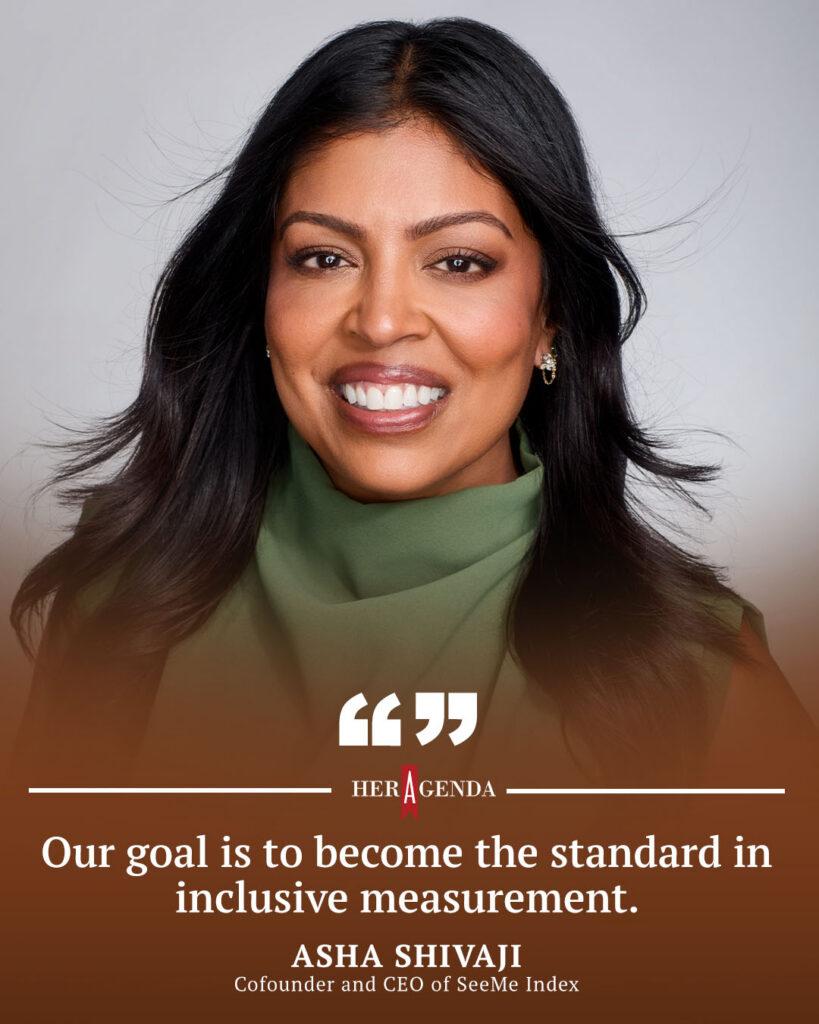
Asha Shivaji: Our goal is to become the standard in inclusive measurement. The brands we’re working with today are starting to see how critical it is to measure inclusion side-by-side with other metrics, like sales data, media data, social listening. We’re starting to integrate our data into these overall dashboards for the organization. Our goal would be no one is ever guessing what inclusion looks like, and brands are using this data to best represent consumers.
At the same time, I believe every consumer deserves to be seen, valued, and celebrated from the brands that the shop with. I think we’re helping both sides of the equation by bringing this data forward. It’s also a big reason why we make our index we publish for the beauty industry. We did one for over-the-counter and health and wellness drugs as well. They’re available on our website.
Our last beauty index was in March. The upcoming one will come out in March of 2026.
Her Agenda: What kind of advice would you give young girls who want to get into advertising and marketing?
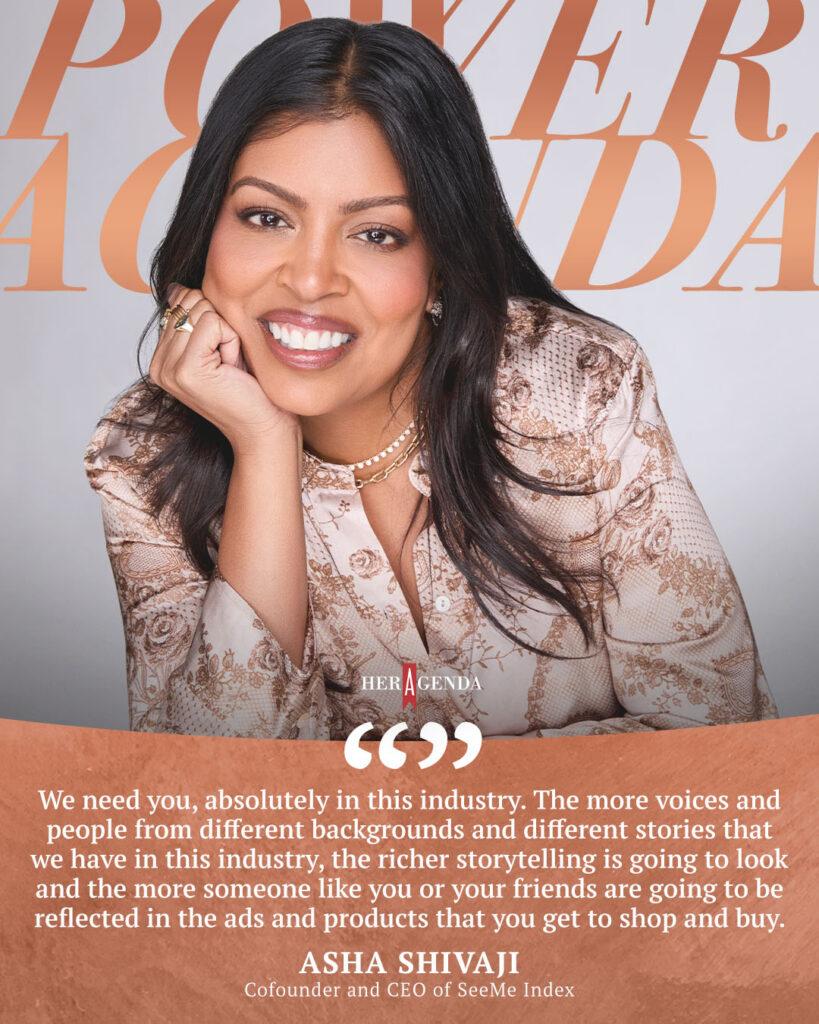
Asha Shivaji: I would say we need you, absolutely in this industry. The more voices and people from different backgrounds and different stories that we have in this industry, the richer storytelling is going to look and the more someone like you or your friends are going to be reflected in the ads and products that you get to shop and buy.
[Editor’s note: This interview has been edited for length and clarity.]