








Dr. Jennifer Pagan, a scientist and founder, chose the offbeat path, not pursuing a traditional academic career, but doing translational research because she wanted to use technology to create products that could directly benefit people. To do this, she is an electrical engineer, researcher, and technology entrepreneur transforming water disinfection with AquiSense, a company she cofounded, pioneering LED-based ultraviolet systems that offer a mercury-free alternative to traditional water-treatment systems that relied on toxic mercury-vapor lamps.
Today, AquiSense is a leader in LED-based UV treatment systems, with its technology being used across multiple environments, from industrial water systems to schools, clinics, disaster-relief efforts, Antarctica, and even the International Space Station. Most recently, she received the 2025 Bayh-Dole Coalition American Innovator Award for her groundbreaking UV‑C LED water disinfection technology, developed during her Ph.D. at UNC Charlotte and commercialized through AquiSense.
In this interview, Pagan discusses her unconventional journey into electrical engineering, the research behind her work in ultraviolet LEDs, and why she chose translational research over an academic career. She also shares the challenges of commercializing new scientific technology, the importance of research partnerships and collaborations, and the role of sustainability in scientific discovery. Pagan further discusses how the Bayh-Dole Act and federal funding programs helped make it possible to move from the laboratory into the marketplace.
Her Agenda: Could you talk about your journey to science and how you ended up choosing to study electrical engineering?
Dr. Jennifer Pagan: I was not originally an engineering major. I was a music major, so I thought I wanted to be an opera singer originally. I went for one semester at a university as a performing arts major, and I switched majors. I realized that really wasn’t what I wanted to do. I thought it was great to have as a hobby, but I had always liked technology.
I had science kits as a kid. They were like mail-order kits you would get, and I would play around with them, but I didn’t really know what an electrical engineer did. I actually chose the major sort of arbitrarily, honestly. I knew I wanted something in the sciences, and I liked that engineering was more hands-on.
Her Agenda: Can you talk about the research you did during your PhD process and what you learned during that process?
Dr. Jennifer Pagan: During my master’s work, I worked on microelectromechanical systems. I worked on a project to move a camera in an endoscope down the throat. Then, for my PhD, I worked in optics and light transmission. So, I was doing refractive and diffractive optics because I really liked light. Around that same time, the world was moving from incandescent light bulbs to LEDs. So, I started working in light-emitting diodes (LEDs), and that was a really exciting time for that technology. My research for my doctorate was trying to make a deep green LED, and through the course of that, I started working on ultraviolet LEDs as well because those were two of the wavelengths that they didn’t have very good or efficient LEDs in. Towards the end of my PhD, I started working for a small startup and stayed on after writing federal grants and working on that technology.
While working with ultraviolet LEDs, I developed an invention around the challenge that these LEDs were extremely low-power. We already knew that ultraviolet light was highly effective at inactivating pathogens. However, the LEDs available at the time were not powerful enough to compete with existing technologies, making it difficult to develop an effective water disinfection system using them. My invention was a way to harness those low-efficiency light-emitting diodes and capture as much of their light as possible, making them viable for an efficient disinfection system. That was a real breakthrough for the company.
Her Agenda: Why do you think you chose to focus on UV light?
Dr. Jennifer Pagan: Yeah, I think it was the excitement of LEDs in general at the time, having so much success with visible lighting and replacing all of the incandescent light bulbs with LED-based light bulbs. This was a new area; I wanted to work in something new, as you do when you’re a researcher. I also loved the idea of coming up with a brand-new technology that would overtake an older, less-efficient technology.
As a student, I watched visible LEDs begin to replace incandescent light bulbs, while flat-screen displays emerged and started replacing tube televisions. So, I had two very clear examples of semiconductor technology overcoming older technologies. To date, virtually all disinfection and water-treatment systems have relied on mercury-vapor lamps. As a result, water-disinfection systems had a very particular form and architecture. These were long, tube-shaped mercury-based lamps that also contained toxic mercury. So, our water-treatment systems were relying on a technology that not only had physical limitations but also introduced the challenge of handling a hazardous material. That created an opportunity for innovation: developing a semiconductor-based solution for water treatment that could deliver all the benefits of UV light without the drawbacks associated with mercury-vapor lamps.
Her Agenda: Why did you choose to do translational research instead of a career in academia?
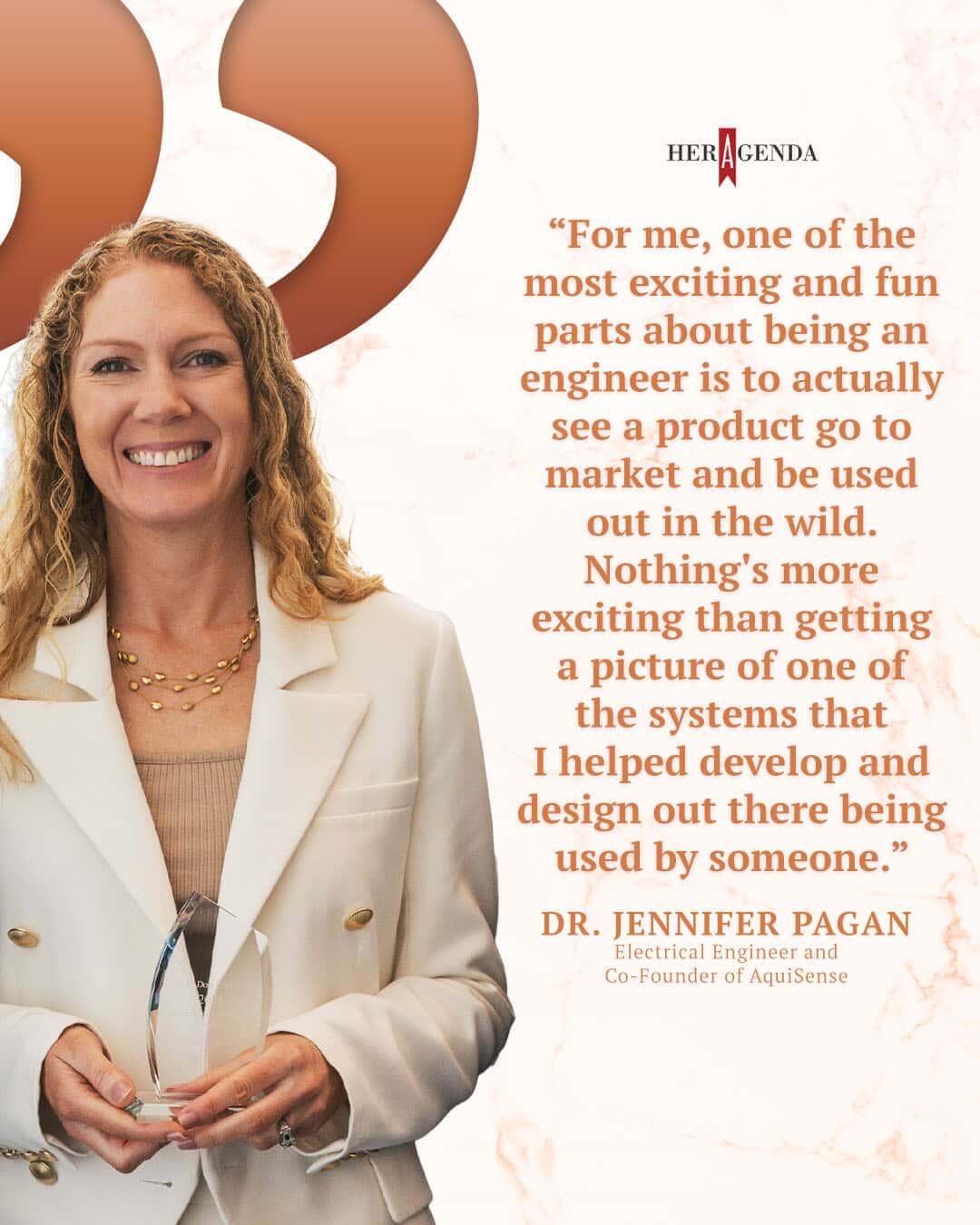
Dr. Jennifer Pagan: For me, one of the most exciting and fun parts about being an engineer is to actually see a product go to market and be used out in the wild. Nothing’s more exciting than getting a picture of one of the systems that I helped develop and design out there being used by someone who doesn’t know me, but their life is being benefited by using the product. I liked being closer to the end result of the technology versus in the basic research in the lab.
Her Agenda: Do you still write research papers?
Dr. Jennifer Pagan: I do. We partner with a lot of different academic institutions that use our products to conduct basic research. Water is an evolving issue worldwide, and there are always new challenges emerging. We now know, for example, that there are “forever chemicals,” such as PFAS, in our water that we need to address, as well as concerns around microplastics. So, there’s definitely going to be a lot of research in these areas. We’re also seeing new challenges with data centers, which require significant amounts of water. There’s an increasing need to understand the environmental impact of that water usage and how we can mitigate it.
Her Agenda: Can you tell us about your experience at Dutch Metrics, the company you joined after graduating, and what led you to decide to commercialize your research with them?
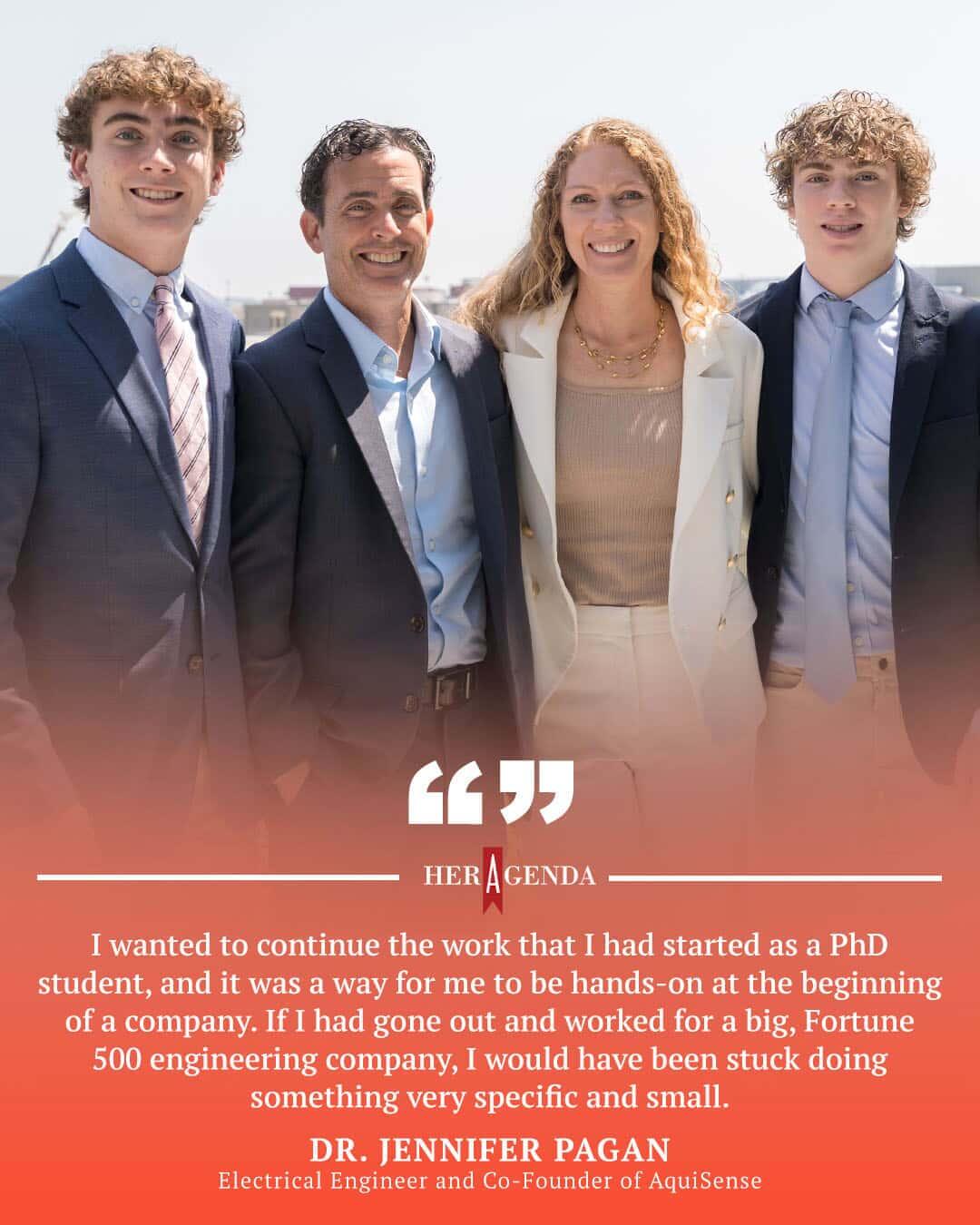
Dr. Jennifer Pagan: Yeah, it was an interesting decision to stay working. This was actually my PhD advisor’s company. I elected to stay on, and that was really because I wanted to continue the work that I had started as a PhD student, and it was a way for me to be hands-on at the beginning of a company. If I had gone out and worked for a big, Fortune 500 engineering company, I would have been stuck doing something very specific and small.
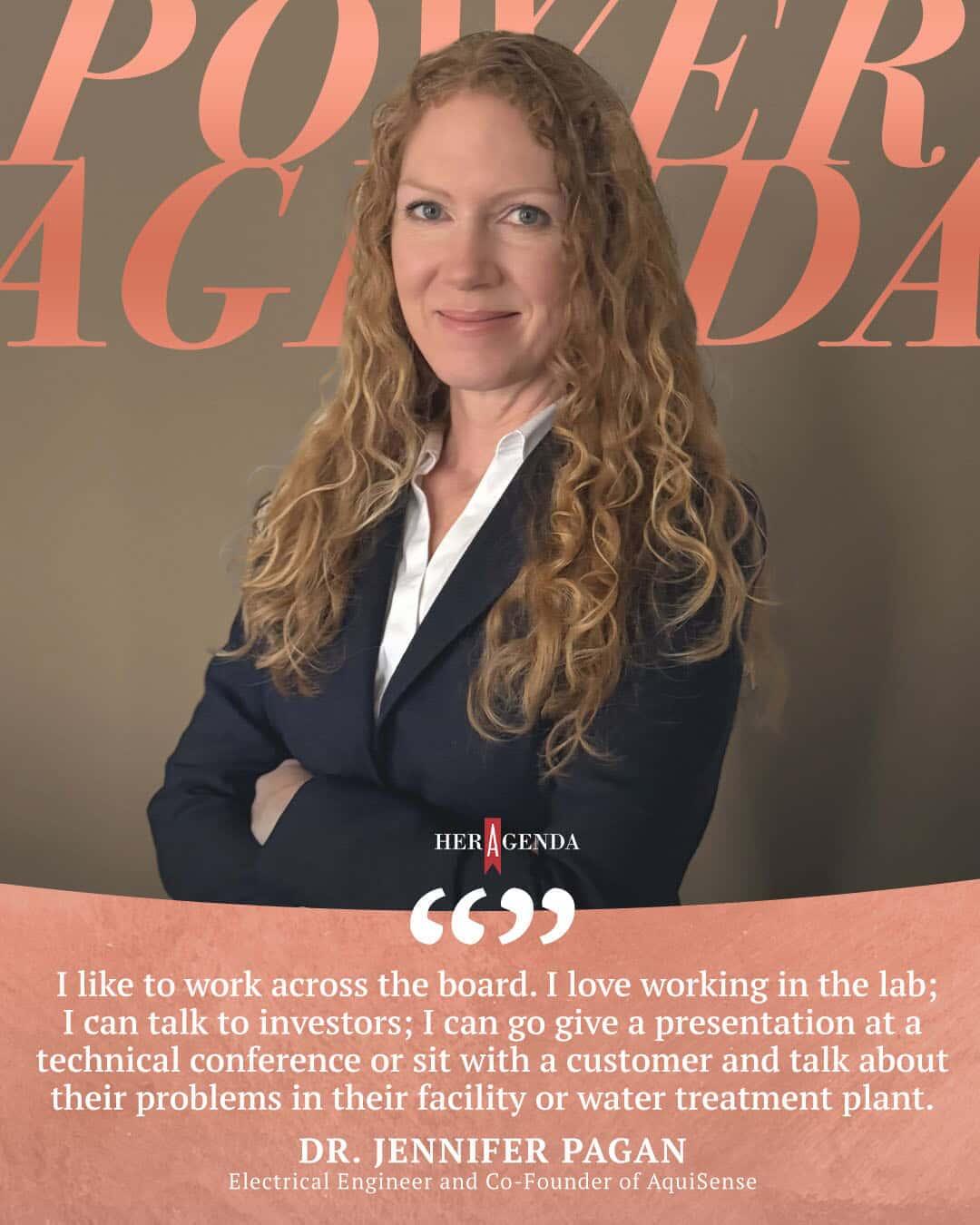
When you work for a small business, you wear a lot of different hats. So, you’re sourcing the material, you’re doing the research, you’re talking to people for money, you kind of have to do it all. And honestly, that probably suited my personality. I like to work across the board. I love working in the lab; I can talk to investors; I can go give a presentation at a technical conference or sit with a customer and talk about their problems in their facility or water treatment plant.
Her Agenda: You mentioned some of the obstacles you faced when bringing your invention to life, particularly the reluctance within the water-disinfection industry to move away from mercury-based methods. Can you talk about some of the challenges you encountered and how you overcame them?
Dr. Jennifer Pagan: I remember at the very beginning going to UV water conferences and getting kind of laughed at when I would make a presentation about the technology, and people would say, ‘Oh, there’s no way. You’re never gonna be able to make a system with LEDs. That’s not going to happen,’ or ‘It’ll be 20 years away.’ That just made me more committed, honestly. And I understood it: when you’re working for a company that uses a different technology, you want to push away the new technology versus embracing it.
Her Agenda: Can you talk about co-founding Aquasense? What was your vision for the company, and how has it evolved over the past decade?
Dr. Jennifer Pagan: When I was with Dot Metrics and their director of research, we started a partnership with a mercury-based UV treatment company, and their president really believed in LED technology. So, we did a joint development agreement with them, and we made the world’s first water treatment system, and it would disinfect two liters per minute, but it cost about $12,000, which was really expensive.
And his company said, ‘Well, I don’t think we want to continue with LEDs. We don’t think it’s ready yet.’ And at the same time, the startup business I was with was willing to sell. So, we said, ‘Let’s just buy both the commercial rights from your company and the technology from the university startup and put them together and form Aquisense.’
Her Agenda: Your research has had far-reaching impacts. From your website, it says you work on the seven continents. Can you talk about that impact and what it means to you personally?
Dr. Jennifer Pagan: It’s pretty amazing to think that we have a system in Antarctica and that we have a system on the International Space Station. In controlled spaces, you have to have disinfection capability, and so that’s a really exciting area for us. But there are also a lot of issues worldwide with water, and frankly, they’re everywhere. I know a lot of people think that North America might not have drinking water problems, but they do. There are a lot of areas that have contaminated water or might have historical problems from long-term agricultural use.
Then there are also water issues in South America and Africa. There are water problems that we also work with partner organizations on. We do a lot of humanitarian work on a small scale with non-governmental organizations, for schools or clinics. It’s heartening to see that the LED systems are really very useful for those environments.
In these kinds of environments, the products need to be more rugged, and you can set them and forget them. Not a lot of maintenance is required. So, our LED-based systems are really well suited for those types of use cases. But we are also in disaster relief. We have a lot of municipal water systems that are protecting water from getting dumped back into our streams.
For example, our technology is used to protect drinking water in Las Vegas, where the water supply relies on groundwater wells. We also have a range of industrial applications, including systems used in ice machines. It’s funny because water is so much bigger than most people think it is, because it’s essential. Everyone uses it, and every factory, plant, farm, aquaculture, you name it, they all use water, and they all have to deal with treating water to make sure their products are safe for their customers.
Her Agenda: Beyond improving access to safe drinking water, your technology also offers environmental benefits. How important has sustainability been in shaping your work?
Dr. Jennifer Pagan: I think initially it was a passion. But as the technology has evolved, there’s also been growing global recognition of the risks associated with mercury. The Minamata Convention has now been ratified by more than 130 countries, with the broader goal of reducing and restricting mercury use and preventing it from entering our oceans, rivers, and ultimately our bodies. This includes mercury used in products such as cosmetics, light bulbs, and UV treatment lamps.
Her Agenda:Can you talk about the collaboration and partnerships that have shaped your journey?
Dr. Jennifer Pagan: We collaborate with a lot of different universities. Early on, we made a product because when we first started the company, some people didn’t even know that LEDs could be used to disinfect anything, so we had to prove it to them. And the best people out there to be able to prove something works are universities, which will write research papers and do the hard and detailed work. So we produced a product that allowed researchers to explore all different wavelengths of ultraviolet LEDs and do research on it to show that they are effective. There are definitely over 100 peer-reviewed research articles using our products that have shown that you can use semiconductor-based ultraviolet sources to do various aspects of disinfection. We have a large formal partnership with Dalhousie University in Canada.
Her Agenda: Can you talk about the Bayh-Dole Act and how it has impacted your career so far?
Dr. Jennifer Pagan: Honestly, all of America has been impacted by the Bayh-Dole Act, which was passed in 1980. And that allowed inventors to commercialize technology that was funded by the federal government. So, up until that time, the government only had the use of the technology developed under its funding. This caused an explosion of growth. So now every university has some kind of tech incubator around it, generating all of these small businesses, startups, and innovations, or helping translate that technology into larger companies. And we were definitely a recipient, as a small business, of Small Business Innovation Research (SBIR) and Small Business Technology Transfer (STTR) funding, and we were able to commercialize that technology through the federal grants we received. Those grants helped us become the company we are today. So, that’s how the Bayh-Dole Act impacted our business directly.
Her Agenda: You also received the Bayh-Dole Coalition American Innovative Award for your disinfection technology. What did receiving that recognition mean to you?
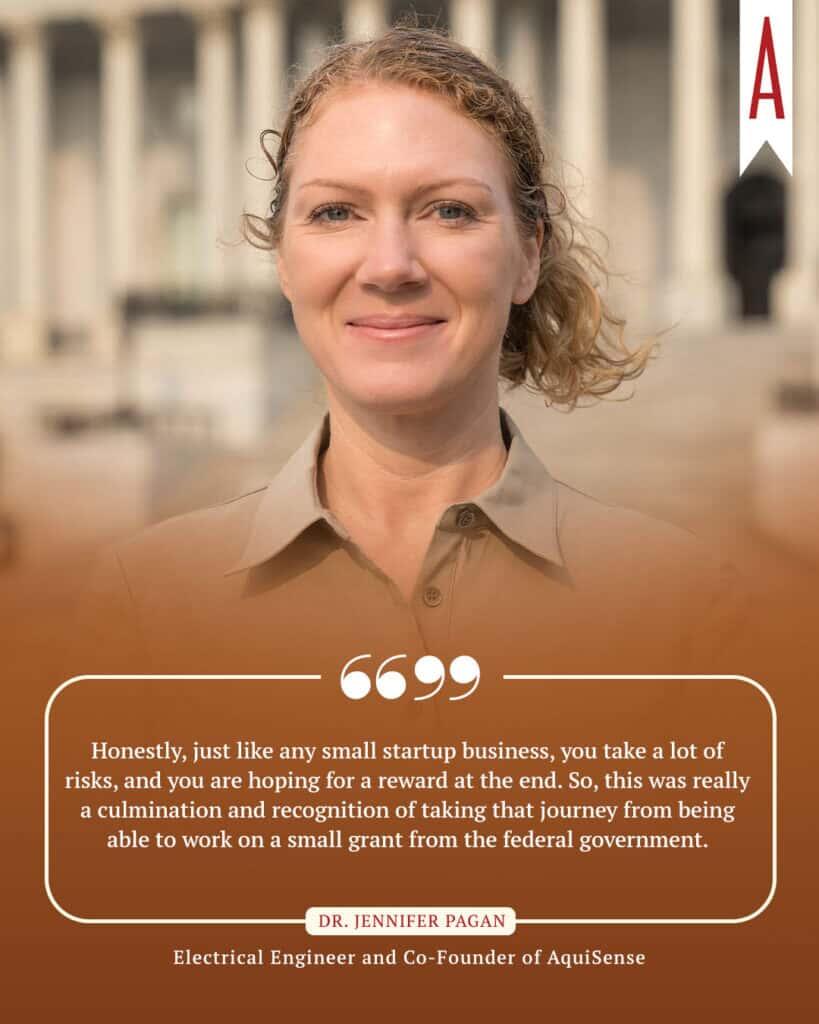
Dr. Jennifer Pagán: It was a personal validation of some of the risks I took in my journey. Honestly, just like any small startup business, you take a lot of risks, and you are hoping for a reward at the end. So, this was really a culmination and recognition of taking that journey from being able to work on a small grant from the federal government to actually commercializing that technology. You can take those risks as an individual along the way and show investors, ‘Oh, look what we’ve made. This does work. Fund us, and we can build a company, sell this product, and be successful. We can change an industry. We can convert people from using mercury-based sources to LED sources.’ So, it was really a vindication of the vision I had for the technology.
Her Agenda: What advice would you give to researchers who want to turn their discoveries into a product company that makes their own water purification?
Dr. Jennifer Pagán: Learn as much as you can. Don’t be afraid to take risks. Look at the world around you; take inspiration from other technologies. I was never in water treatment before. I was an electrical engineer who worked in semiconductors, right? But I learned an entire new industry because I saw something that could be used in a different way. There are a lot of problems that can be solved by looking at things through a different lens. Don’t just focus so narrowly on your research; talk to other people in other departments, be more collaborative and open-minded about where technology could be used, and take the risk of exploring it.
Her Agenda: Looking ahead, what excites you most about the future of your work with UV-C LED technology?
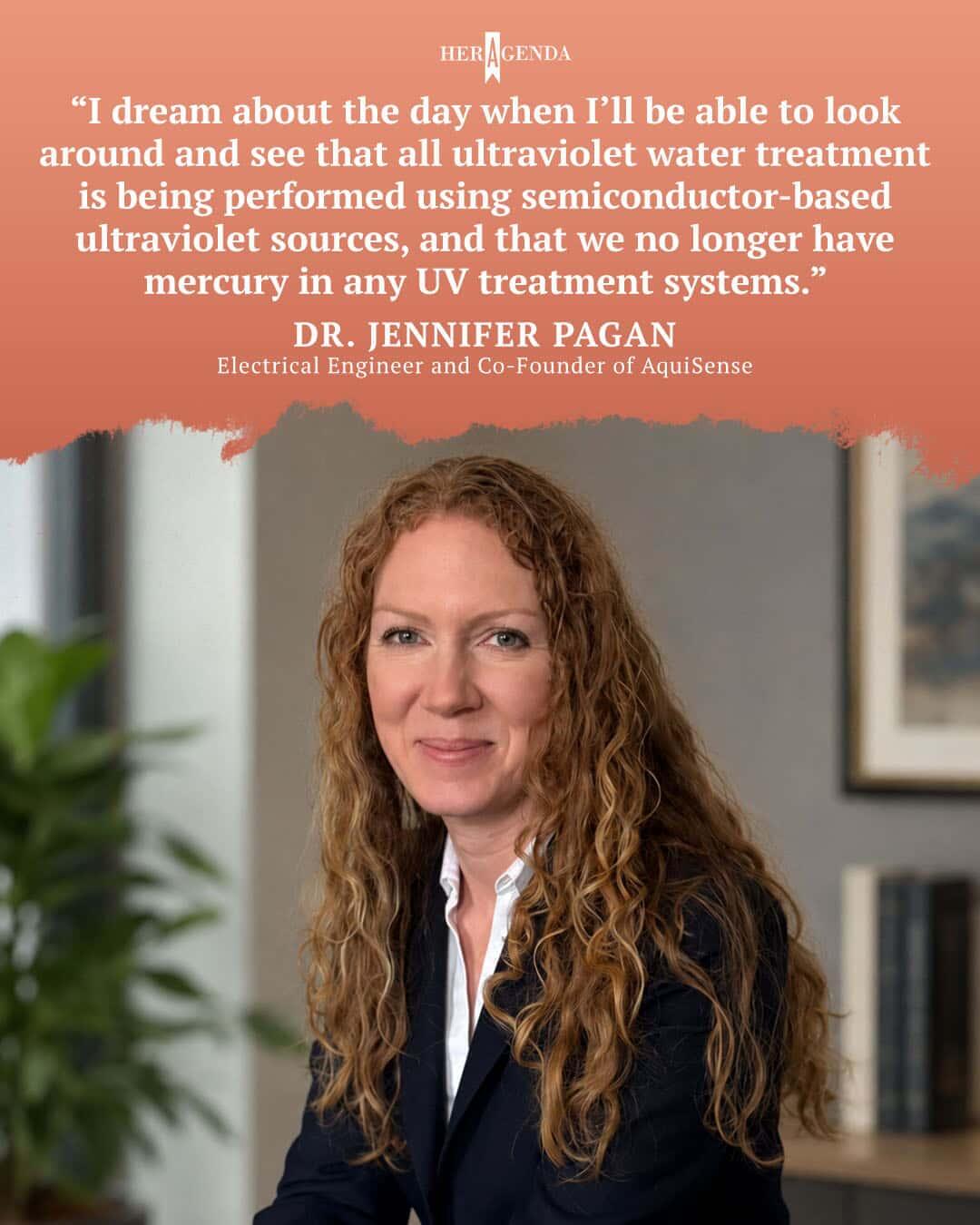
Dr. Jennifer Pagán: I dream about the day when I’ll be able to look around and see that all ultraviolet water treatment is being performed using semiconductor-based ultraviolet sources, and that we no longer have mercury in any UV treatment systems. I think that would honestly be a great legacy for me to leave behind.
Her Agenda: So, this is the last question. What is your personal motto?
Dr. Jennifer Pagán: There should be no neurotoxins in drinking water.
[Editor’s note: This article has been edited for length and clarity.]