










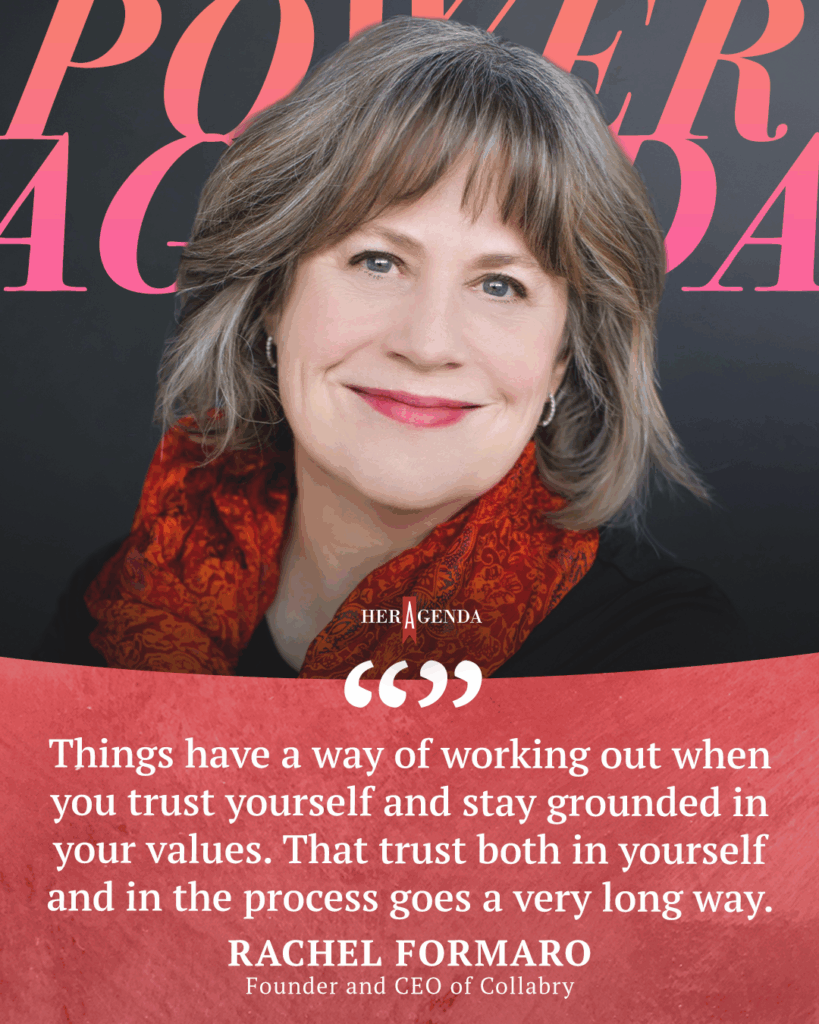
Rachel Formaro is the Founder and co-CEO of Collabry, a consulting and communications collective. With over two decades of experience across the communications industry, Rachel has built a career rooted in compassion and measurable results.
Her track record includes more than a decade of leading client and crisis communications at Charles Schwab, where she guided teams through high-stakes moments with clarity and care.
She is currently serving on the board of the National Association of Women Business Owners (NAWBO), where she is helping champion women’s leadership and equitable business practices.
Today, Collabry is a woman-owned collective that’s both flexible and fiercely mission-oriented, guided by the principle: ‘We believe in doing good and being good to each other.’ Influenced by her upbringing as a family of entrepreneurs and her own experiences as a mother and advocate, Rachel has built a company that merges high-quality work with accountability to the earth, clients, and the community alike.
Her Agenda: You spent more than a decade at Charles Schwab, leading client and advisor communications before launching Collabry. How did that experience shape your leadership style and influence your decision to start something of your own?
Rachel Formaro: They’re a wonderful company to work for, and I had an opportunity to grow a team there. I headed up client communications and what we call crisis communications, so if there was a major market event or situation, my team would be working on that. It required a lot of grit and determination, but I also loved being a manager of a diverse team. I had a really good leader and manager whom I learned a lot from. Another person I learned many of my leadership skills from was my father, because he was also an entrepreneur and ran some large teams. I had a great opportunity to work with him and see him in action. Really, Charles Schwab was the only time I’ve been on what we call the client side of the work, and it allowed me to be what you might call today an intrapreneur—having new ideas and launching them within a large corporation.
Her Agenda: What first inspired the idea for Collabry, and what gap did you see in the industry that you felt uniquely equipped to fill?
Rachel Formaro: I always said that with my work at Charles Schwab, I would not leave Schwab to just go to another large corporation. If I were going to leave, I knew it would be to start my own thing. It’s just something in you when you know you have the drive and the desire to create something new in the world. I’m not an artist or a musician, but I love to create community and be of service. At the same time, I was a new mom. My daughter, when I started the company, she was three and a half, and I realized I wanted a bit more flexibility to enjoy my time with her. I certainly recognize it’s a privilege [that] I was able to make that choice, because where we live in the Midwest the cost of living is much lower than San Francisco or New York. I had been in my role for about eight years when I left Schwab, and I still had a passion for working in financial services. I had a very strong network, and I felt confident I would be able to find clients. That first year was not easy, it took a lot of hours and a lot of work to get those first few projects and have people start to build that relationship with you as a business owner.
Her Agenda: Collabry has thrived as a woman-owned business for over ten years—no small feat. What do you think has been key to sustaining that success?
Rachel Formaro: I think a few keys to this are having focus. There were a couple of opportunities in the first couple years where I could’ve gone in one direction, like a few folks approached me about becoming a speaker’s bureau or becoming a ghostwriter or book writer and publishing books in the industry. When you’re starting out, we sometimes have an opportunity to say, ‘Yes, I’ll do that,’ but keeping a focus on delivering marketing and project management in financial services and just really sticking to that helped me fine-tune the offer and the target market.
At one point I thought, ‘Could I do this in green energy or health care?’ but that’s not where I had my career experience, and I didn’t know people in those industries. So having that focus was key. Naturally having a desire to be of service and to help others has also been important. It wasn’t ever just to make money, it was to build something more meaningful, like having a focus on inclusion and diversity and pay equity for women. I wanted to be a place where women, folks with neurodiversity, or LGBTQ+ could feel welcome. Strength comes out of that diversity, and that diversity has been a key to our success.
Her Agenda: Collabry’s mission is rooted in ‘doing good and being good to one another.’ How do you bring that philosophy to life in your daily operations and client relationships?
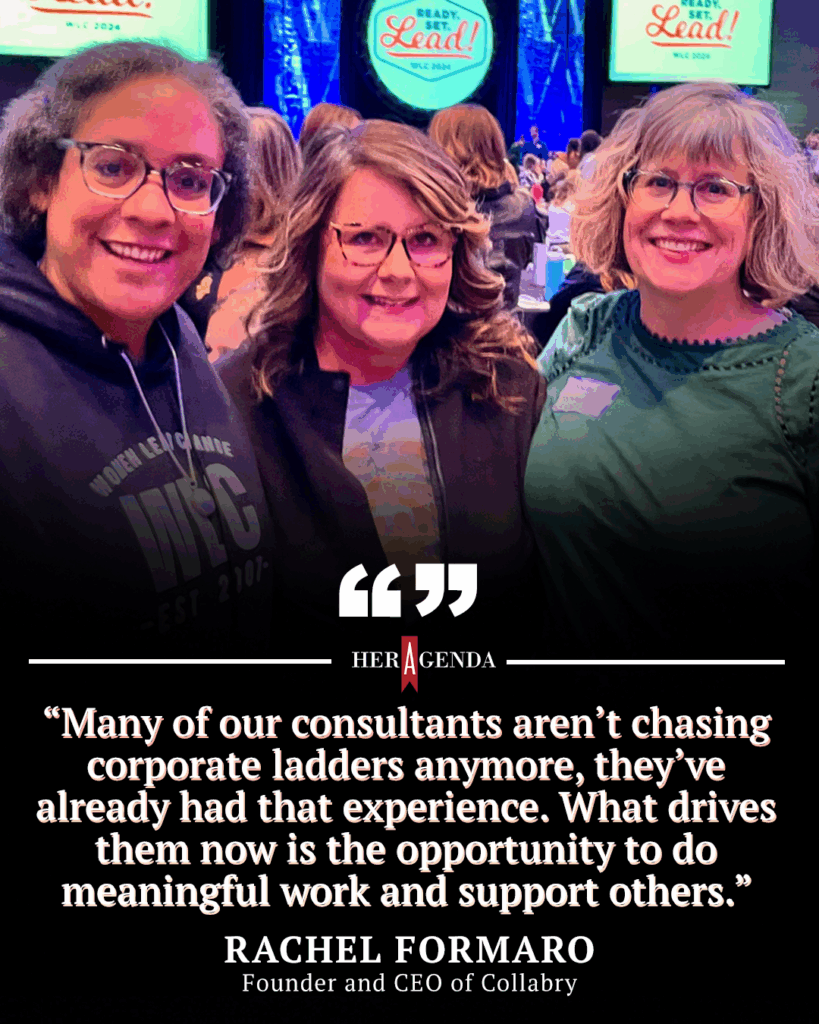
Rachel Formaro: It really starts with checking our egos at the door. Many of our consultants aren’t chasing corporate ladders anymore, they’ve already had that experience. What drives them now is the opportunity to do meaningful work and support others. We try to cultivate that sense of community intentionally. Every Wednesday, for instance, we gather on Slack for a quick online trivia game. It’s lighthearted, but it helps us connect as people. We share pet photos, laugh together, and genuinely get to know one another beyond the work. Over the years, many of us have gone through big life events such as losing parents, raising kids, managing health challenges and we show up for each other through all of it. That’s what ‘doing good and being good to one another’ means to me: remembering that every person we work with is whole. Whether it’s a teammate or a client, we try to lead with empathy, understanding that we are all human first.
Her Agenda: Having worked with Fortune 500 companies, startups, and small businesses, what decision-making principle do you rely on most in high-stakes moments that other women leaders could learn from?
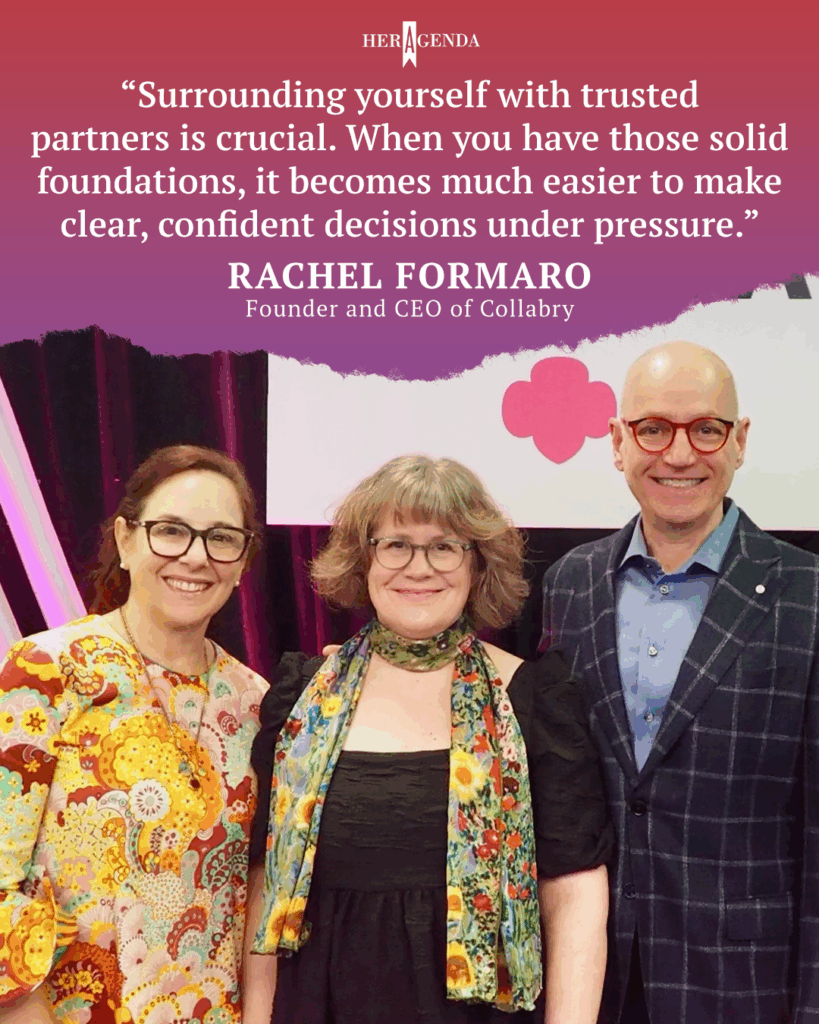
Rachel Formaro: Early on as a new business owner, it is easy to panic and want to say yes to everything. But I learned pretty quickly that not every opportunity is worth taking especially if it comes at the cost of your self-respect. I once had a client who spoke to me in a way that just didn’t feel right. It was disrespectful, and even though it meant walking away from money, I decided to end the relationship. That experience taught me a valuable lesson about boundaries. From that point forward, I promised myself and my team that we’d never stay in a situation where we were disrespected or treated unfairly. Setting boundaries has also meant protecting my time and energy. I don’t take calls after dinner or on my days off, because burnout clouds decision-making. And finally, surrounding yourself with trusted partners is crucial. When you have those solid foundations, it becomes much easier to make clear, confident decisions under pressure.
Her Agenda: Over your two decades in communications, what changes have you seen for women in the industry—and where do you believe we still have work to do?
Rachel Formaro: I think we’ve made great strides, but there’s still room to grow especially around communication and bias. One thing I’ve learned is that it’s always better to over-communicate than under-communicate. What feels obvious to one person may not be obvious to someone else, so clarity is everything. At the same time, I think it’s important for all of us to pause and examine our own biases. I do this often myself. If I have a certain reaction in a meeting or conversation, I’ll stop and ask: Did I think that because they’re a woman or because they’re a man? That kind of self-reflection is critical if we want to create truly equitable workplaces. And on a broader scale, I think we need to keep asking the tough questions: Would you ask a man that? Would you treat a man that way? And I’ll add one more layer to this; It is about intersectionality. I ask, how is my own experience creating any bias? Those small but intentional checks are how real progress happens.
Her Agenda: You’ve described Collabry as a ‘collective’ rather than a traditional agency. Why do you believe this model works so well, and how does it reflect your values as an entrepreneur?
Rachel Formaro: We chose the collective model very intentionally. As a group of independent consultants, it gives our team members real agency and sovereignty over their work. They get to decide which projects they want to take on and how much they want to work. If someone can only commit to twenty hours a week because of childcare or eldercare, we make that possible. We even have job-sharing arrangements where two people collaborate on one project, depending on the client’s needs. That flexibility has been a huge part of our success as it’s helped us retain incredible talent. Many of our consultants have been with us for six years or more, which is rare in this industry. For our clients, the model offers something equally valuable: access to knowledge from a deep bench of experienced professionals. Rather than a traditional model where on one hand the consultant is completely on her own or the other where you are paying for a full team at all times, with Collabry you get someone who can tap into the collective for guidance and unique expertise. It is a model rooted in collaboration. Our tagline is ‘We are good together’ and we mean that in all ways.
Her Agenda: With your appointment as Director of Advocacy at NAWBO Iowa, how has this role influenced your mission of empowering women in business and leadership?
Rachel Formaro: Advocacy has always been close to my heart. In addition to being a business owner, I am deeply passionate about creating opportunities for women and girls. I have a daughter, and as someone who started out in the advertising world, I saw firsthand the inequities and the lack of support that so many women still face. So when the opportunity came to serve as Director of Advocacy for the Iowa chapter of NAWBO (National Association of Women Business Owners) I jumped at it. The role has helped me become an even stronger voice in our community for women business owners, especially around issues like access to childcare, transportation, and capital. We know from the data that women are still turned down for business loans and investment funding at higher rates than men. Being in this position allows me to not only raise awareness but also push for tangible change. And this year was especially meaningful for me, I was able to invest in another woman’s business for the first time. That moment felt full-circle. It was deeply rewarding to move from advocating for women to actively helping another woman grow her business
Her Agenda: When you think about success, not just in terms of growth, but meaning and fulfillment. What does that look like for you right now?
Rachel Formaro: For me, success at this stage of life is really about purpose and that purpose is deeply rooted in family. I want to be fully present during this time with my daughter before she launches into the world, and even after that, to continue nurturing our bond. Losing my father a few years ago made me acutely aware of how precious time is. My mom is still with us, but we live quite a distance apart, so I try to be intentional about spending time with her, with my husband, and with the people I love most. Beyond family, my sense of fulfillment also comes from community, doing what I can to support others and to leave things a little better than I found them. That, to me, is what real success looks like.
Her Agenda: How do you balance motherhood and self-care while also running a business?
Rachel Formaro: I think it really goes back to boundaries. My calendar is everything. I live by time blocking. Every morning, I carve out at least five minutes to meditate. I use the Insight Timer app, which I love, and I try to get outside for a walk with my dog or just some fresh air. Over the last few years, I’ve gained a deeper appreciation for health and well-being because you can’t lead effectively if you are running on empty. I protect my time for the things that keep me grounded. Mondays and Fridays at lunchtime, for example, I go to Pilates and I don’t trade that time in. It makes me feel stronger, more centered, and ready to show up fully for others. I also make sure to nurture joy and connection, spend time with friends, reading, and my monthly book club meetings. My dad used to tell me to always have something on the calendar that I’m looking forward to, maybe a day off, a visit to a museum, something that breaks the routine and recharges you. That lesson has really stayed with me.
Her Agenda: Finally, if you could write a note to your younger self at the start of your communications career, what would you tell her?
Rachel Formaro: I’d tell her to believe in herself more. To know that she’s capable of doing hard things and that she has the power and agency to take risks. I’d remind her not to stay in spaces where she doesn’t feel comfortable or respected. You always have the right to choose something better for yourself. And I’d probably tell her not to worry so much. I think as women, we often carry a lot and shoulder more than people realize. But things have a way of working out when you trust yourself and stay grounded in your values. That trust both in yourself and in the process goes a very long way.
[Editor’s note: This interview has been edited for length and clarity.]